
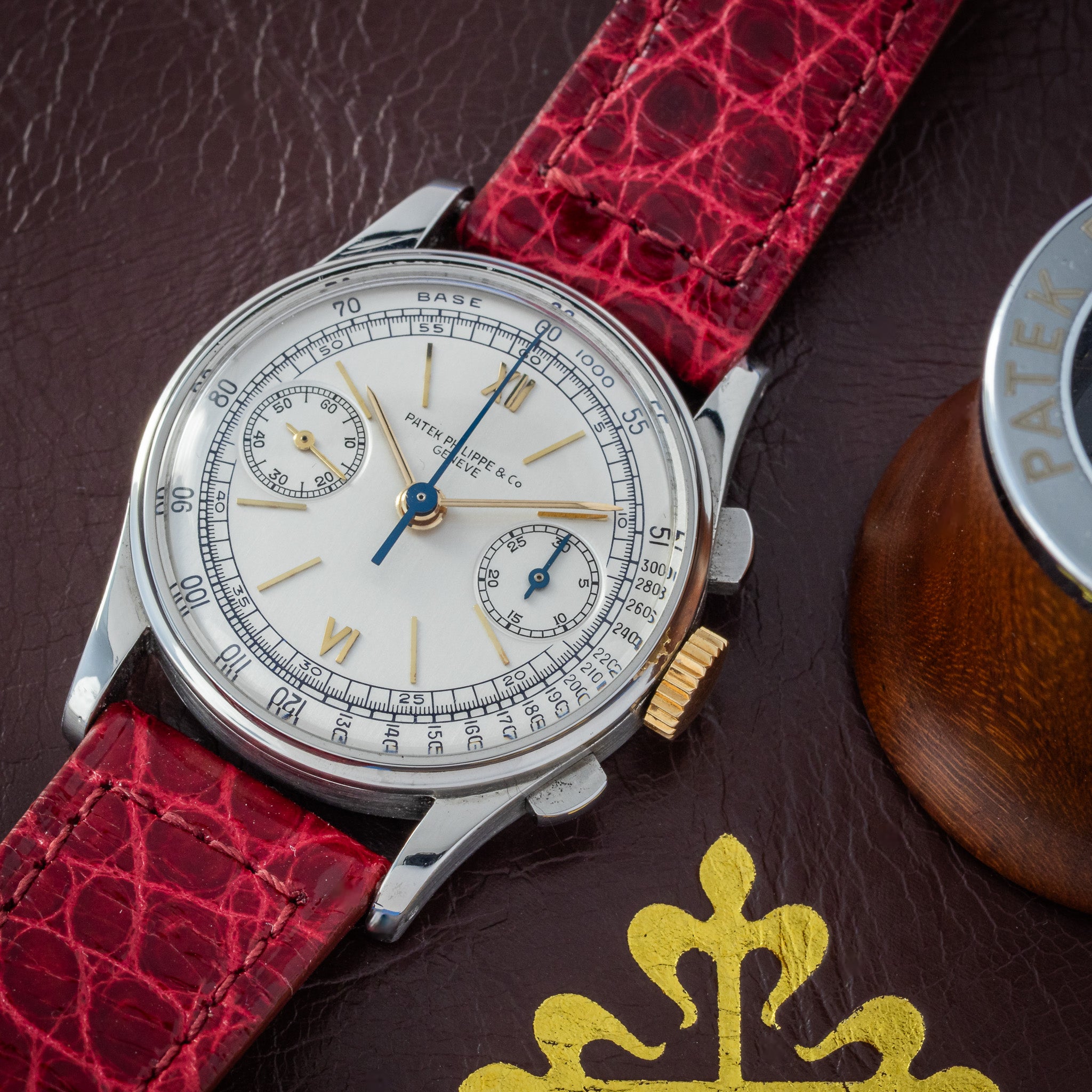


Patek Philippe Ref. 130A · Steel Chronograph · Gold Roman/Baton Indices & Crown · 1941 · Extract From The Archives
 Trusted Globally by Collectors
Lifetime Guarantee of Authenticity
Complimentary Fully Insured Shipping
Patek Philippe Ref. 130A · Steel Chronograph · Gold Roman/Baton Indices & Crown · 1941 · Extract From The Archives
Sale price$275,000
Choose options
Timepiece Information
Catalogue Notes
Few wristwatches occupy a more consequential position in the history of Patek Philippe than Reference 130. Introduced in 1934, shortly after the Stern family's acquisition of the manufacture, it became Patek Philippe's first regularly produced chronograph wristwatch. Its elegantly proportioned case, twin rectangular pushers, two-register dial, and sophisticated manually wound movement established an enduring design vocabulary that would influence the manufacture's most celebrated chronographs for generations. Production continued into the 1960s, yet the reference remained decidedly exclusive, with approximately 1,500 examples estimated to have been manufactured across all case materials, predominantly in yellow gold. Stainless-steel examples were produced in considerably smaller numbers, with specialist research suggesting approximately 270 examples, although this remains an estimate rather than a definitive factory production figure.
An Early Stainless-Steel Case
The present Reference 130A, manufactured in 1941 and originally sold on November 21 of that year, belongs to this limited stainless-steel population. More importantly, it represents an especially compelling variation distinguished by a rarely encountered combination of case material, dial furniture, crown, and typography. The watch belongs to the first series of steel cases, associated with Geneva case-maker Georges Croisier and dating principally from 1937 through 1942. Unlike their precious-metal counterparts, these stainless-steel examples were manufactured with subtly different case proportions, including shorter, more substantial lugs that impart a sporting character without sacrificing the elegance of the original Calatrava-inspired design. Measuring approximately 33 millimeters in diameter, the case combines a polished, gently concave bezel, rectangular chronograph pushers, a snap-back construction, and gracefully integrated lugs. Its restrained dimensions are characteristic of the period, but the balance between case and dial gives the watch a visual presence that transcends its nominal size.
An Exceptionally Distinctive Dial Configuration
The defining feature of this example is its particularly distinctive silvered dial, furnished with applied yellow-gold Roman numerals at twelve and six o'clock, complemented by elongated yellow-gold baton markers and matching gold hour and minute hands. Stainless-steel Reference 130 chronographs were frequently fitted with steel hour markers and hands, making this use of gold appointments especially appealing. The combination introduces an uncommon aesthetic, marrying the functional character of stainless steel with the warmth and refinement traditionally associated with precious-metal Patek Philippe wristwatches. The yellow-gold winding crown extends this relationship beyond the dial and into the case itself, creating a carefully balanced interplay between contrasting metals. The result is a composition of considerable sophistication, in which the precious-metal details enhance rather than overwhelm the watch's inherently restrained character.
The Roman numerals XII and VI establish a classical vertical axis, while the surrounding elongated baton markers create an elegantly ordered composition. Rather than employing the concentric divisions of a conventional sector dial, this execution achieves its geometric discipline through applied markers, proportion, and the relationship between its subsidiary registers. The dial bears the longer Patek Philippe & Co., Genève signature associated with early production, complemented by a finely delineated peripheral minutes track and an outer tachymeter scale identified by the inscription BASE 1000. Two recessed subsidiary registers are positioned horizontally, with continuous seconds at nine o'clock and the 30-minute chronograph counter at three. Their clearly defined boundaries provide visual depth without interrupting the dial's overall harmony, while blued-steel chronograph indications offer a further contrast to the yellow-gold timekeeping hands. Taken together, these details create an exceptionally balanced dial, simultaneously functional, architecturally disciplined, and unmistakably characteristic of Geneva watchmaking during the early Stern era.
A Historically Important Chronograph Movement
Within the case is Patek Philippe's manually wound calibre 13-130, developed from the Valjoux 23VZ chronograph ébauche and extensively modified and finished by Patek Philippe. This 23-jewel, column-wheel-controlled movement exemplifies the traditional construction of fine mechanical chronographs, with carefully developed components, precision regulation, and meticulous finishing reflecting the technical standards that distinguished Patek Philippe's complicated wristwatches during this period. Its historical importance extends well beyond Reference 130, as the modified Valjoux chronograph architecture subsequently supported some of the manufacture's most significant complications, including the perpetual-calendar chronographs References 1518 and 2499. Accordingly, this watch represents more than an early chronograph; it belongs to the mechanical lineage from which several of Patek Philippe's most celebrated twentieth-century wristwatches emerged.
Archival Documentation and Historical Identity
The watch is accompanied by a Patek Philippe Extract from the Archives dated June 28, 2024, recording its manufacture in 1941 and original sale on November 21, 1941. The archival dial description identifies a silvered dial with applied gold hour markers and a tachymetric scale, providing historically important confirmation of the configuration that distinguishes this example from more conventional stainless-steel executions. The watch is also identifiable in earlier public auction catalogues through its documented movement and case numbers, establishing a traceable record of this particular timepiece. Such documentation is especially meaningful in the world of important vintage chronographs, where an individual watch's identity, historical specifications, and provenance contribute substantially to its significance.
A Distinguished Reference 130A
The attraction of this 1941 chronograph ultimately lies in the convergence of several qualities seldom encountered together: an early first-series stainless-steel case, an archivally documented gold-marker dial, the elegant pairing of Roman numerals and elongated batons, a yellow-gold crown, the early Patek Philippe & Co. signature, and one of the most historically important chronograph movements of the twentieth century. Each characteristic contributes to the watch's appeal, but it is their combination that distinguishes this example from the more familiar executions of Reference 130. For the discerning collector seeking historical significance, distinctive period design, documented identity, and considerable horological substance, this Reference 130A represents a particularly compelling expression of Patek Philippe's formative chronograph tradition.
Condition: The watch presents attractively, with its distinctive silvered dial, applied yellow-gold Roman numerals and baton hour markers, clearly defined subsidiary registers, and characteristic stainless-steel Reference 130 case. An Antiquorum auction catalogue from July 2019 described the dial as "refreshed," the case as "slightly repolished," and the hands as original. The precise nature and extent of any previous cosmetic intervention have not been independently established. The accompanying Patek Philippe Extract from the Archives confirms the original dial configuration but does not independently certify its present cosmetic originality. These qualifications are presented in the interest of accurate documentation and responsible stewardship of this historically important timepiece.
Specifications & Accompaniments
Reference
Patek Philippe Reference 130A
Year of Production
1941
Original Date of Sale
November 21, 1941
Case Material
Stainless steel with yellow gold crown
Dimensions
Diameter 33.0 mm; thickness approximately 11.0 mm; lug width 19 mm; lug-to-lug 41 mm
Dial
Silvered dial with applied yellow gold Roman numerals at 12 and 6, applied yellow gold baton markers, outer tachymetric scale
Movement
Patek Philippe manually wound calibre 13-130 (13 lignes), 23 jewels, featuring a column-wheel chronograph with horizontal clutch. Developed from the Valjoux 23VZ ébauche and extensively modified, assembled, regulated, and hand-finished by Patek Philippe in Geneva. Distinguished by its three-arm chronograph bridge, swan-neck precision regulator, and traditional Geneva striping, reflecting the manufacture's exacting standards of mechanical craftsmanship.
Caseback
Snap-back case (fond encliqueté), stainless steel
Strap / Bracelet / Buckle
Later burgundy alligator leather strap with Patek Philippe 18k white gold pin buckle stamped “PPCo 750”
Accompanied By
Patek Philippe Extract from the Archives dated June 28, 2024 and WRISTORIAN presentation packaging
All information is from sources deemed reliable; accuracy is not guaranteed.
WRISTORIAN Perspective
Certain watches are important because of what they represent in horological history. Others command attention because of an unusual design, uncommon configuration, or the artistry of their execution. Occasionally, a watch brings these qualities together. This 1941 Patek Philippe Reference 130A is such a timepiece. Among vintage Patek Philippe chronographs, the Reference 130 occupies a singular position. Introduced in 1934, it established a design language that would influence generations of the manufacture's most celebrated chronographs. Yet historical importance alone does not distinguish one Reference 130 from another. Among vintage watches of this caliber, the individual execution matters enormously, and it is here that this particular example becomes especially compelling.
What first captures my attention is the dial. That observation should not diminish the importance of the stainless-steel case or its unusual combination with yellow-gold appointments, but the dial is unquestionably the visual centerpiece of this watch. Its silvered surface provides a beautifully restrained foundation for the applied gold Roman numerals, elongated baton markers, and matching hands. The long Patek Philippe & Co., Genève signature introduces an unmistakable period character, while the finely delineated tachymeter scale and recessed chronograph registers create an impression of remarkable architectural precision. There is an extraordinary amount of information contained within a relatively small space, yet nothing appears crowded or unnecessarily decorative. Every element seems to occupy precisely the position it should. The effect is one of unusual clarity, balance, and sophistication.
Equally compelling is the unexpected marriage of metals. Stainless steel brings a purposeful restraint to the case, lending it a quietly sporting character that distinguishes it from the more familiar yellow-gold examples. Against this cool metallic foundation, the yellow-gold Roman numerals, baton markers, and hands introduce warmth and refinement without ostentation. The matching gold winding crown extends this relationship beyond the dial, completing an aesthetic that feels entirely deliberate. Gold is used sparingly, but to extraordinary effect. It is an unusually successful demonstration of how subtle variations in materials and design can transform the personality of a familiar reference into something altogether more individual.
The Roman numerals at twelve and six o'clock are especially appealing. They establish a classical vertical axis, while the surrounding elongated batons maintain the discipline and legibility expected of a precision instrument. The recessed subsidiary registers add visual depth, and the blued-steel chronograph indications provide a striking counterpoint to the warm gold timekeeping hands. Although the arrangement recalls the geometric discipline of period sector dials, its appeal rests in a more restrained interpretation of that aesthetic. The result is an exceptional balance between classical elegance and mechanical purpose. What I find particularly satisfying is that the watch is unmistakably a serious chronograph, yet possesses all the refinement of a fine dress watch.
The importance of this configuration becomes even clearer when considered within the broader population of surviving Reference 130 chronographs. Stainless-steel examples account for only a small proportion of the reference's estimated production, and those combining a steel case with applied yellow-gold Roman numerals, elongated baton markers, matching hands, and a gold crown are less familiar still. Rarity is frequently discussed in numerical terms, but I have never considered production totals alone an adequate measure of a vintage watch's desirability. A watch becomes truly compelling when historical significance, thoughtful design, craftsmanship, documentation, and individual character converge. This Reference 130A illustrates that principle particularly well. It is not simply a scarce version of an important chronograph; it is an unusually expressive interpretation of one of Patek Philippe's foundational designs.
Its proportions contribute substantially to that appeal. At approximately 33 millimeters, the watch reflects an era when elegance was achieved through balance rather than physical scale. The relatively substantial steel lugs, gently concave bezel, and precisely positioned rectangular pushers give the case a presence that its dimensions alone cannot convey. There is a wonderful harmony between the purposeful exterior and the delicacy of the dial. The watch needs neither exaggerated proportions nor conspicuous ornamentation to establish its authority. It belongs to a period when the finest watchmakers understood that refinement could be expressed through restraint, and that successful design did not require attention to be demanded when it could be quietly earned.
There is also something particularly evocative about a chronograph manufactured in 1941. This was a period when such watches were still regarded primarily as instruments of precision, created to measure elapsed time, speed, and performance. Yet the finest examples were already evolving into objects of enduring aesthetic importance. Reference 130 stands precisely at that intersection. Its manually wound chronograph movement represents a remarkable chapter in Patek Philippe's technical development, while its exterior reflects a level of artistic discipline that has lost none of its relevance more than eight decades later. The combination reminds us that the greatest vintage watches were never merely mechanical devices. They were expressions of the knowledge, ambition, and aesthetic sensibilities of the people who created them.
For the serious collector, an important vintage timepiece also carries the responsibility of understanding and preserving its individual history. The accompanying Patek Philippe Extract from the Archives confirms the historical dial configuration and original sale in November 1941, while earlier auction documentation establishes a traceable record of this particular watch. Such documentation does not replace careful examination of condition or originality, but it provides a valuable foundation for informed ownership. In a collecting environment where details matter, the ability to connect a watch to its documented historical identity is part of its enduring appeal. Responsible stewardship begins with knowing precisely what one owns and appreciating the circumstances that make it significant.
Experienced collectors often develop an instinctive response to a watch that possesses an unusually successful combination of qualities. It may begin with the dial, continue with an appreciation of the case and movement, and deepen as the watch's history and individual characteristics become apparent. The attraction is rarely attributable to a single feature. Instead, it emerges from the way those features work together to create something greater than their individual contributions. That is the response this Reference 130A inspires in me. Its contrasting metals, classical Roman numerals, disciplined dial architecture, early stainless-steel case, and important mechanical heritage combine to give it a character that is immediately recognizable and difficult to reproduce.
More than eight decades have passed since this chronograph left Patek Philippe's workshops. During that time, the manufacture has introduced extraordinary complications, larger cases, new materials, and increasingly sophisticated expressions of mechanical watchmaking. Yet there is something especially satisfying about returning to a watch such as this and recognizing how completely its designers understood the essential principles of proportion, legibility, and restraint. Nothing about its appeal depends upon contemporary fashion. Its significance is historical, its refinement is intrinsic, and its individuality remains as compelling today as the design itself.
For me, the ultimate attraction of this Reference 130A is that it brings together two qualities that do not always coexist in vintage watch collecting: genuine horological consequence and an unusually distinctive aesthetic personality. It is an important Patek Philippe chronograph by virtue of its reference, movement, and place in the manufacture's history. But it is this particular combination of stainless steel, yellow gold, Roman numerals, and beautifully ordered dial details that makes the individual watch so memorable. For the thoughtful collector who values historical importance, elegant design, and the pleasure of owning something genuinely uncommon, it represents an especially compelling opportunity.
A chronograph of genuine historical consequence, distinguished by a personality entirely its own.
Service & Operation
Service History
Serviced March 1, 2025
Operational Status
Observed running and setting normally at the time of cataloguing. The movement has not been tested for accuracy over extended periods or for power reserve duration, and may require servicing at the buyer’s discretion. As is customary with vintage timepieces, future performance cannot be guaranteed.
For additional context on the mechanical characteristics, conditional considerations and stewardship associated with vintage timepieces, see Understanding Vintage Timepieces.

