Skip to content

Your Cart

Your cart is empty

Patek Philippe – Ref 2597J – 1960
First-Series
Louis Cottier Travel Time
“Heures Sautantes”
Extract from the Archives

Sale price$155,000.00 USD
Lifetime Guarantee of Authenticity
Complimentary Insured Worldwide Shipping
Three-Day Inspection Window
Trusted Globally by Collectors
Patek Philippe – Ref 2597J – 1960 <br>First-Series <br>Louis Cottier Travel Time <br>“Heures Sautantes” <br>Extract from the Archives
Patek Philippe – Ref 2597J – 1960
First-Series
Louis Cottier Travel Time
“Heures Sautantes”
Extract from the Archives
Sale price$155,000.00 USD

Timepiece Information

Catalogue Notes

The Patek Philippe reference 2597, introduced at the 1957 Basel Fair and entering production shortly thereafter, represents one of the manufacture's earliest purpose-built travel watches, developed during the formative years of international commercial aviation. Created in collaboration with the renowned Geneva watchmaker Louis Cottier, the reference incorporates his ingenious Heures Sautantes mechanism, allowing the local hour hand to be advanced or reversed in one-hour increments through pushers on the case side without interrupting the running minutes or stopping the movement.


The case of the reference 2597 follows the strong Calatrava proportions associated with the reference 570, measuring approximately 35.5 millimeters in diameter and characterized by a flat bezel, vertical case band, and elegantly curved lugs. Distinguishing the reference are the two cylindrical pushers positioned at 8 and 10 o'clock on the left side of the case, used to advance or reverse the local hour. These pushers are flanked by subtle protective shoulders that integrate the mechanism into the architecture of the case while maintaining the restrained elegance expected of a mid-century Patek Philippe dress watch. Cases for the reference were manufactured by Antoine Gerlach, a long-standing partner of the manufacture responsible for numerous important Calatrava models of the period and identifiable by the No. 4 maker's mark within the Geneva key hallmark inside the caseback.


The watch is powered by the manually wound caliber 12-400 HS, a movement supplied by Patek Philippe and subsequently modified in Louis Cottier's atelier to incorporate the independent jumping-hour travel-time system. This mechanism allowed travelers to adjust the local hour forward or backward while maintaining the continuity of the minute and seconds display, a practical innovation at a time when reliable reference time signals were less readily available.


Archival research and surviving records from Louis Cottier's workshop suggest that total production of the reference was extremely limited, generally estimated at approximately 90 to 110 examples manufactured between 1958 and the early 1960s. The majority were produced in yellow gold, with a smaller group executed in pink gold, placing the reference among the more elusive vintage travel-time wristwatches produced by Patek Philippe during the mid-twentieth century.


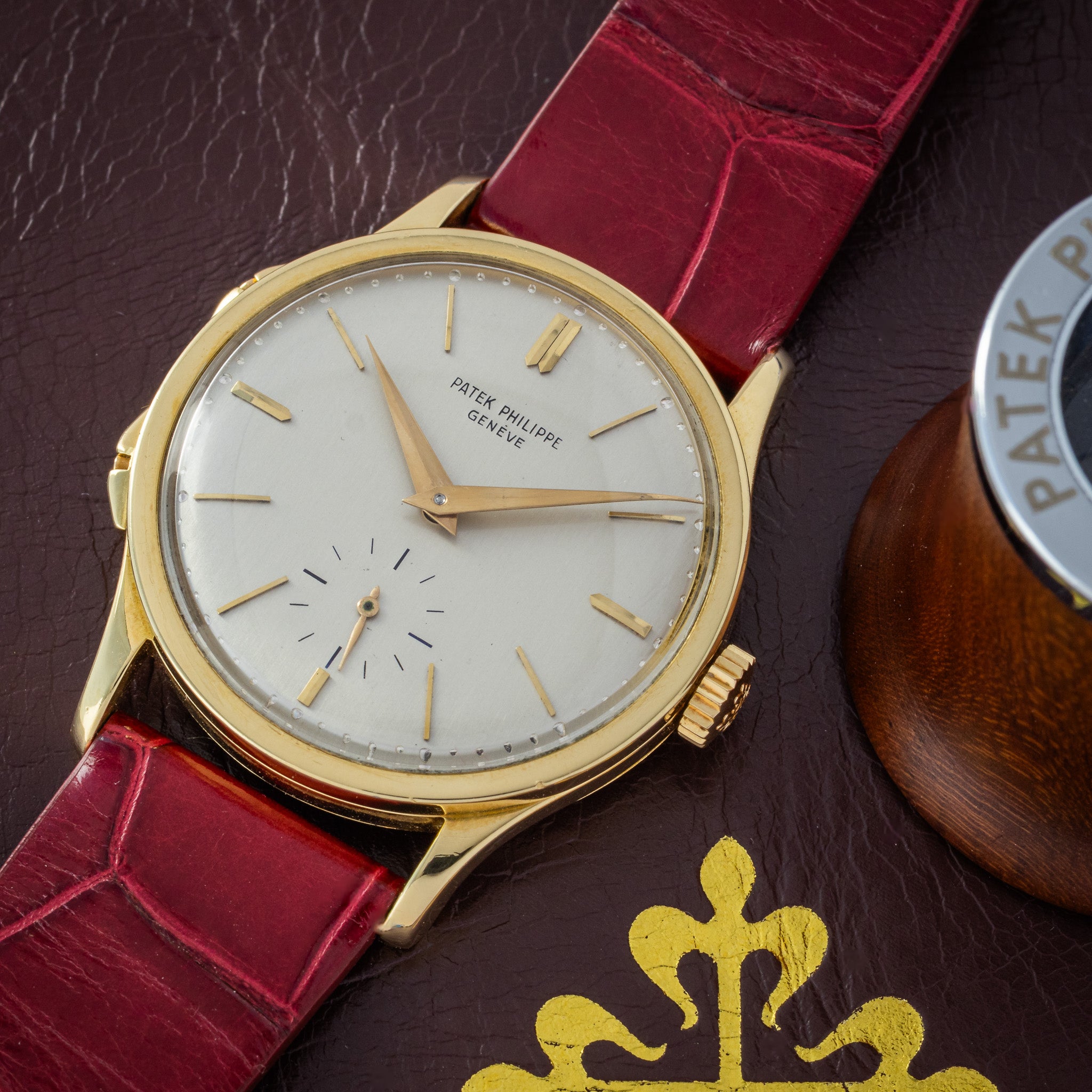
Dials for the reference were produced by Stern Frères and are typically executed in silver with a pearled minute track, applied hour markers, and a subsidiary seconds register at six o'clock. The present example, produced in 1960 and sold the following year, features a silvered dial with exceptionally fine applied yellow gold hour markers, double index at 12 o'clock, and a finely executed pearled minute track. The signature PATEK PHILIPPE / GENEVE is rendered in crisp raised enamel script without accent over "GENEVE," and notably the dial does not display a "SWISS" designation at the lower edge. The dial surface remains particularly well preserved, retaining sharply defined printing and intact enamel within both the signature and the subsidiary seconds markings.


The watch further retains an engraved snap-back caseback bearing a personal dedication to a previous owner from Rhode Island, reflecting the longstanding tradition of commemorative engravings found on mid-century Patek Philippe wristwatches.


Condition: Preserved in notably attractive condition, the watch retains strong case geometry with clear hallmarks and a particularly well-preserved dial displaying crisp raised enamel signature, intact pearled minute track, and well-defined applied markers.

Specifications & Accompaniments
Reference
Patek Philippe Reference 2597J
Year of Production
1960
Original Date of Sale
February 3, 1961
Case Material
18k Yellow Gold
Dimensions
35.2 mm diameter; 9.1 mm thickness; 43.2 mm lug-to-lug; 20 mm lug width
Dial
Silvered first-series dial with very fine applied yellow gold hour markers, double index at 12, pearled minute track, and subsidiary seconds at 6 o’clock. Signed PATEK PHILIPPE / GENEVE in crisp raised enamel script, without accent over “GENEVE” and without “SWISS” designation.
Movement
Caliber 12-400 HS. Manual winding. Louis Cottier “Heure Sautante” jumping-hour mechanism allowing the hour hand to be advanced or reversed via case pushers without stopping the movement.
Caseback
Snap-back caseback (fond encliqueté), engraved
Strap / Bracelet / Buckle
Burgundy gloss alligator leather strap, aftermarket replacement. Thin cut-edge construction with attractive scale pattern. Previously worn with light signs of use, remaining supple and suitable for continued wear. Original Patek Philippe 18k yellow gold tang buckle, stamped “PPC” and “750.” Vintage 16 mm example with classic mid-century proportions and light honest wear.
Accompanied By
Extract from the Archives and WRISTORIAN Presentation packaging
WRISTORIAN Perspective
The Patek Philippe reference 2597 occupies an extraordinary position in the history of modern horology. Introduced during the late 1950s, at a moment when commercial jet travel was beginning to reshape the geography of the world, the watch addressed a problem that had suddenly become relevant to an entirely new class of global traveler. Crossing time zones had become routine for diplomats, businessmen, and early international tourists, yet the mechanical wristwatch remained stubbornly local in its conception. In response, Patek Philippe turned to one of the great innovators of the era, the Geneva watchmaker Louis Cottier, whose work on world-time watches had already established him as the foremost authority on practical travel complications. The result was the reference 2597, a quietly ingenious watch that allowed the wearer to adjust local time forward or backward in one-hour increments while the movement continued to run uninterrupted.

What makes the reference particularly fascinating today is the understated elegance with which this mechanical innovation was introduced. The watch retains the visual language of the classic Calatrava, avoiding the technical or instrument-like appearance that many later travel watches would adopt. Its balanced 35.5 mm case follows the architectural proportions associated with the reference 570 and was produced by the respected case maker Antoine Gerlach, whose workshop supplied cases for a number of Patek Philippe’s most celebrated mid-century references. The two pushers positioned along the left side of the case provide the interface for the jumping-hour system, yet they are integrated so naturally into the form of the watch that the mechanism reveals itself only to the attentive observer. It is precisely this combination of restraint and ingenuity that gives the reference its enduring charm.

Early examples such as the present watch are especially compelling because they preserve the original two-hand configuration of the model. In this earliest form, the watch expresses Cottier’s travel-time concept with remarkable clarity. The absence of a central seconds hand allows the jumping-hour function to remain the conceptual centerpiece of the design, reinforcing the disciplined simplicity that defines Patek Philippe’s finest mid-century creations. Over time, many watches were later modified with additional hands through factory kits, but collectors often regard the early two-hand execution as the most intellectually satisfying expression of the idea.

The present example illustrates these qualities beautifully. Produced in 1960 and sold in early 1961, it retains a dial of striking clarity, distinguished by a crisp raised enamel signature, finely preserved pearled minute track, and exceptionally delicate applied gold hour markers. The absence of a “SWISS” designation at the lower edge of the dial further reinforces its early character. Details such as these are the quiet signals that experienced collectors recognize immediately, subtle indicators of originality that contribute enormously to the watch’s appeal.

For the thoughtful collector, the reference 2597 represents far more than an uncommon mid-century complication. It stands at the beginning of a lineage that would eventually lead to some of Patek Philippe’s most admired modern travel watches. At the same time, it remains deeply rooted in the restrained elegance of the Calatrava tradition. Examples preserved with this degree of clarity and authenticity offer the rare opportunity to own not merely a beautiful vintage wristwatch, but a watch that marks the moment when mechanical horology first began to adapt to a truly global world.
Service & Operation
Service History
Serviced March 4, 2025
Operational Status
Observed running and setting normally at the time of cataloguing.