Skip to content

Your Cart

Your cart is empty

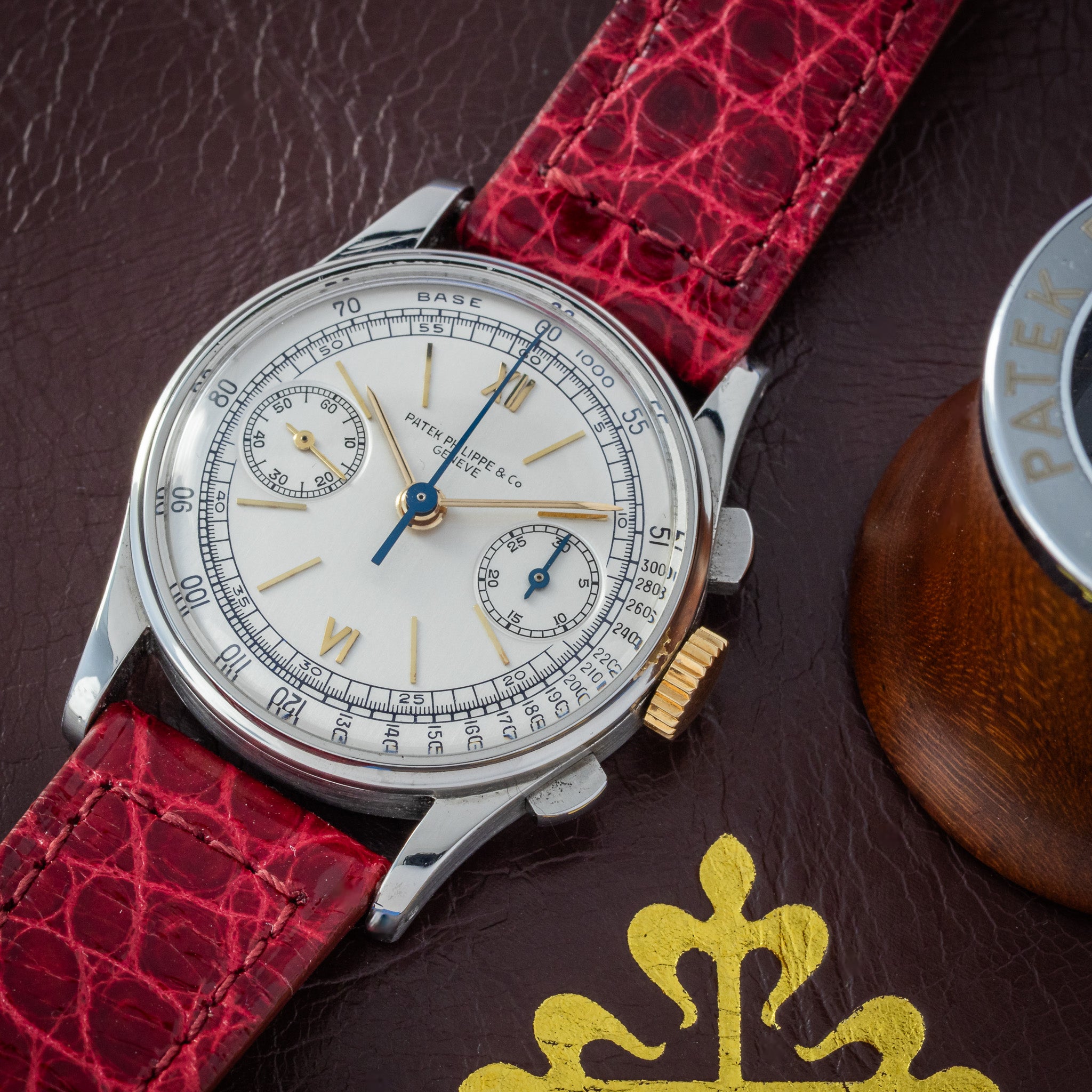
Patek Philippe Ref 130A – 1941
Stainless Steel Chronograph
Roman Numeral Dial
Tachymeter
Long “Patek Philippe & Co” Signature
Extract from the Archives

Sale price$1,150,000.00 USD
Lifetime Guarantee of Authenticity
Complimentary Insured Worldwide Shipping
Three-Day Inspection Window
Trusted Globally by Collectors
Patek Philippe Ref 130A – 1941 <br>Stainless Steel Chronograph <br>Roman Numeral Dial <br>Tachymeter <br> Long “Patek Philippe & Co” Signature <br>Extract from the Archives
Patek Philippe Ref 130A – 1941
Stainless Steel Chronograph
Roman Numeral Dial
Tachymeter
Long “Patek Philippe & Co” Signature
Extract from the Archives
Sale price$1,150,000.00 USD

Timepiece Information

Catalogue Notes

The Patek Philippe Reference 130 occupies a foundational place in the manufacture's history as its first serially produced chronograph wristwatch and remains one of the most historically significant chronographs produced by the firm. Introduced in 1934 and produced for nearly three decades, the reference established the visual and mechanical language that would define Patek Philippe chronographs for generations.


The present example, manufactured and sold in 1941, represents a particularly attractive early execution of the reference. The stainless steel case measures approximately 33 millimeters in diameter and displays the balanced proportions that have made the model enduringly admired among collectors. Rectangular chronograph pushers, slender lugs, and a polished bezel contribute to the refined and disciplined appearance characteristic of early Stern era production.


What immediately distinguishes this watch is its exceptionally well preserved dial and distinctive marker configuration. As confirmed by the Extract from the Archives, the watch features a silvered dial with applied gold hour markers and a tachymetric scale. The dial further incorporates applied yellow gold Roman numerals at twelve and six o'clock paired with elongated baton markers and matching yellow gold hands. A yellow gold crown completes the composition, creating a subtle two tone aesthetic rarely encountered among stainless steel examples of the reference.


The marker layout itself is particularly noteworthy. The combination of Roman numerals at twelve and six with intermediate baton markers creates a highly balanced dial architecture that collectors often describe as quasi sector in character. While not a traditional sector dial, the structure introduces a disciplined visual geometry that gives the watch a strong sense of symmetry and legibility. Among surviving examples of the reference, this Roman numeral configuration appears far less frequently than the more typical baton or Arabic layouts and contributes meaningfully to the visual identity of the watch.


The dial signature is executed in the long Patek Philippe & Co format associated with early Stern era production. The raised enamel printing remains remarkably crisp, standing in clear relief against the silvered surface. Particularly striking are the deeply recessed chronograph registers, whose preserved circular graining and clean edges create a strong sense of dimensionality and depth. Together with the sharply defined tachymeter scale marked BASE 1000 at twelve o'clock, the dial presents with exceptional clarity and balance.


Chronographs such as the reference 130 were closely associated with the measurement of speed during the golden age of motorsport and aviation, when tachymeter scales were used to calculate velocity over a fixed distance. The presence of the tachymetric scale reinforces the watch's historical connection to these practical timing applications while adding visual dynamism to the dial design.


Equally impressive is the overall state of preservation. The dial displays extraordinary crispness, with minimal visible aging and unusually sharp printing throughout. The enamel signature, tachymeter scale, and applied markers remain well defined, producing a level of clarity seldom encountered in watches produced in the early 1940s. The stainless steel case retains pleasing geometry with light, honest wear consistent with careful long term preservation.


Within the broader reference family, stainless steel examples of the ref. 130 are themselves scarce, with scholarship suggesting that approximately 280 examples were produced. Among that already limited population, configurations combining steel cases with applied yellow gold furniture and Roman numeral markers are seldom encountered. When further paired with the extraordinary level of dial preservation present here, the result is a particularly distinguished example of one of Patek Philippe’s most important chronograph references, illustrating the model with a clarity and integrity that collectors rarely have the opportunity to encounter.


Condition: The watch is preserved in outstanding vintage condition. The dial displays exceptional crispness, with beautifully preserved raised enamel signature, sharply defined tachymeter scale, and remarkably well maintained applied gold markers and hands. The recessed sub registers retain excellent depth and definition. The stainless steel case shows light, honest wear while maintaining strong overall geometry. Overall presentation is highly attractive and consistent with careful long term preservation.

Specifications & Accompaniments
Reference
Patek Philippe Reference 130A
Year of Production
1941
Original Date of Sale
November 21, 1941
Case Material
Stainless steel with yellow gold crown
Dimensions
Diameter 33.0 mm; thickness approximately 11.0 mm; lug width 19 mm; lug-to-lug 41 mm
Dial
Silvered dial with applied yellow gold Roman numerals at 12 and 6, applied yellow gold baton markers, outer tachymetric scale
Movement
Patek Philippe manual-winding chronograph caliber 13''' CH, based on a Valjoux ébauche and finished by Victorin Piguet
Caseback
Snap-back case (fond encliqueté), stainless steel
Strap / Bracelet / Buckle
Later burgundy alligator leather strap with Patek Philippe 18k white gold pin buckle stamped “PPCo 750”
Accompanied By
Patek Philippe Extract from the Archives dated June 28, 2024 and WRISTORIAN presentation packaging
WRISTORIAN Perspective
Among vintage Patek Philippe chronographs, the reference 130 occupies a singular position. Introduced in 1934, it represents the manufacture’s first serially produced chronograph wristwatch and established the design language that would shape Patek Philippe chronographs for decades to come. The restrained case proportions, rectangular pushers, and beautifully balanced dial architecture that collectors now associate with classic Patek chronographs first came together in this reference.

What makes this particular example so compelling is the dial. That observation should not be taken to diminish the appeal of the stainless steel case or the rare and attractive combination of steel with yellow gold markers, hands, and crown, all of which contribute meaningfully to the watch’s character. Yet when encountering the watch for the first time, it is the dial that quietly commands attention. Vintage collectors often speak about watches that seem to have escaped the decades with unusual grace. Occasionally a dial appears whose preservation immediately arrests the eye. The present example falls squarely into that category. The raised enamel long signature remains strikingly crisp, the tachymeter printing retains excellent clarity, and the recessed chronograph registers display remarkable depth and definition. The overall impression is one of uncommon sharpness, suggesting a life spent carefully preserved rather than gradually softened by decades of daily wear.

The configuration itself adds further intrigue. Steel reference 130 chronographs are already scarce, with scholarship suggesting that approximately 280 examples were produced. Within that already limited population, examples combining a steel case with applied yellow gold Roman numerals, baton markers, and matching hands appear only infrequently. The Roman numerals at twelve and six introduce a disciplined symmetry that collectors often associate with the elegant quasi sector layouts of the period, lending the dial a sense of architectural balance that is both refined and visually distinctive.

Equally appealing is the proportion the watch maintains on the wrist. Measuring just over thirty three millimeters in diameter, the reference reflects a period in which elegance was achieved through balance rather than scale. The slender case, rectangular pushers, and carefully structured dial create a timepiece that feels purposeful, refined, and unmistakably of its era.

For experienced collectors, watches such as this often produce a moment of immediate recognition. Within the population of surviving reference 130 chronographs, examples displaying this dial configuration and level of preservation appear only occasionally. When they do surface, they reveal the reference with unusual clarity, allowing collectors to appreciate the design, craftsmanship, and proportions exactly as they were originally conceived.

Now more than eight decades removed from its manufacture in 1941, surviving examples of reference 130 have gradually found their way into long term collections, where they are often preserved for generations. As a result, opportunities to encounter particularly well preserved examples have become increasingly uncommon.

A timepiece like this does more than measure elapsed seconds. It reflects a moment when chronographs were still instruments of precision, built to record speed, distance, and performance, yet already evolving into objects of quiet elegance. The reference 130 sits precisely at that intersection. For the thoughtful collector, an example preserved with this level of clarity offers something rare: the opportunity to experience the watch very nearly as it must have appeared when it first left the workshops of Patek Philippe in the early 1940s.

For collectors who value originality, proportion, and historical importance in equal measure, the appeal becomes self evident. A stainless steel reference 130 is already a rare chronograph. One displaying this uncommon Roman numeral configuration and preserved with such remarkable clarity stands apart even within that small population. It is not simply a fine example of the reference. It is the kind of example that reminds collectors why the earliest Patek Philippe chronographs continue to command such admiration today.
Service & Operation
Service History
Serviced March 1, 2025
Operational Status
Observed running and setting normally at the time of cataloguing. The movement has not been tested for accuracy over extended periods or for power reserve duration, and may require servicing at the buyer’s discretion. As is customary with vintage timepieces, future performance cannot be guaranteed.