Skip to content

Your Cart

Your cart is empty

Patek - 96J - 1946
Long Signature
Extract

Sale price$20,000.00 USD
Lifetime Guarantee of Authenticity
Complimentary Insured Worldwide Shipping
Three-Day Inspection Window
Trusted Globally by Collectors
Patek - 96J - 1946 <br>Long Signature <br>Extract
Patek - 96J - 1946
Long Signature
Extract
Sale price$20,000.00 USD

Timepiece Information

Catalogue Notes

Patek Philippe Calatrava Ref. 96J


The Ref. 96 stands as the foundational Calatrava reference introduced in 1932, establishing the architectural template that would define Patek Philippe's dress watches for generations. This example, sold October 31, 1946 and documented by a Patek Philippe Extract from the Archives, represents the mature wartime execution of the model.


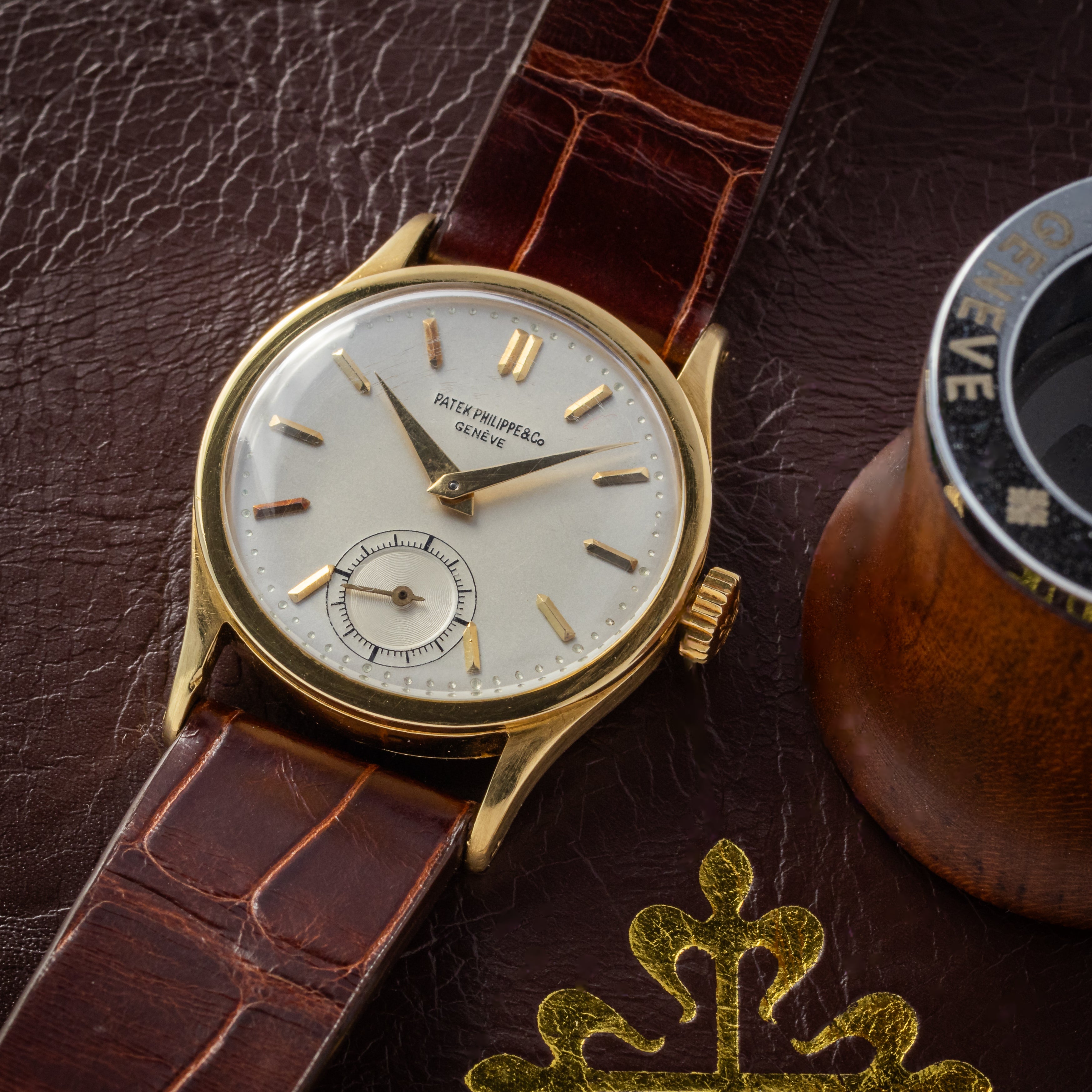
The silvered dial exhibits subtle tonal differentiation between its outer chapter and central field, creating depth within an otherwise restrained composition. Applied gold hour markers punctuate the surface, and the raised long "Patek Philippe & Co." signature executed in enamel remains striking, retaining crisp definition along its edges. Subsidiary seconds at six o'clock preserve the classical symmetry characteristic of the reference.


The 18K yellow gold case retains the disciplined proportions that made the Ref. 96 the archetype of the modern dress watch. The slender lugs include the desirable drilled construction typical of earlier production, a practical feature that has largely disappeared from contemporary watchmaking. Case surfaces remain well preserved, and the hallmark is clearly struck.


Inside, the watch is powered by the manually wound calibre 12'''120, the definitive mid-century Calatrava movement, finished to Geneva Seal standard and executed with subsidiary seconds.


Condition: The watch presents in beautifully preserved vintage condition with visible hallmarks and strong structural definition throughout. The raised enamel long signature remains crisp and visually prominent, and the dial's balanced tonality suggests careful preservation over time. The case shows evidence of earnest stewardship across nearly eight decades, retaining the character and integrity collectors seek in early Calatrava examples.

Specifications & Accompaniments
Reference
Reference 96J
Year of Production
Year of production not recorded
Original Date of Sale
Sold October 31, 1946
Case Material
18K yellow gold
Dimensions
Case diameter 30.5 mm; thickness approximately 9 mm; lug width 18 mm; lug-to-lug 38.5 mm
Dial
Silvered dial exhibiting subtle tonal differentiation between the outer chapter and central field, with applied gold baton hour markers and raised “Patek Philippe & Co.” long signature
Movement
Manually wound calibre 12'''120
Caseback
Fond clipsé (snap-on caseback)
Strap / Bracelet / Buckle
Patek Philippe thin brown dress strap, likely exotic skin, well suited to the period character of the watch. Fitted with an aftermarket buckle marked INOX, consistent with gold-plated stainless steel
Accompanied By
Patek Philippe Extract from the Archives
WRISTORIAN Perspective
In 1932, Patek Philippe introduced the Reference 96 — the manufacture’s first serially produced wristwatch following the Stern family’s acquisition of the company. It was not a complicated watch. It was not conceived as a technical showcase. It was a stabilizing instrument — a deliberate articulation of proportion and identity at a moment when the company required structural clarity more than mechanical novelty.

The design has since become so canonical that it appears inevitable: narrow bezel, elongated lugs, restrained dial, balanced subsidiary seconds. Yet inevitability is often the result of discipline. The Ref. 96 established a grammar for the modern dress watch — proportion before personality, surface integrity before ornament, geometry before spectacle. Nearly every round dress watch that followed, across brands, carries its imprint.

By the 1940s the reference had reached mechanical and aesthetic maturity. The Calibre 12'''120 had settled into reliable production, dial variations reflected evolving signature conventions, and the case proportions were fully resolved. This era represents the 96 not in its experimental youth but in confident continuity — post-war refinement without post-war inflation.

Modern scholarship has sharpened the way serious collectors evaluate the 96. What was once treated as a single model is now understood as a landscape of variations: long signatures versus short, enamel execution nuances, pearl versus baton markers, subtle dial tone shifts, and distinctions among case makers. The transition from “Patek Philippe & Co.” to the later simplified signature in the late 1940s functions not merely as typography but as chronology. In the Ref. 96, details serve as timestamps.

The reference has also accumulated mythology. Among the most persistent claims is that David Penney designed the Ref. 96. He did not. The confusion stems from later commemorative illustrations that were mistaken for original design documents. Correcting that record is not pedantic; it reinforces an important principle. Watches of this importance deserve factual clarity rather than inherited anecdote. Serious collecting begins with verified history.

Condition, in a watch defined by restraint, becomes the central differentiator. The hard-enamel signature — engraved and inlaid rather than printed — was engineered to endure, yet decades of cleaning, moisture exposure, or over-polishing reveal themselves in softened edges or enamel thinning. The minute track, the definition of applied markers, and the tension of the case lines are not minor details. In the Ref. 96, they are the watch.

The present example reflects that discipline. The dial retains a crisp raised enamel long signature and subtle tonal depth between outer chapter and central field, while the case hallmark remains clearly struck. Nearly eighty years after leaving the Patek Philippe workshops, the watch presents with the quiet evidence of earnest stewardship rather than intervention — a quality that collectors of early Calatravas value deeply.

Serious collectors have long recognized that certain watches define a manufacture’s identity rather than merely participating in it, and the Ref. 96 stands firmly in that category. It endures not because it is rare, but because it is structural — the blueprint against which simplicity in wristwatch design continues to be measured. In a thoughtful collection of vintage Patek Philippe, the reference is not chosen for spectacle but for calibration. This example, preserved with clarity and character after nearly eight decades of life, offers exactly that: the assurance that proportion, restraint, and enduring design never lose their authority.
Service & Operation
Service History
Service history unknown
Operational Status
Observed running and setting correctly at the time of cataloguing