


Patek Philippe Reference 96A-SCI
Caliber 12 120, Stainless Steel Case
Movement No. 821 309 | Case No. 617 389
The Foundational Calatrava, Expressed in Stainless Steel Simplicity.
TECHNICAL SUMMARY
All details are documented and disclosed to the best of our ability.
· Brand: Patek Philippe
· Reference Number: 96A
· Case Number: 617 389
· Movement Number: 821 309
· Year of Production: ca.1935–1939
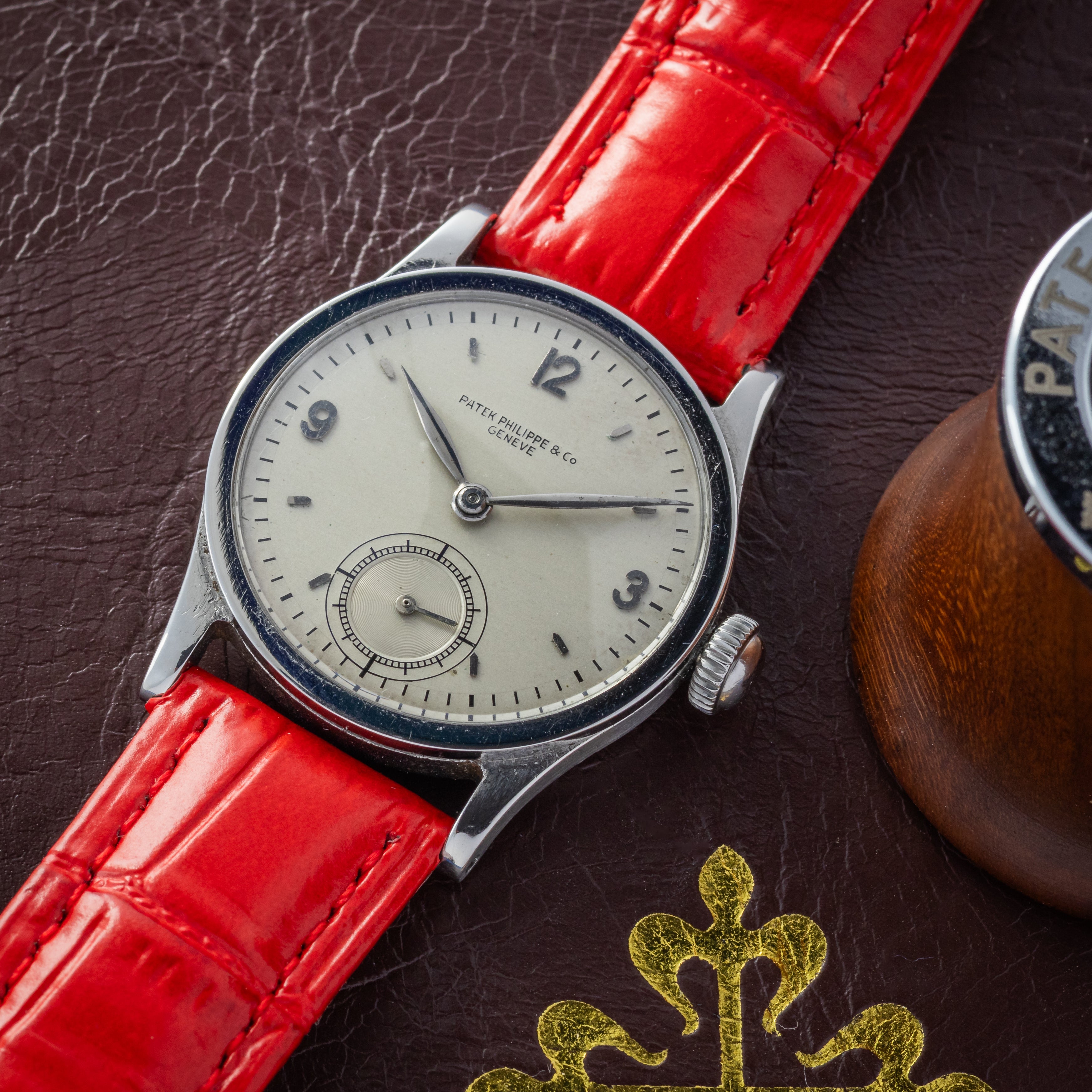
· Unique Features: Long-signature dial (“Patek Philippe & Co.” versus “Patek Philippe” style), stainless steel case, applied Arabic numerals at 3,6,9,12
· Last Serviced: July 26, 2025
· Type of Service Performed: Movement Clean, Oil Lubricate and Regulation
· Condition Summary: Honest vintage wear consistent with period use, sympathetically maintained
· Provenance / Ownership History: Personal anecdote from current owner: “I love to wear this timepiece anywhere at any time and always get gushing comments on its beauty.”
· Movement Type: Mechanical – Manual
· Movement Calibre: 12-120 – Patek’s first in-house movement.
· Complications: Time only with sub-seconds at 6:00
· Case Diameter: 30 to 31 mm (excluding crown)
· Case Thickness: 7 mm
· Case Material: Stainless steel
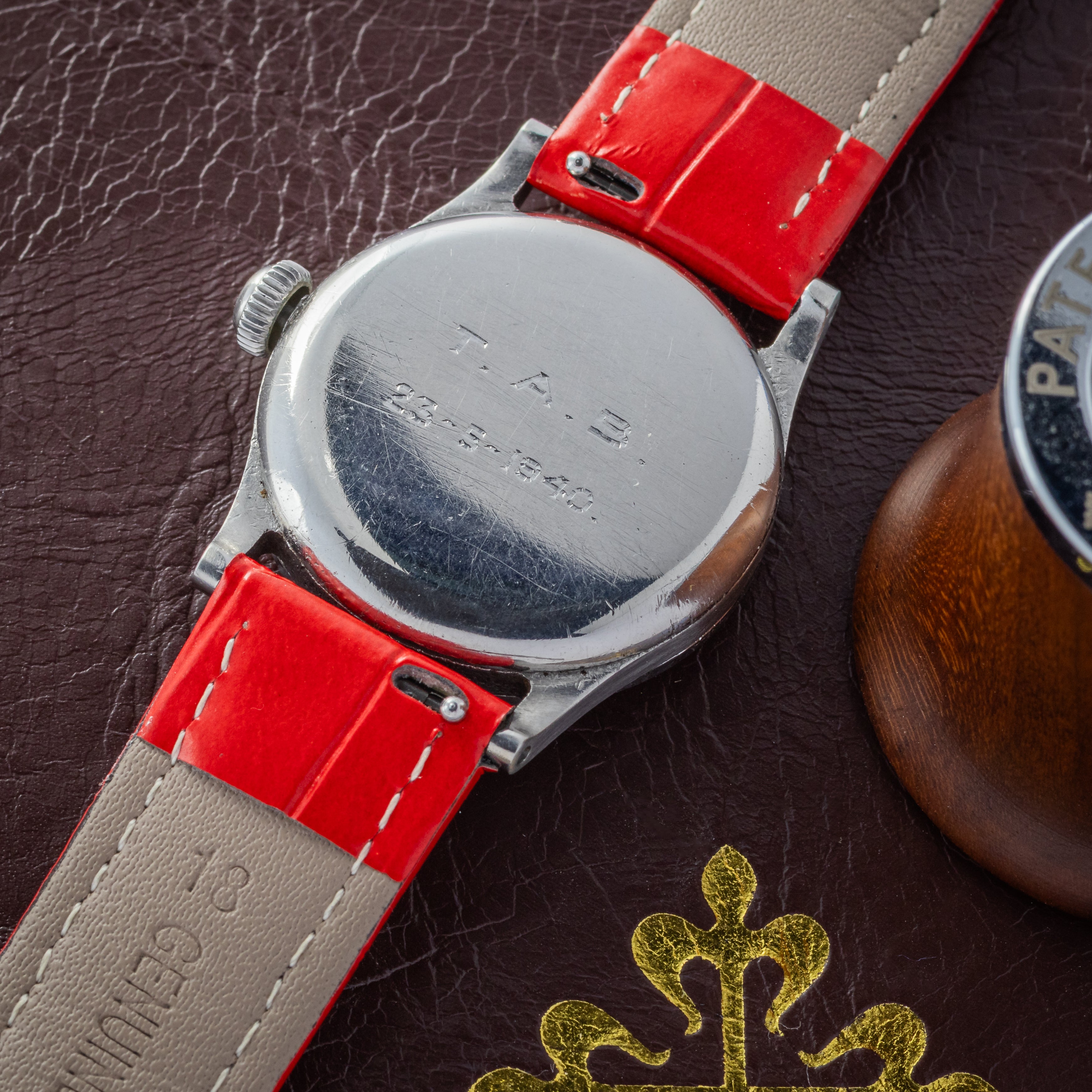
· Caseback Style: Solid, Engraved “T.A.B. 23-5-1940”
· Lug Width: 18 mm
· Crystal Type: Acrylic
· Dial Manufacturer: Stern Frères or Period Dial Supplier
· Indices: Applied Arabic numerals at 3, 6, 9, 12; applied baton/leaf indices elsewhere as shown in photos
· Hand Style: Alpha, Leaf, Dauphine (see photos)
· Water Resistance: None
· Strap Material: After-market, unbranded, and embossed genuine leather
· Strap Color: Red
· Buckle Type and Material: After-market stainless tang
· Original Box: No
· Original Papers: No
· Extract From The Archives: Applied for – status pending
· Other Included Accessories: None
WRISTORIAN’s Perspective
When one reflects upon the evolution of the dress timepiece, the Patek Philippe Reference 96 stands at the summit, the genesis of modern dress design whose Calatrava lineage became the archetype for nearly every manufacturer that followed. Introduced in 1932, the Ref. 96 emerged as the manufacture’s first serially produced wrist-timepiece and in doing so helped define the ethos of understated elegance in the wrist-borne form. (Collectability) This particular example - Reference 96A in stainless steel with long-signature dial, and Arabic numerals - offers a rare intersection of historical weight and wearable dimensions.
Of particular interest: the choice of stainless steel (rather than gold) points to a more pragmatic, even experimental, variant of the reference. Collectors today recognize that steel examples of the Ref. 96 series are considerably rarer than their gold counterparts, increasing their cultural and archival import. (unekual) In this form – case diameter ~30 to 31 mm, thickness ~7 mm – it wears with subtlety yet carries gravitas: you are wearing the genesis of Patek’s dress watch heritage.
Given the movement number 821 309 and case number 617 389, production falls within the mid-1930s–late-1930s bracket, typical of early-to-mid Ref. 96 run. Note the caseback engraving “T.A.B. 23-5-1940” - European styled date presentation – a personal touch (perhaps a presentation or commemoration) that adds provenance texture without overshadowing the timepiece’s intrinsic merits. Given the date 23 May 1940, which coincides historically with the early days of the Battle of France in WWII, it’s conceivable (though unprovable) that “T.A.B.” refers to an individual commemorating a personal milestone or military posting. Several period steel Pateks of the 1930s–40s carry similar engravings tied to wartime service. The preceding statement borders on being a rank speculation, so, don’t let it influence your decision.
In design terms, this reference exemplifies what scholars describe as Patek’s embrace of Bauhaus-inspired minimalism: flowing case lines, integrated lugs (rather than added), and a restrained but purposeful dial layout. (Analog:Shift) The applied Arabic numerals at the quarters, combined with leaf or dauphine hands, deliver legibility and period style; the long signature signifies the maison’s branding phase, making the dial not only aesthetic but documentary.
Turning to the movement: it houses Patek Philippe’s Caliber 12-120, the firm’s first fully in-house wrist-timepiece movement and a milestone in its transition toward vertical integration. This manual-winding mechanism exemplifies the manufacture’s early mastery of precision and finishing - anglage, chamfering, and black polishing executed to standards few could rival in the 1930s - at a time when most competitors still relied on ébauches. Patek Philippe was, by this stage, operating as an integrated manufacture with its own movement finishing and uncompromising technical ideals.
In the context of dial manufacture: dials of the period were frequently produced by Stern Frères (which the Stern family later made its ownership base of the manufacture) or in Patek’s own dial division; the long-signature style here is consistent with dialing of the era and speaks to archival correctness.
This timepiece is additionally enhanced by its service history: fully serviced on 26 July 2025, making it immediately ready for wear or collection. The honest vintage wear is sympathetically consistent with its age; in our judgement, no over-polishing or heavy rework appears evident, preserving form and proportion close to original intent.
From a collector’s vantage, this 96A is compelling not because of complication or ostentation but because it embodies the pivot-point where Patek moved from pocket-timepiece traditions to wrist-timepiece modernity. A steel long-signature Arabic variant powered by the seminal Caliber 12-120, an in-house movement that laid the mechanical foundation for every Patek Philippe dress timepiece that followed, it represents the moment when design philosophy and mechanical autonomy aligned. For someone who genuinely wears and enjoys it - as the owner anecdote confirms - it is an authenticated conduit into 1930s Geneva manufacture elegance.
Would I wear this myself? Yes. The form is low-profile, the diameter modest (but appropriate for the era and for modern discreet wear). The red leather strap adds character (though non-original), and the presence of the presentation engraving adds a narrative layer rather than just a serial number. In sum, this is not a flashy collector piece that screams for attention; rather it invites appreciation from those who know and listen.
If one embraces intellectual depth and horological significance, this Reference 96A offers both. Its surface is graceful, its story is rich, and its presence feels both lived-in and timeless.
Subtle in scale. Monumental in lineage.
