Two thousand years before Patek Philippe introduced the Golden Ellipse, the Greek mathematician Euclid described what would later become known as the Golden Section — a proportional relationship long associated with structural harmony in architecture, art, and the natural world. From the Parthenon to Renaissance painting, the ratio appeared wherever balance and visual equilibrium were pursued with rigor. When Patek Philippe unveiled the Ellipse in 1968, the manufacture did not reference that proportion casually. It built an entire case around it. The watch was conceived not as ornament, but as geometry rendered in gold.
The first generation of the model consisted principally of two references: the 3546, which retained conventional lugs, and the 3548, which removed them entirely. In the 3548, the ellipse stands uninterrupted — self-contained, autonomous, and uncompromising. Without projecting lugs, the case becomes a continuous figure, allowing the proportions themselves to dominate the design. In that sense, the 3548 represents the purest articulation of the Golden Ellipse concept. Later references would refine, enlarge, and reinterpret the shape, but the architectural thesis of the model appears here in its most distilled form.
The timing of the Ellipse’s introduction is equally significant. The late 1960s were a period of stylistic experimentation across the watch industry, and within a few years the technological shock of quartz would reshape the entire landscape of Swiss horology. Yet Patek Philippe’s response was neither novelty nor spectacle. Instead, the manufacture introduced a watch grounded in mathematical certainty. The Ellipse declared that modernity could be anchored in proportion rather than disruption. In doing so, it articulated a design philosophy that would carry the brand through one of the most turbulent eras in watchmaking history.
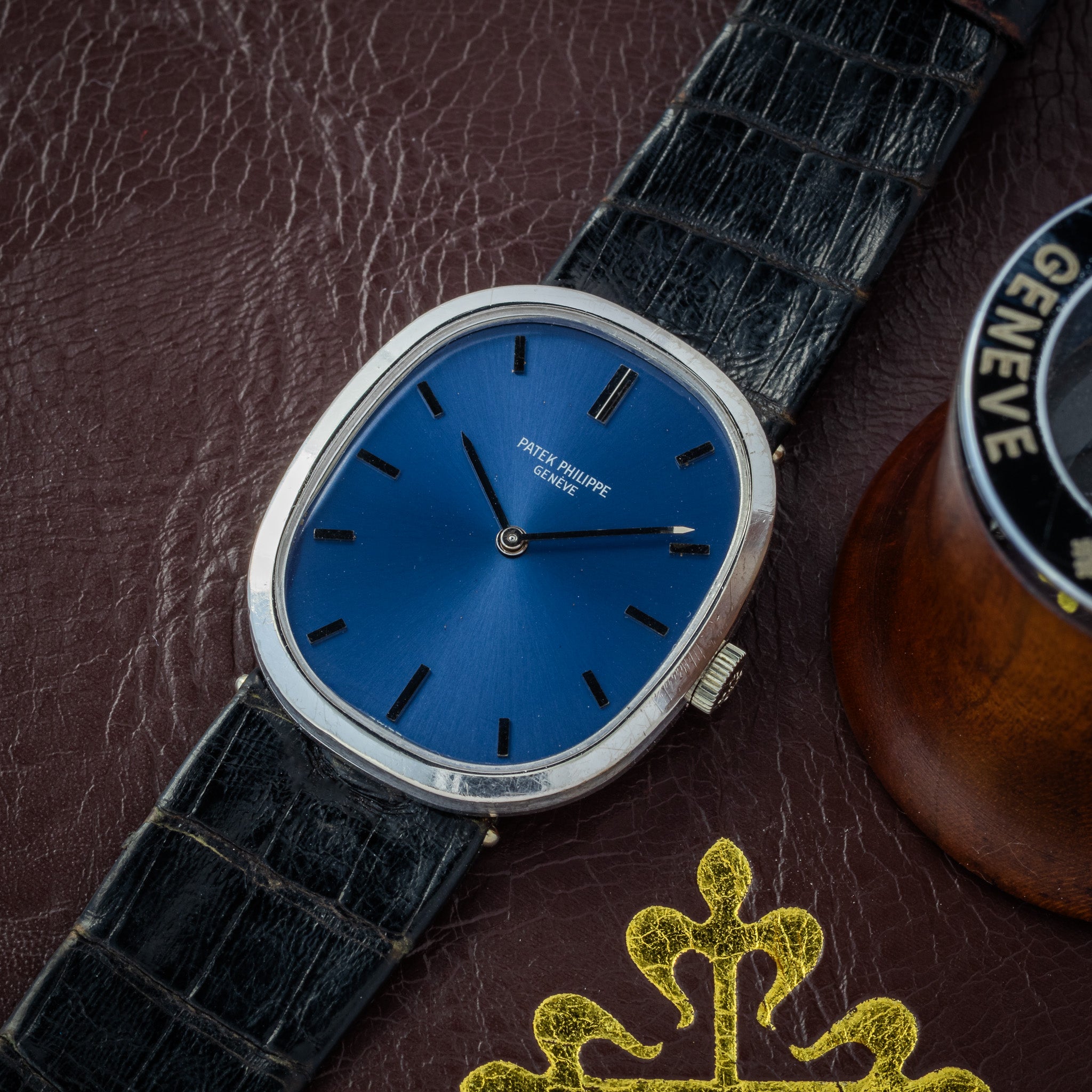
The patented blued gold dial completed that statement. Developed by Stern Frères, Patek Philippe’s long-standing dial maker, the surface was produced by depositing an ultrathin metallic layer onto a solid 18K gold base through a controlled vacuum process. The result was not simply a colored dial but a surface with unusual depth and tonal dynamism — a blue that shifts subtly with light, neither lacquer nor enamel but something altogether more architectural. In period catalogues, that cobalt field became inseparable from the Golden Ellipse itself, establishing a visual identity that would define the reference for decades.
The importance of the Ref. 3548 within the Ellipse lineage therefore cannot be overstated. It represents the moment when Patek Philippe established a design language that would endure for generations. Unlike many shaped watches introduced during moments of stylistic experimentation, the Ellipse did not fade with changing tastes. It became a permanent axis within the manufacture’s design vocabulary, remaining in continuous production across decades and evolving into one of the most recognizable forms in the brand’s catalogue.
Material choice further shapes the character of these early watches. First-generation Ellipse references are encountered most frequently in yellow gold, reflecting the material preferences of the era and reinforcing the warmth of the design. White gold examples such as the present watch appear considerably less often and introduce a different visual dynamic. In white gold the ellipse reads less as ornament and more as architecture, the cooler metal emphasizing line, shadow, and proportion while allowing the saturated blue dial to command visual attention.
Collectors evaluating early 3548 examples tend to focus on the preservation of the details that give the reference its architectural clarity. The integrity of the blued gold dial, the sharpness of the case geometry, and the visibility of original hallmarks remain the principal indicators of quality. When those elements remain intact, the mathematical elegance of the design remains immediately legible, and the watch communicates the intellectual confidence that defined its creation.
The present example reflects those qualities with notable clarity. The pre-Sigma blued gold dial retains the depth and tonal dynamism characteristic of Stern Frères’ early vacuum-deposited surfaces. The case appears preserved in honest vintage condition, with surfaces consistent with original finishing and a crisp hallmark that reinforces the structural definition of the watch. These details allow the reference to be appreciated not merely as an early Ellipse, but as a faithful expression of the model’s original architectural intent.
For the serious student of Patek Philippe design, the Ref. 3548 occupies a position similar to the earliest Calatrava references of the 1930s: it marks the moment when a new aesthetic language entered the manufacture’s vocabulary. The Golden Ellipse would go on to become one of the brand’s most enduring and recognizable forms, but its intellectual foundation begins here. Elegant, mathematically disciplined, and visually distinctive, the Ref. 3548G stands not simply as an early Ellipse, but as the origin of the lineage itself — a cornerstone timepiece whose importance lies as much in its ideas as in its beauty, and a profoundly satisfying addition to any thoughtful collection of vintage Patek Philippe wristwatches.