Patek - 5236P - Despliegue
c. 2022 · Caja n.° 6.585.034 · Movimiento n.° 7.518.068 Calendario Perpetuo. Un ejemplar cuidadosamente seleccionado por su equilibrio entre originalidad y honestidad, esta pieza refleja el atractivo imperecedero del diseño de mediados de siglo de Patek Philippe. Sus proporciones se adaptan con elegancia a la muñeca, mientras que la fina tipografía de la esfera y el acabado de la caja subrayan la discreta búsqueda de la excelencia de la manufactura. Los coleccionistas apreciarán la integridad de sus componentes y la sobria elegancia que lo eleva por encima de las modas: un objeto funcional refinada en forma. En el mercado actual, los conocedores valoran estos ejemplares por su coherencia y la claridad de su historia: un reloj con propósito, conservado con respeto en lugar de con excesos. Ideal para uso diario o para una colección selecta, ofrece satisfacción estética y un gran valor como pieza de colección a largo plazo. Incluye certificado de origen.


Patek - 5236P - Despliegue
Lifetime Guarantee of Authenticity
Complimentary Insured Worldwide Shipping
Three-Day Inspection Window
Trusted Globally by Collectors
Elige opciones


Patek - 5236P - Despliegue
Precio de oferta$120,000.00 USD
Timepiece Information
Catalogue Notes
Specifications & Accompaniments
Reference
Patek Philippe Reference 5236P-001
Year of Production
Manufactured and shipped from the Patek Philippe manufacture in July 2022
Original Date of Sale
December 2, 2022 — retailed by Berger Joyeros, Mexico City
Case Material
Platinum (Pt950) case featuring the Patek Philippe signature diamond set between the lugs at 6 o’clock (approximately 0.02 carat)
Dimensions
41.3 mm diameter; approximately 11.2 mm thickness; 21 mm lug width; approximately 48.3 mm lug-to-lug span
Dial
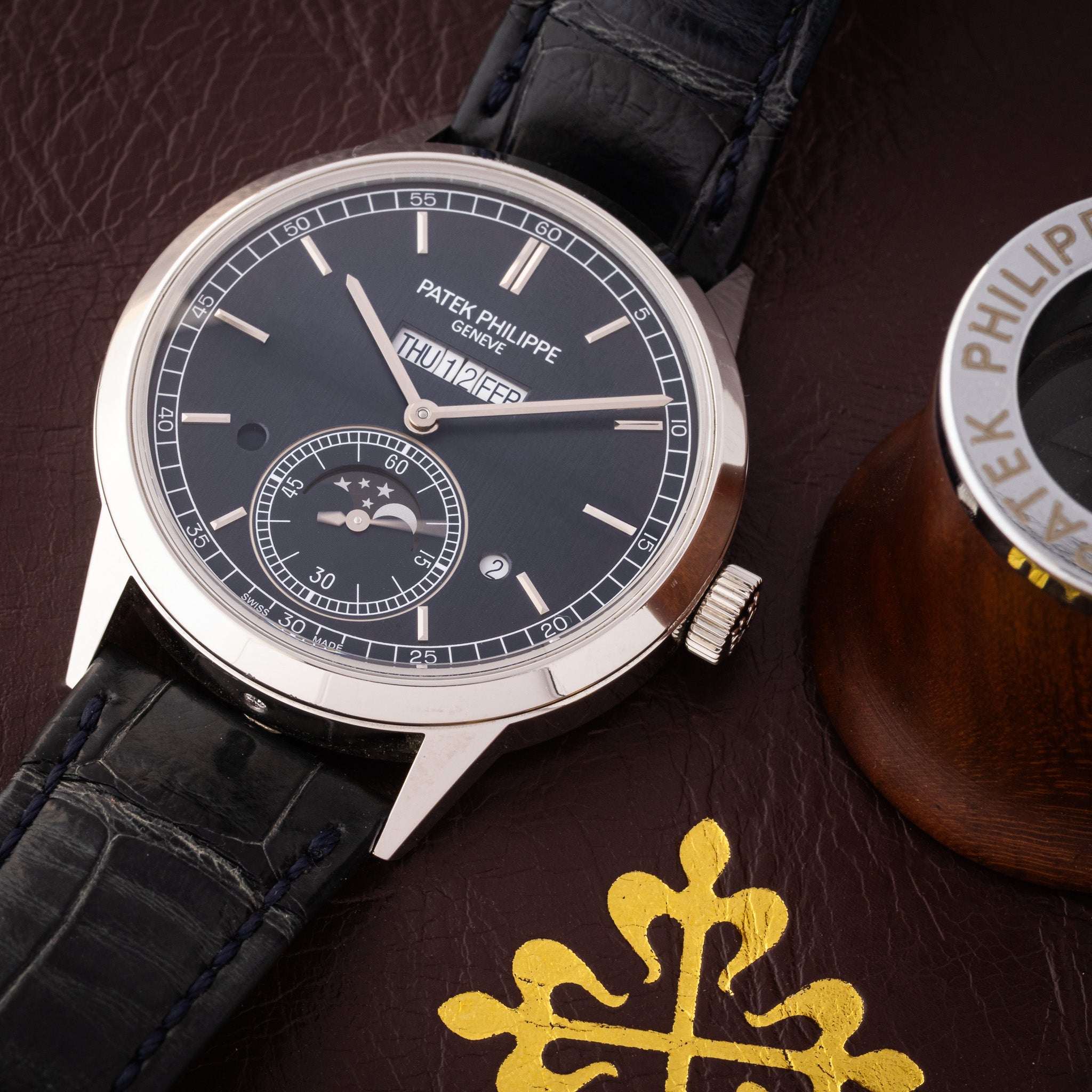
Gradient blue-to-black (Bleu dégradé noir) vertically satin-finished dial with applied white-gold hour markers and faceted white-gold hands. In-line perpetual calendar display with day, date, and month apertures across the upper dial; subsidiary seconds with integrated moonphase at 6 o’clock; railroad minute track; and leap-year and day/night indicators flanking the moonphase display.
Movement
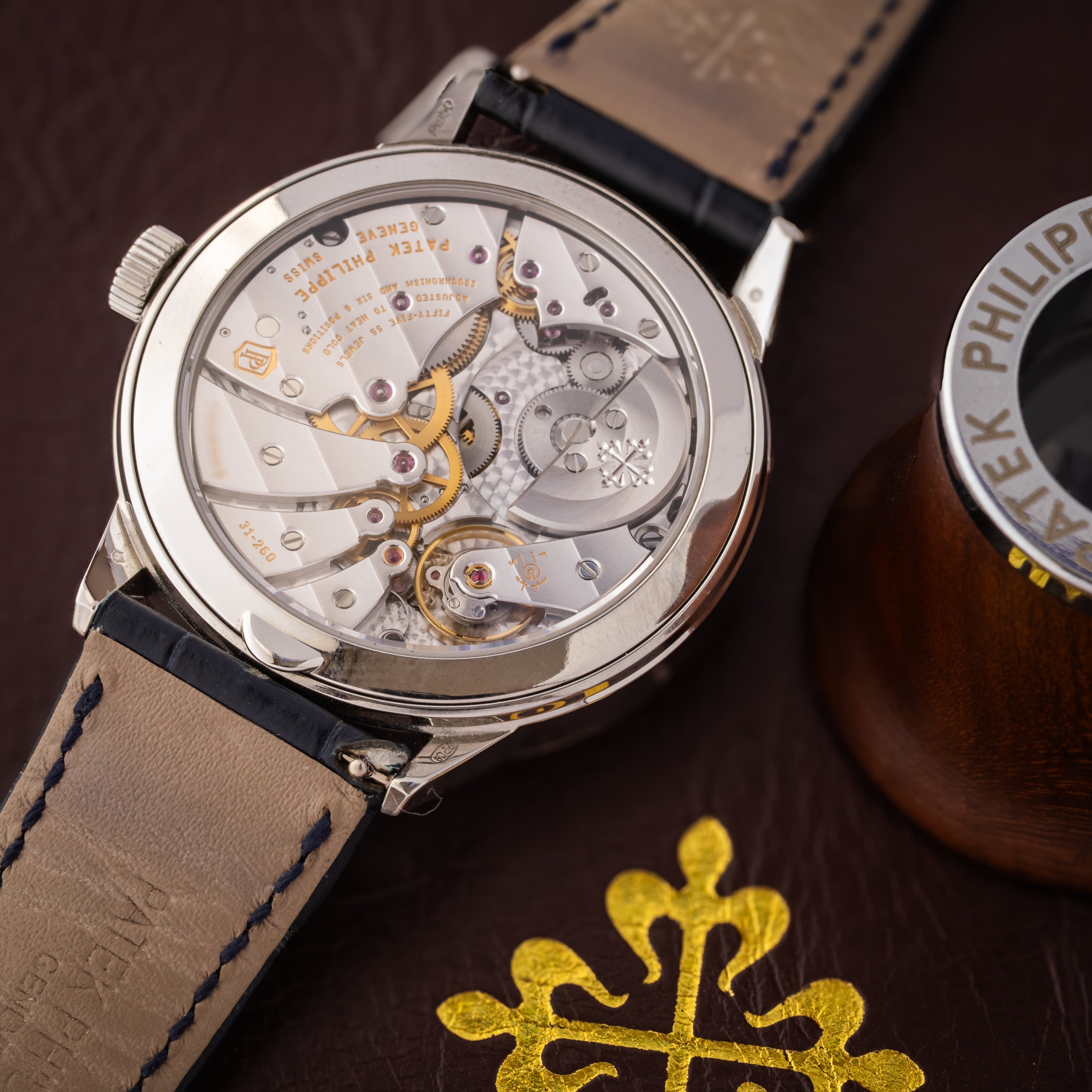
Patek Philippe Caliber 31-260 PS QL, self-winding perpetual calendar movement featuring the patented in-line calendar display with co-planar four-disc system. Platinum micro-rotor winding system, Gyromax balance, Spiromax silicon balance spring; 55 jewels; approximately 38–48 hour power reserve.
Caseback
Interchangeable caseback system including sapphire crystal display back and solid platinum caseback (fond saphir / fond plein)
Strap / Bracelet / Buckle
Dark blue Patek Philippe alligator leather strap with platinum Patek Philippe deployant clasp
Accompanied By
Complete set including outer box, inner presentation box, Certificate of Origin dated December 2, 2022, setting stylus, solid platinum caseback, manuals, and WRISTORIAN presentation packaging.
WRISTORIAN Perspective
Among modern Patek Philippe complicated watches, the Reference 5236P occupies a particularly intriguing position. While unmistakably contemporary in its engineering, the watch draws deeply from the historical language of the manufacture—both mechanically and aesthetically. At first glance the dial appears unusually restrained for a perpetual calendar, yet this quiet symmetry conceals one of the most technically ambitious calendar displays Patek Philippe has produced in the modern era.
The defining feature of the reference is its in-line perpetual calendar display, presenting the day, date, and month together across a single horizontal aperture at the top of the dial. The arrangement feels intuitive to the eye, yet achieving it within the confines of a wristwatch required an entirely new mechanical architecture. To preserve legibility while maintaining reliability, Patek Philippe developed a patented system using four calendar discs mounted on a single plane and stabilized by anti-backlash mechanisms that ensure perfect alignment as the calendar jumps instantaneously at midnight. The result is a display that appears deceptively simple—precisely the type of mechanical elegance long associated with the manufacture’s finest complications.
What makes the concept especially compelling for students of Patek Philippe history is that the display itself is rooted in the manufacture’s earlier work in complicated pocket watches. During the mid-twentieth century, certain perpetual calendar pocket watches—most notably examples of the Patek Philippe Reference 725 introduced in the 1940s—experimented with similar in-line calendar displays in which the day, date, and month were arranged across a single horizontal window. These watches were produced in extremely small numbers and typically reserved for highly complicated pocket watches made for important clients. Translating this display architecture into a modern wristwatch proved far more difficult than it might appear. Miniaturizing the system while preserving legibility required decades of technical development and ultimately resulted in the creation of the Caliber 31-260 PS QL specifically for the Reference 5236. In this sense, the watch represents the culmination of an idea that had quietly existed within Patek Philippe’s design vocabulary for nearly a century.
The visual character of the watch reinforces this connection between past and present. The vertically satin-finished gradient blue dial offers a restrained depth that shifts subtly under changing light, while applied white-gold hour markers and slender faceted hands maintain the disciplined clarity that has defined Patek Philippe dial design for generations. The moonphase display integrated within the subsidiary seconds at six o’clock introduces a touch of classical symmetry, balanced by leap-year and day-night indicators that complete the perpetual calendar indications without disturbing the visual calm of the layout.
On the wrist, the 5236P carries the reassuring presence expected of a platinum Patek Philippe. The case proportions remain elegant despite the complexity of the mechanism within, while the signature diamond set discreetly between the lugs at six o’clock signals the precious metal construction known only to the wearer. Viewed through the sapphire caseback, the movement reveals the finishing standards associated with the manufacture—Geneva striping across the bridges, polished anglage, perlage on the baseplate, and the engraved platinum micro-rotor that quietly powers the watch.
For collectors whose interests are rooted in vintage Patek Philippe, the Reference 5236P holds a particularly compelling intellectual appeal. Much as references such as the celebrated 2497 and the groundbreaking 3448 once redefined the perpetual calendar wristwatch in their respective eras, the 5236 introduces an entirely new display architecture that draws upon the manufacture’s historical experimentation with perpetual calendar pocket watches. In doing so, it bridges two eras of Patek Philippe watchmaking—linking the rare complicated pocket watches of the mid-twentieth century with a thoroughly modern mechanical interpretation.
For that reason the Reference 5236P has increasingly attracted attention from collectors who normally focus on earlier watches. It offers something rare within contemporary watchmaking: a modern complication that feels intellectually connected to the historical lineage of the manufacture rather than merely inspired by it. Indeed, within Patek Philippe’s modern catalog, the 5236 is often regarded by enthusiasts as one of the most intellectually interesting complications introduced since the celebrated Reference 5204 split-seconds perpetual calendar chronograph.
For the collector who values both historical continuity and mechanical innovation, the Reference 5236P represents a particularly thoughtful acquisition. It is a watch that can sit comfortably alongside vintage perpetual calendars while quietly demonstrating where the art of horological complication continues to evolve—an object that honors Patek Philippe’s past while pointing clearly toward its future.
The defining feature of the reference is its in-line perpetual calendar display, presenting the day, date, and month together across a single horizontal aperture at the top of the dial. The arrangement feels intuitive to the eye, yet achieving it within the confines of a wristwatch required an entirely new mechanical architecture. To preserve legibility while maintaining reliability, Patek Philippe developed a patented system using four calendar discs mounted on a single plane and stabilized by anti-backlash mechanisms that ensure perfect alignment as the calendar jumps instantaneously at midnight. The result is a display that appears deceptively simple—precisely the type of mechanical elegance long associated with the manufacture’s finest complications.
What makes the concept especially compelling for students of Patek Philippe history is that the display itself is rooted in the manufacture’s earlier work in complicated pocket watches. During the mid-twentieth century, certain perpetual calendar pocket watches—most notably examples of the Patek Philippe Reference 725 introduced in the 1940s—experimented with similar in-line calendar displays in which the day, date, and month were arranged across a single horizontal window. These watches were produced in extremely small numbers and typically reserved for highly complicated pocket watches made for important clients. Translating this display architecture into a modern wristwatch proved far more difficult than it might appear. Miniaturizing the system while preserving legibility required decades of technical development and ultimately resulted in the creation of the Caliber 31-260 PS QL specifically for the Reference 5236. In this sense, the watch represents the culmination of an idea that had quietly existed within Patek Philippe’s design vocabulary for nearly a century.
The visual character of the watch reinforces this connection between past and present. The vertically satin-finished gradient blue dial offers a restrained depth that shifts subtly under changing light, while applied white-gold hour markers and slender faceted hands maintain the disciplined clarity that has defined Patek Philippe dial design for generations. The moonphase display integrated within the subsidiary seconds at six o’clock introduces a touch of classical symmetry, balanced by leap-year and day-night indicators that complete the perpetual calendar indications without disturbing the visual calm of the layout.
On the wrist, the 5236P carries the reassuring presence expected of a platinum Patek Philippe. The case proportions remain elegant despite the complexity of the mechanism within, while the signature diamond set discreetly between the lugs at six o’clock signals the precious metal construction known only to the wearer. Viewed through the sapphire caseback, the movement reveals the finishing standards associated with the manufacture—Geneva striping across the bridges, polished anglage, perlage on the baseplate, and the engraved platinum micro-rotor that quietly powers the watch.
For collectors whose interests are rooted in vintage Patek Philippe, the Reference 5236P holds a particularly compelling intellectual appeal. Much as references such as the celebrated 2497 and the groundbreaking 3448 once redefined the perpetual calendar wristwatch in their respective eras, the 5236 introduces an entirely new display architecture that draws upon the manufacture’s historical experimentation with perpetual calendar pocket watches. In doing so, it bridges two eras of Patek Philippe watchmaking—linking the rare complicated pocket watches of the mid-twentieth century with a thoroughly modern mechanical interpretation.
For that reason the Reference 5236P has increasingly attracted attention from collectors who normally focus on earlier watches. It offers something rare within contemporary watchmaking: a modern complication that feels intellectually connected to the historical lineage of the manufacture rather than merely inspired by it. Indeed, within Patek Philippe’s modern catalog, the 5236 is often regarded by enthusiasts as one of the most intellectually interesting complications introduced since the celebrated Reference 5204 split-seconds perpetual calendar chronograph.
For the collector who values both historical continuity and mechanical innovation, the Reference 5236P represents a particularly thoughtful acquisition. It is a watch that can sit comfortably alongside vintage perpetual calendars while quietly demonstrating where the art of horological complication continues to evolve—an object that honors Patek Philippe’s past while pointing clearly toward its future.
Service & Operation
Service History
Serviced July 15, 2024
Operational Status
Observed running and setting normally at the time of cataloguing. The movement has not been tested for accuracy over extended periods or for power reserve duration, and may require servicing at the buyer’s discretion. As is customary with vintage timepieces, future performance cannot be guaranteed.