
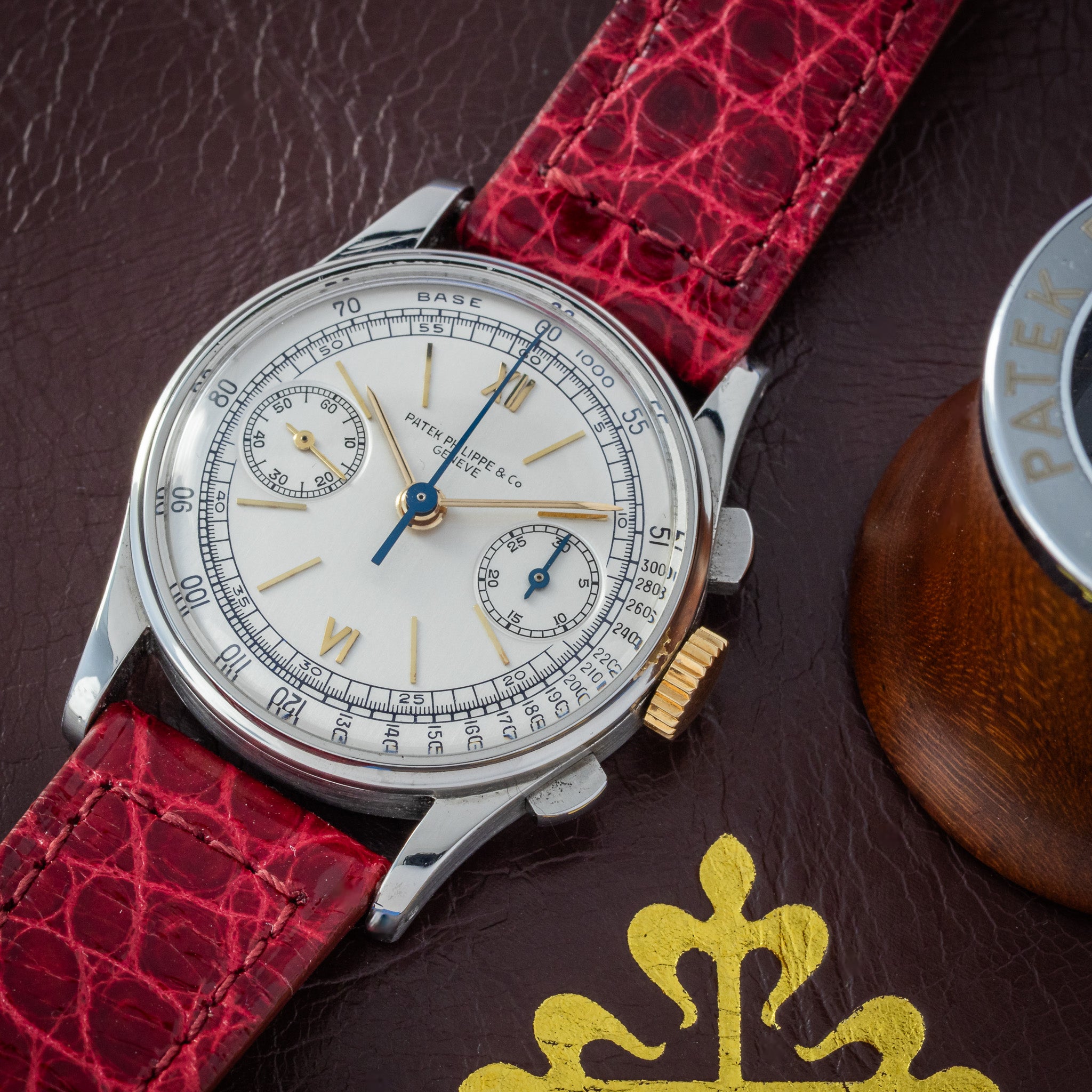


Patek - 130A - Firma larga
 Trusted Globally by Collectors
Lifetime Guarantee of Authenticity
Complimentary Fully Insured Shipping
Trusted Globally by Collectors
Lifetime Guarantee of Authenticity
Complimentary Fully Insured Shipping
Elige opciones
Timepiece Information
Patek - 130A - Firma larga
Hacia 1941 · Número de caja 505.799 · Número de movimiento 862.656 Cronógrafo. Un ejemplar cuidadosamente seleccionado por su equilibrio entre originalidad y honestidad, esta pieza refleja el atractivo perdurable del lenguaje de diseño de mediados de siglo de Patek Philippe. Sus proporciones se adaptan con elegancia a la muñeca, mientras que la fina tipografía de la esfera y el acabado de la caja subrayan la discreta búsqueda de la excelencia de la manufactura. Los coleccionistas apreciarán la integridad de sus componentes y la sobria elegancia que lo eleva por encima de las modas: un objeto funcional refinado en forma. En el mercado actual, los conocedores valoran estos ejemplares por su coherencia y la claridad de su historia: un reloj con propósito, conservado con respeto en lugar de con excesos. Adecuado para el uso diario o para un estudio minucioso en una colección selecta, ofrece tanto satisfacción estética como un gran valor como pieza de colección a largo plazo.
What makes this particular example so compelling is the dial. That observation should not be taken to diminish the appeal of the stainless steel case or the rare and attractive combination of steel with yellow gold markers, hands, and crown, all of which contribute meaningfully to the watch’s character. Yet when encountering the watch for the first time, it is the dial that quietly commands attention. Vintage collectors often speak about watches that seem to have escaped the decades with unusual grace. Occasionally a dial appears whose preservation immediately arrests the eye. The present example falls squarely into that category. The raised enamel long signature remains strikingly crisp, the tachymeter printing retains excellent clarity, and the recessed chronograph registers display remarkable depth and definition. The overall impression is one of uncommon sharpness, suggesting a life spent carefully preserved rather than gradually softened by decades of daily wear.
The configuration itself adds further intrigue. Steel reference 130 chronographs are already scarce, with scholarship suggesting that approximately 280 examples were produced. Within that already limited population, examples combining a steel case with applied yellow gold Roman numerals, baton markers, and matching hands appear only infrequently. The Roman numerals at twelve and six introduce a disciplined symmetry that collectors often associate with the elegant quasi sector layouts of the period, lending the dial a sense of architectural balance that is both refined and visually distinctive.
Equally appealing is the proportion the watch maintains on the wrist. Measuring just over thirty three millimeters in diameter, the reference reflects a period in which elegance was achieved through balance rather than scale. The slender case, rectangular pushers, and carefully structured dial create a timepiece that feels purposeful, refined, and unmistakably of its era.
For experienced collectors, watches such as this often produce a moment of immediate recognition. Within the population of surviving reference 130 chronographs, examples displaying this dial configuration and level of preservation appear only occasionally. When they do surface, they reveal the reference with unusual clarity, allowing collectors to appreciate the design, craftsmanship, and proportions exactly as they were originally conceived.
Now more than eight decades removed from its manufacture in 1941, surviving examples of reference 130 have gradually found their way into long term collections, where they are often preserved for generations. As a result, opportunities to encounter particularly well preserved examples have become increasingly uncommon.
A timepiece like this does more than measure elapsed seconds. It reflects a moment when chronographs were still instruments of precision, built to record speed, distance, and performance, yet already evolving into objects of quiet elegance. The reference 130 sits precisely at that intersection. For the thoughtful collector, an example preserved with this level of clarity offers something rare: the opportunity to experience the watch very nearly as it must have appeared when it first left the workshops of Patek Philippe in the early 1940s.
For collectors who value originality, proportion, and historical importance in equal measure, the appeal becomes self evident. A stainless steel reference 130 is already a rare chronograph. One displaying this uncommon Roman numeral configuration and preserved with such remarkable clarity stands apart even within that small population. It is not simply a fine example of the reference. It is the kind of example that reminds collectors why the earliest Patek Philippe chronographs continue to command such admiration today.

