

Patek Philippe - 3919J - Correa marrón
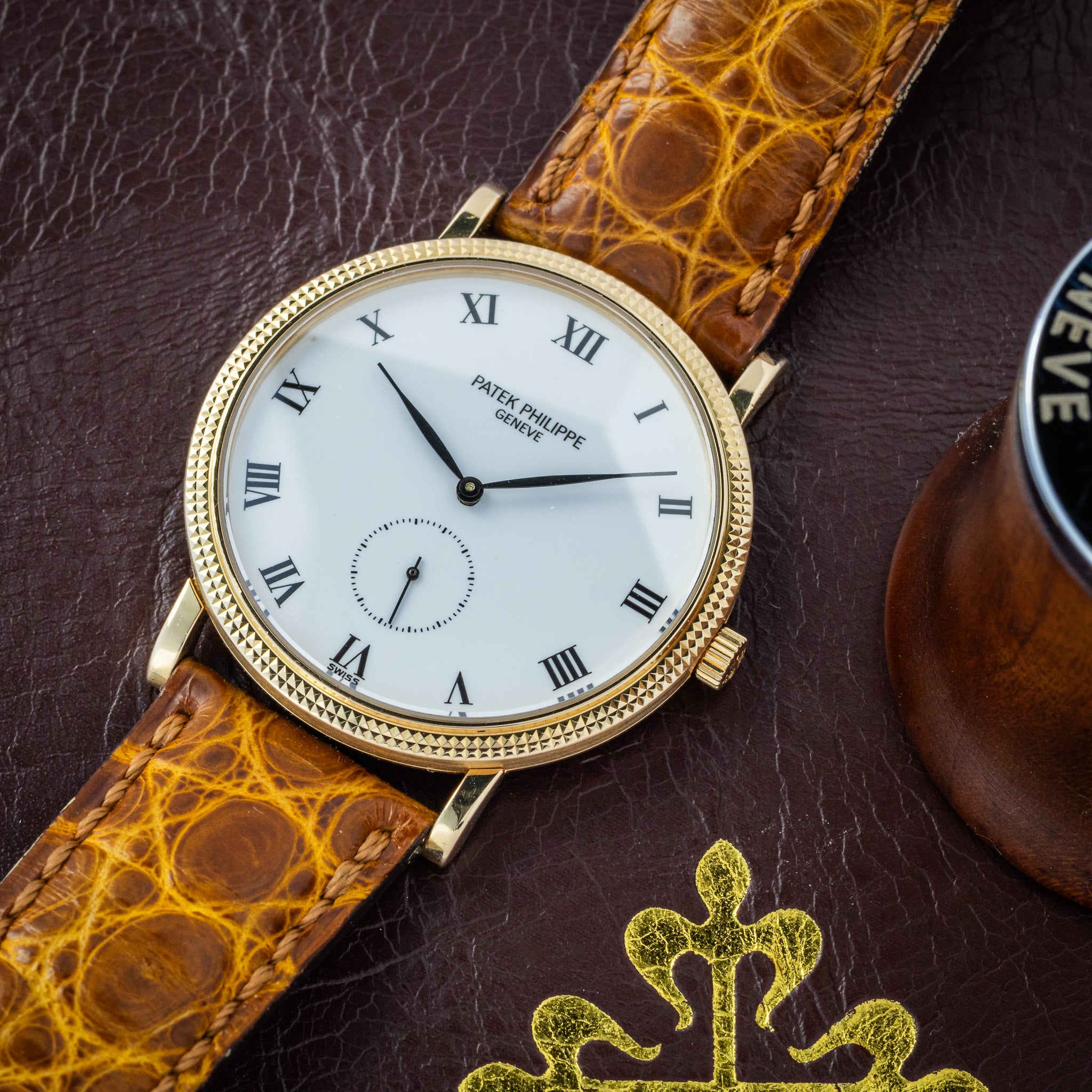
c. 1980-85? · Caja n.° 2.835.450 · Movimiento n.° 1.357.394 . Solo hora. Un ejemplar cuidadosamente seleccionado por su equilibrio entre originalidad y honestidad, esta pieza refleja el atractivo perdurable del lenguaje de diseño de mediados de siglo de Patek Philippe. Sus proporciones se adaptan con elegancia a la muñeca, mientras que la fina tipografía de la esfera y el acabado de la caja subrayan la discreta búsqueda de la excelencia por parte de la manufactura. Los coleccionistas apreciarán la integridad de sus componentes y la sobria elegancia que lo eleva por encima de la moda: un objeto funcional refinado en forma. En el mercado actual, los conocedores valoran estos ejemplares por su coherencia y la claridad de su historia: un reloj con propósito, conservado con respeto en lugar de con excesos. Adecuado para el uso diario o para un estudio minucioso en una colección selecta, ofrece tanto satisfacción estética como un gran valor como pieza de colección a largo plazo. Incluye la opción de solicitar.
Patek Philippe - 3919J - Correa marrón
 Lifetime Guarantee of Authenticity
Complimentary Insured Worldwide Shipping
Three-Day Inspection Window
Trusted Globally by Collectors
Lifetime Guarantee of Authenticity
Complimentary Insured Worldwide Shipping
Three-Day Inspection Window
Trusted Globally by Collectors
Patek Philippe - 3919J - Correa marrón
Precio de oferta$16,000.00 USD
Elige opciones
Patek Philippe - 3919J - Correa marrón
Precio de oferta$16,000.00 USD
Timepiece Information
Catalogue Notes
Specifications & Accompaniments
Reference
Reference 3919J
Year of Production
Serial number indicates production circa 1980–1985
Original Date of Sale
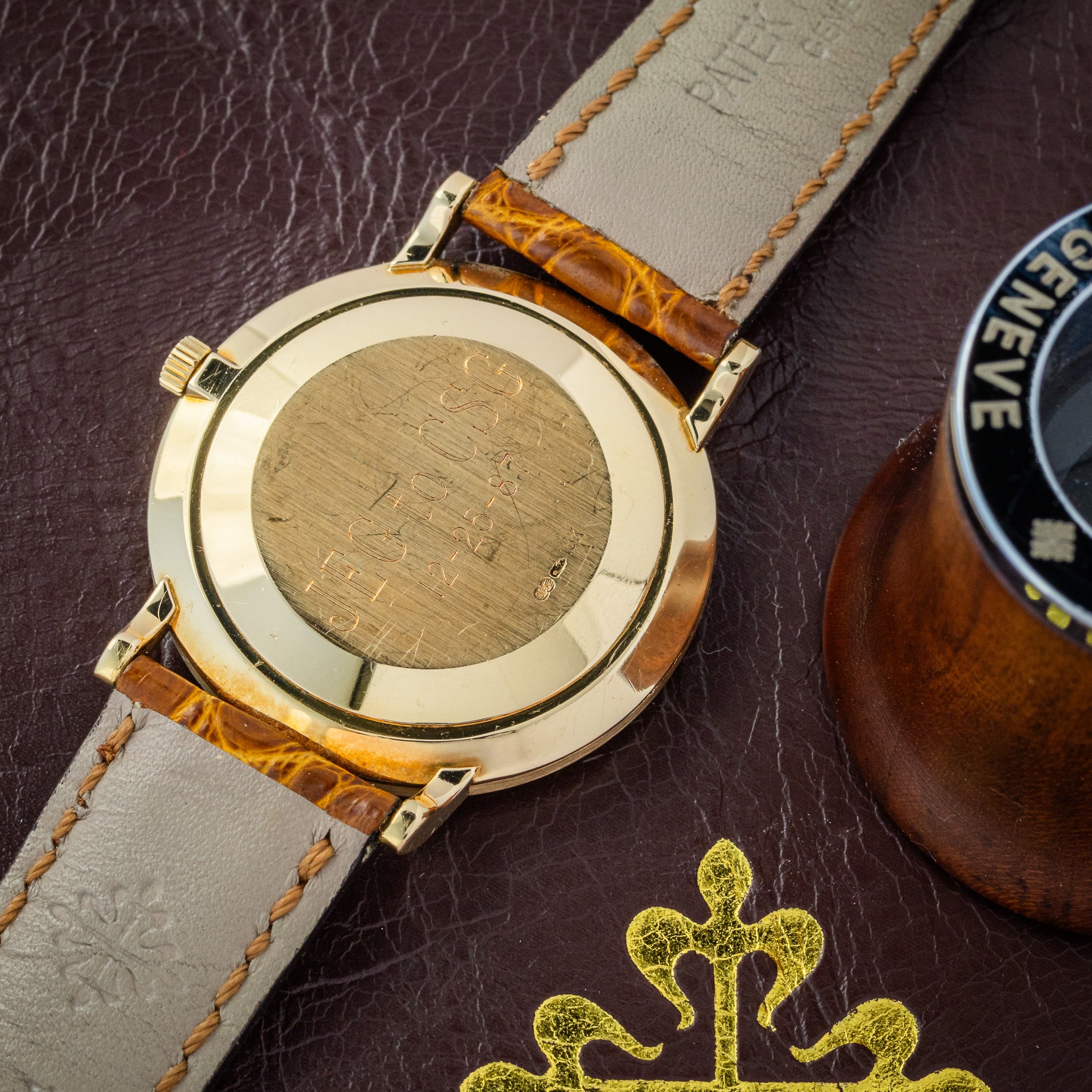
Original date of sale unknown; caseback engraving suggests February 1987
Case Material
18K yellow gold
Dimensions
Case diameter 33 mm; thickness approximately 6 mm; lug width 18 mm; lug-to-lug 38.5 mm
Dial
Bright white dial with black painted Roman numerals
Movement
Manually wound calibre 215
Caseback
Fond clipsé (snap-on caseback)
Strap / Bracelet / Buckle
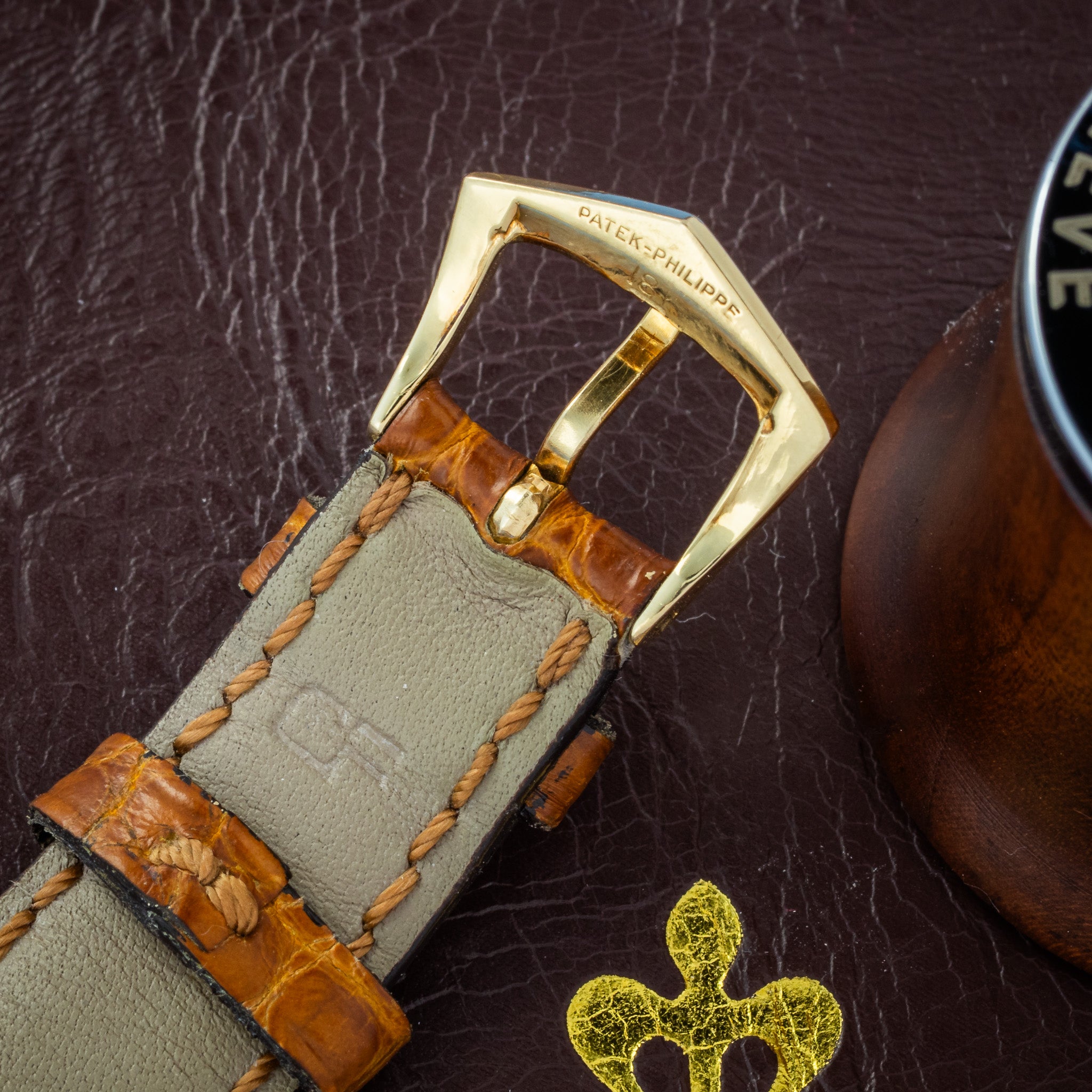
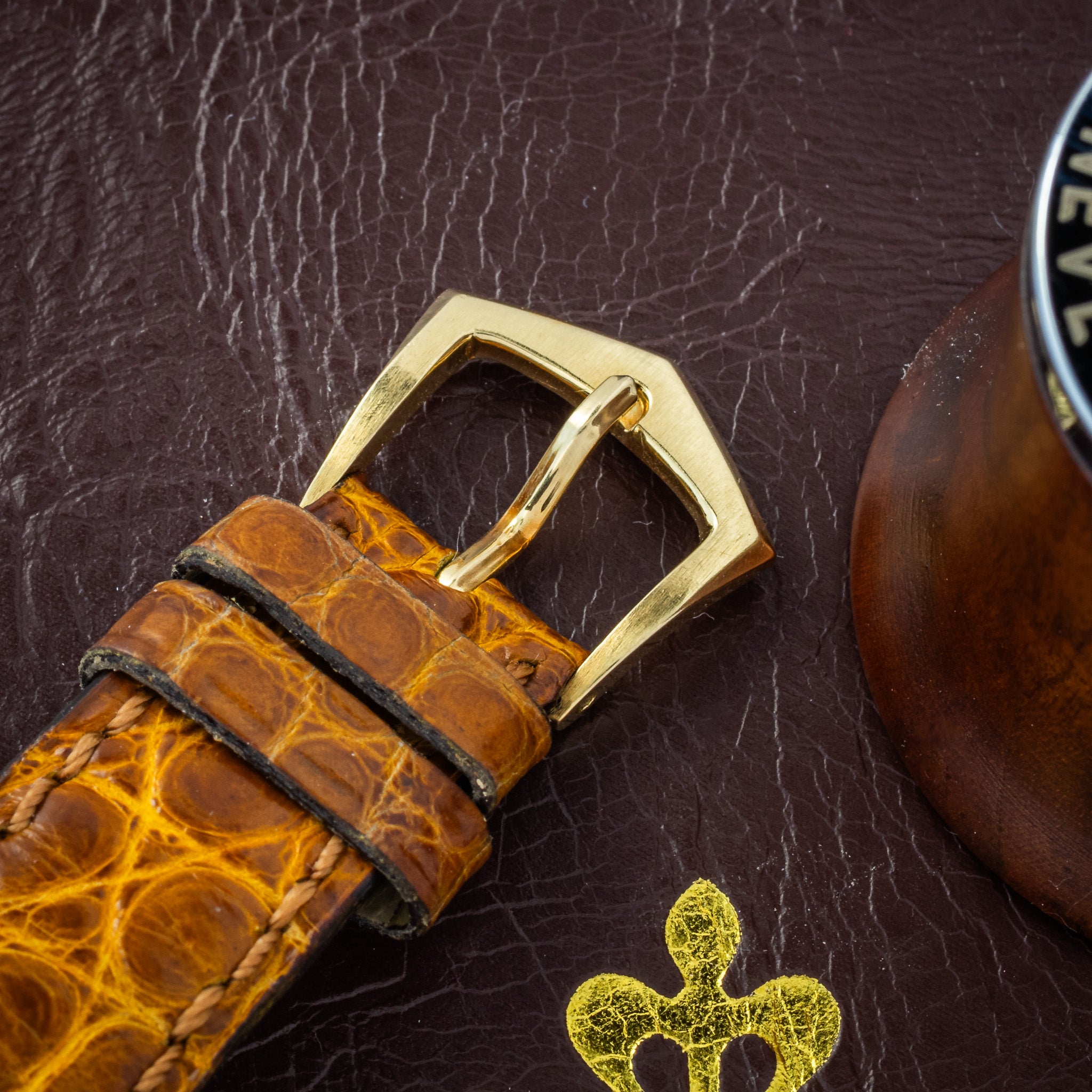
Patek Philippe brown leather strap stamped “Cousu Main” (hand-stitched) and bearing Camille Fournet maker’s mark; strap likely exotic skin and shows wear consistent with age and use. Fitted with a Patek Philippe buckle
Accompanied By
Original outer box, inner presentation box, leather wallet, and period Patek Philippe
WRISTORIAN Perspective
The Reference 3919 occupies a singular place in the modern history of Patek Philippe. Introduced in 1985, it did more than add another Calatrava reference to the catalogue; it represented a moment of deliberate reaffirmation. The Swiss watch industry had only recently begun to emerge from the upheaval of the quartz crisis, and many historic manufactures were still redefining their identity. Patek Philippe’s response was not experimentation or spectacle, but a renewed commitment to proportion, classical design language, and the disciplined aesthetics that had long defined the Calatrava lineage.
The defining feature of the reference is, of course, the Clous de Paris bezel. Executed in twin rows of sharply cut hobnail guilloché, the bezel frames the dial with architectural precision, catching light through hundreds of minute pyramid studs. While the motif traces its lineage to earlier Patek Philippe references—including variations seen in the mid-century Calatrava family—the 3919 transformed it into a defining modern signature. For an entire generation of collectors encountering the brand in the late twentieth century, the image of a Calatrava with a Clous de Paris bezel became synonymous with Patek Philippe itself.
Equally important is the reference’s scale and mechanical philosophy. At 33 millimeters, powered by the manually wound calibre 215, the 3919 adhered unapologetically to traditional dress watch proportions. During a decade in which the broader market increasingly experimented with larger case sizes and stylistic flourish, the 3919 preserved the thin, disciplined geometry that had characterized Patek Philippe’s most enduring references since the 1930s. The movement itself—thin, mechanically conservative, and precisely finished—reinforced the watch’s identity as a study in classical restraint rather than mechanical exhibition.
The longevity of the reference within the catalogue further underscores its significance. Remaining in production well into the early twenty-first century, the 3919 served as the visual ambassador of the manufacture throughout the late 1980s and 1990s. It appeared prominently in international advertising campaigns that reshaped public awareness of the brand and helped restore Patek Philippe’s global prestige after the industry’s most turbulent period. In many respects, the modern cultural identity of the Calatrava was defined during the years when the 3919 stood at the center of the collection.
Over time the reference acquired an informal cultural nickname: the “banker’s watch.” The phrase did not emerge from marketing but from observation. Professionals in finance, law, and diplomacy gravitated toward the reference because it communicated seriousness without ostentation. The watch signaled knowledge of horology and respect for tradition while remaining discreet enough to pass unnoticed in formal environments. In that sense the 3919 became not merely a product of Patek Philippe, but a subtle emblem of professional discretion.
What separates compelling surviving examples today is preservation of the very features that made the reference important. The crispness of the Clous de Paris bezel, the clarity of the dial printing, and the structural definition of the case surfaces remain the principal measures of quality. Early examples in particular reward careful scrutiny of these details, as the architectural character of the watch depends heavily on the sharpness of its engraving and the balance of its dial.
The present example reflects that standard of preservation. The hobnail bezel retains strong dimensional definition, the dial remains bright and well balanced, and the hallmark to the caseback is clearly struck. The period presentation engraving adds a subtle layer of personal history without disturbing the watch’s architectural clarity. Combined with its original accessories and careful stewardship, the watch presents as a coherent and well-preserved example of one of Patek Philippe’s most culturally significant modern references.
For collectors of vintage Patek Philippe, the Ref. 3919 represents more than a simple dress watch. It stands as the reference that carried the Calatrava into the modern era and reintroduced an entire generation to the manufacture’s philosophy of proportion and restraint. This particular example belongs to the earliest years of the reference’s production, a period when the model was first establishing the design language that would define the modern Calatrava. Now approaching four decades of age, it demonstrates how successfully the design has endured. The crisp Clous de Paris bezel, preserved dial printing, and strong hallmark allow the architecture of the watch to remain fully legible today—an object that, quite simply, has aged gracefully. For the collector seeking a historically important and quietly authoritative expression of Patek Philippe’s dress watch tradition, the Ref. 3919 remains one of the most compelling cornerstone references in the vintage Calatrava lineage.
The defining feature of the reference is, of course, the Clous de Paris bezel. Executed in twin rows of sharply cut hobnail guilloché, the bezel frames the dial with architectural precision, catching light through hundreds of minute pyramid studs. While the motif traces its lineage to earlier Patek Philippe references—including variations seen in the mid-century Calatrava family—the 3919 transformed it into a defining modern signature. For an entire generation of collectors encountering the brand in the late twentieth century, the image of a Calatrava with a Clous de Paris bezel became synonymous with Patek Philippe itself.
Equally important is the reference’s scale and mechanical philosophy. At 33 millimeters, powered by the manually wound calibre 215, the 3919 adhered unapologetically to traditional dress watch proportions. During a decade in which the broader market increasingly experimented with larger case sizes and stylistic flourish, the 3919 preserved the thin, disciplined geometry that had characterized Patek Philippe’s most enduring references since the 1930s. The movement itself—thin, mechanically conservative, and precisely finished—reinforced the watch’s identity as a study in classical restraint rather than mechanical exhibition.
The longevity of the reference within the catalogue further underscores its significance. Remaining in production well into the early twenty-first century, the 3919 served as the visual ambassador of the manufacture throughout the late 1980s and 1990s. It appeared prominently in international advertising campaigns that reshaped public awareness of the brand and helped restore Patek Philippe’s global prestige after the industry’s most turbulent period. In many respects, the modern cultural identity of the Calatrava was defined during the years when the 3919 stood at the center of the collection.
Over time the reference acquired an informal cultural nickname: the “banker’s watch.” The phrase did not emerge from marketing but from observation. Professionals in finance, law, and diplomacy gravitated toward the reference because it communicated seriousness without ostentation. The watch signaled knowledge of horology and respect for tradition while remaining discreet enough to pass unnoticed in formal environments. In that sense the 3919 became not merely a product of Patek Philippe, but a subtle emblem of professional discretion.
What separates compelling surviving examples today is preservation of the very features that made the reference important. The crispness of the Clous de Paris bezel, the clarity of the dial printing, and the structural definition of the case surfaces remain the principal measures of quality. Early examples in particular reward careful scrutiny of these details, as the architectural character of the watch depends heavily on the sharpness of its engraving and the balance of its dial.
The present example reflects that standard of preservation. The hobnail bezel retains strong dimensional definition, the dial remains bright and well balanced, and the hallmark to the caseback is clearly struck. The period presentation engraving adds a subtle layer of personal history without disturbing the watch’s architectural clarity. Combined with its original accessories and careful stewardship, the watch presents as a coherent and well-preserved example of one of Patek Philippe’s most culturally significant modern references.
For collectors of vintage Patek Philippe, the Ref. 3919 represents more than a simple dress watch. It stands as the reference that carried the Calatrava into the modern era and reintroduced an entire generation to the manufacture’s philosophy of proportion and restraint. This particular example belongs to the earliest years of the reference’s production, a period when the model was first establishing the design language that would define the modern Calatrava. Now approaching four decades of age, it demonstrates how successfully the design has endured. The crisp Clous de Paris bezel, preserved dial printing, and strong hallmark allow the architecture of the watch to remain fully legible today—an object that, quite simply, has aged gracefully. For the collector seeking a historically important and quietly authoritative expression of Patek Philippe’s dress watch tradition, the Ref. 3919 remains one of the most compelling cornerstone references in the vintage Calatrava lineage.
Service & Operation
Service History
Serviced July 2025
Operational Status
Observed running and setting correctly at the time of cataloguing
