
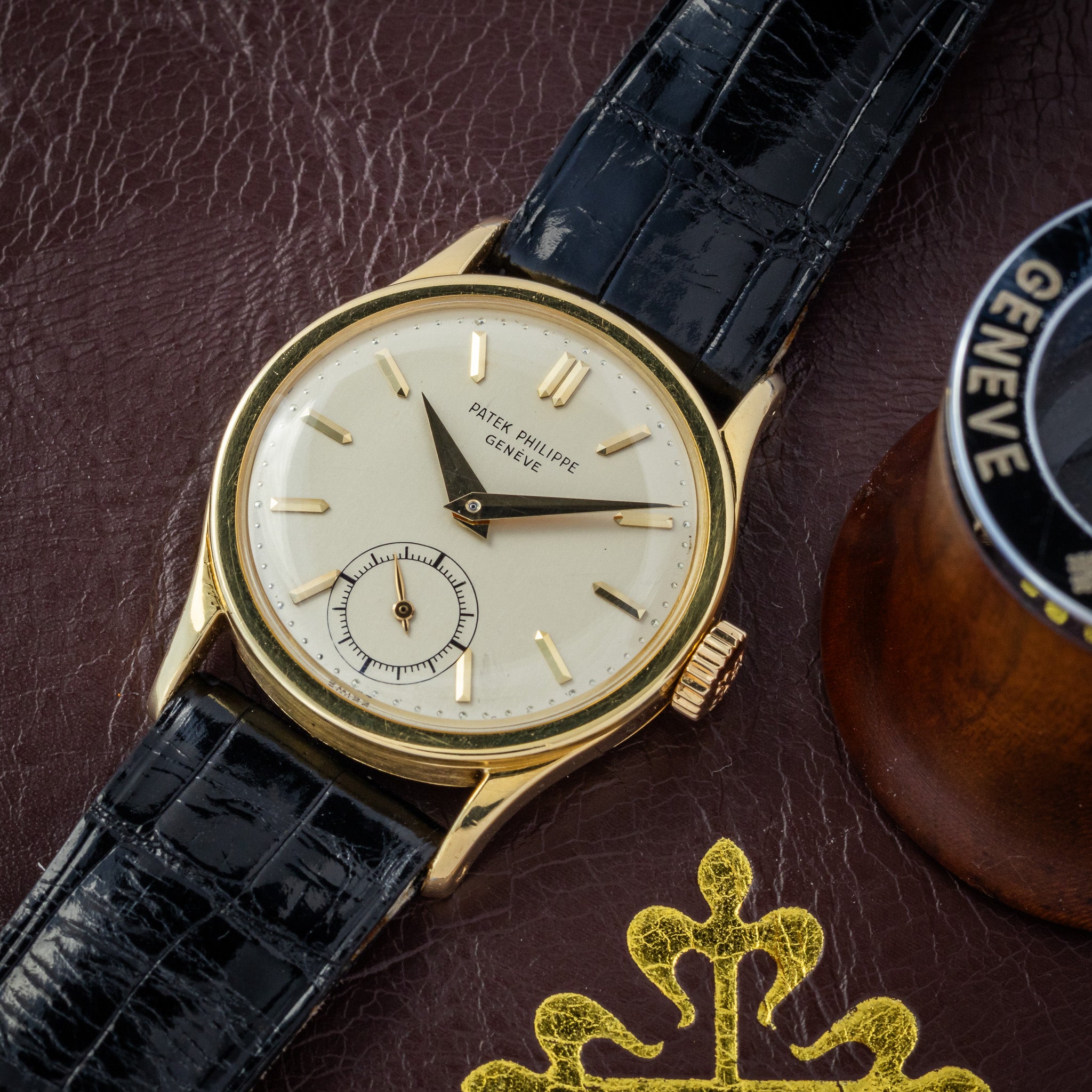


Patek Philippe Ref. 96J Calatrava, 1953
 Trusted Globally by Collectors
Lifetime Guarantee of Authenticity
Complimentary Fully Insured Shipping
Choose options
Timepiece Information
Patek Philippe Reference 96J in 18K yellow gold, produced in 1953 and sold on May 11 of that year, as confirmed by the accompanying Extract from the Archives.
Silvered opaline dial with applied yellow gold baton hour markers and subsidiary seconds at six o'clock. The dial exhibits the restrained composition characteristic of mid-century Calatrava examples and features the raised Patek Philippe signature executed in enamel—a detail associated with earlier production of the reference. The dial surface appears well preserved, presenting with balanced tone and clear printing.
The 30.5 mm yellow gold case reflects the classical proportions established by the Calatrava family, with slender 18 mm lugs and a snap-on caseback (fond clipsé). Case surfaces retain strong structural definition, and the hallmark remains crisp and clearly struck.
Manually wound Patek Philippe Calibre 12-120 with subsidiary seconds and Geneva Seal finishing.
Factory serviced by Patek Philippe on May 1, 2025.
Condition: The watch presents in beautifully preserved vintage condition, with crisp case definition and a strong hallmark. The dial appears untouched, and the raised enamel Patek Philippe signature remains striking. Overall presentation is refined and highly attractive on the wrist.
When Patek Philippe introduced the reference in 1932, the manufacture itself was entering a decisive new chapter. That same year, the Stern family assumed control of the company and began redefining its direction after the turbulence of the early twentieth century. The Ref. 96 emerged as the architectural expression of that transition: restrained, lucid, and governed by proportion rather than ornament. Drawing upon the disciplined visual language of early modernism, it established the design vocabulary that would shape Patek Philippe’s dress watches for generations.
By 1953, that vocabulary had reached one of its clearest and most mature expressions. The measured diameter, slender bezel, balanced lugs, and subsidiary seconds create a watch whose visual logic feels complete rather than styled. On paper, 30.5 mm may sound modest to modern eyes; on the wrist, the proportions resolve differently. The extended 18 mm lug span gives the case a broader stance and a sense of architectural presence that has made the Ref. 96 one of the most studied templates in twentieth-century watch design.
This particular example expresses those qualities with unusual clarity. The accompanying Extract from the Archives confirms production in 1953 and sale on May 11 of that year, placing the watch squarely within the mature mid-century period of Ref. 96 production. Its silvered opaline dial remains notably composed, with applied gold baton markers, subsidiary seconds at six o’clock, and the raised enamel Patek Philippe signature that collectors rightly regard as one of the most charming and telling details of earlier examples. The crisp hallmark, strong case definition, and recent 2025 factory service all support the same conclusion: this is a watch whose physical integrity and historical character remain comfortably aligned.
For collectors who appreciate the references that define a manufacture rather than simply participate in it, the Ref. 96 occupies essential ground. It represents the original Calatrava idea in its purest and most influential form—disciplined, elegant, and enduringly correct. Examples preserved in this manner offer something increasingly difficult to find: not spectacle, but authority. As a result, this is the kind of watch that rewards repeated study, wears with complete naturalness, and belongs easily in any serious collection of vintage Patek Philippe.

