Skip to content

Your Cart

Your cart is empty

Patek - Ref 96A - Circa 1932-1935
Long Signature Dial with Arabic Numerals
Stainless Steel - François Borgel Case
SOLD

Lifetime Guarantee of Authenticity
Complimentary Insured Worldwide Shipping
Three-Day Inspection Window
Trusted Globally by Collectors
Patek -  Ref 96A - Circa 1932-1935 <br>Long Signature Dial with Arabic Numerals <br> Stainless Steel - François Borgel Case <br>SOLD
Patek - Ref 96A - Circa 1932-1935
Long Signature Dial with Arabic Numerals
Stainless Steel - François Borgel Case
SOLD

Timepiece Information

Catalogue Notes

Patek Philippe Reference 96A, produced during the early period of Calatrava manufacture and fitted with the manually wound Calibre 12-120, the movement that would become the mechanical foundation of the reference throughout the 1930s.


Introduced in 1932, the Reference 96 established the architectural language of the Calatrava line, defined by its restrained round case, slender bezel, and balanced lug geometry. At approximately 30.5 mm in diameter, the model set the dimensional standard for Patek Philippe's dress watches for decades, emphasizing proportion and clarity rather than ornamentation.


The movement employed in the reference, the manually wound Calibre 12-120 with subsidiary seconds, represents one of Patek Philippe's earliest fully developed wristwatch calibres. Thin, manually wound, and finished to the standards of the period, it became one of the manufacture's most enduring movements and was produced for more than two decades.


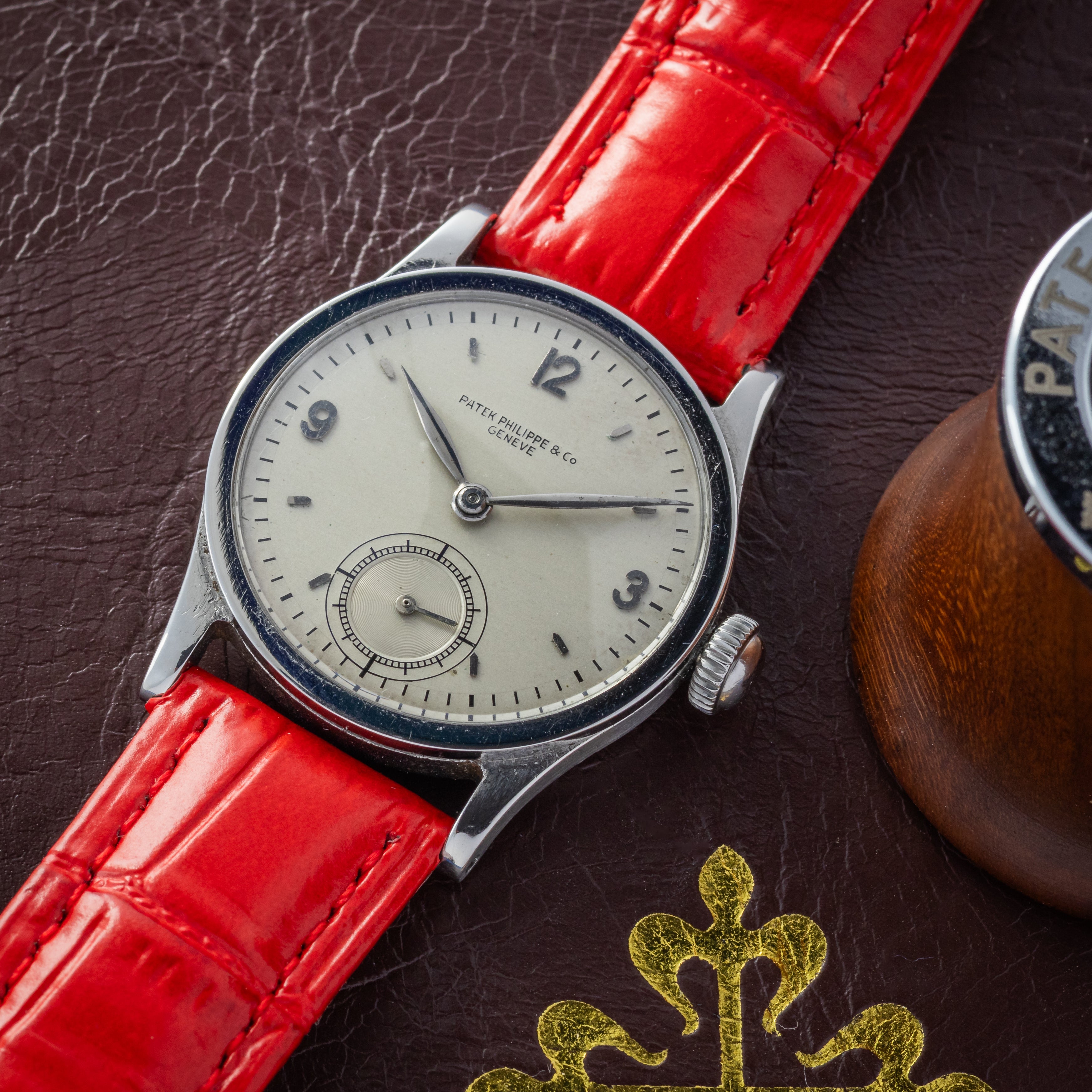
The present example is configured with a silvered dial displaying a warm ivory tonality, executed with applied Arabic numerals at the quarter hours and baton markers for the remaining positions. The dial bears the raised enamel Patek Philippe & Co long signature above the GENEVE designation, a format associated with earlier examples of the reference, and incorporates a chemin de fer minute track with subsidiary seconds at six o'clock.


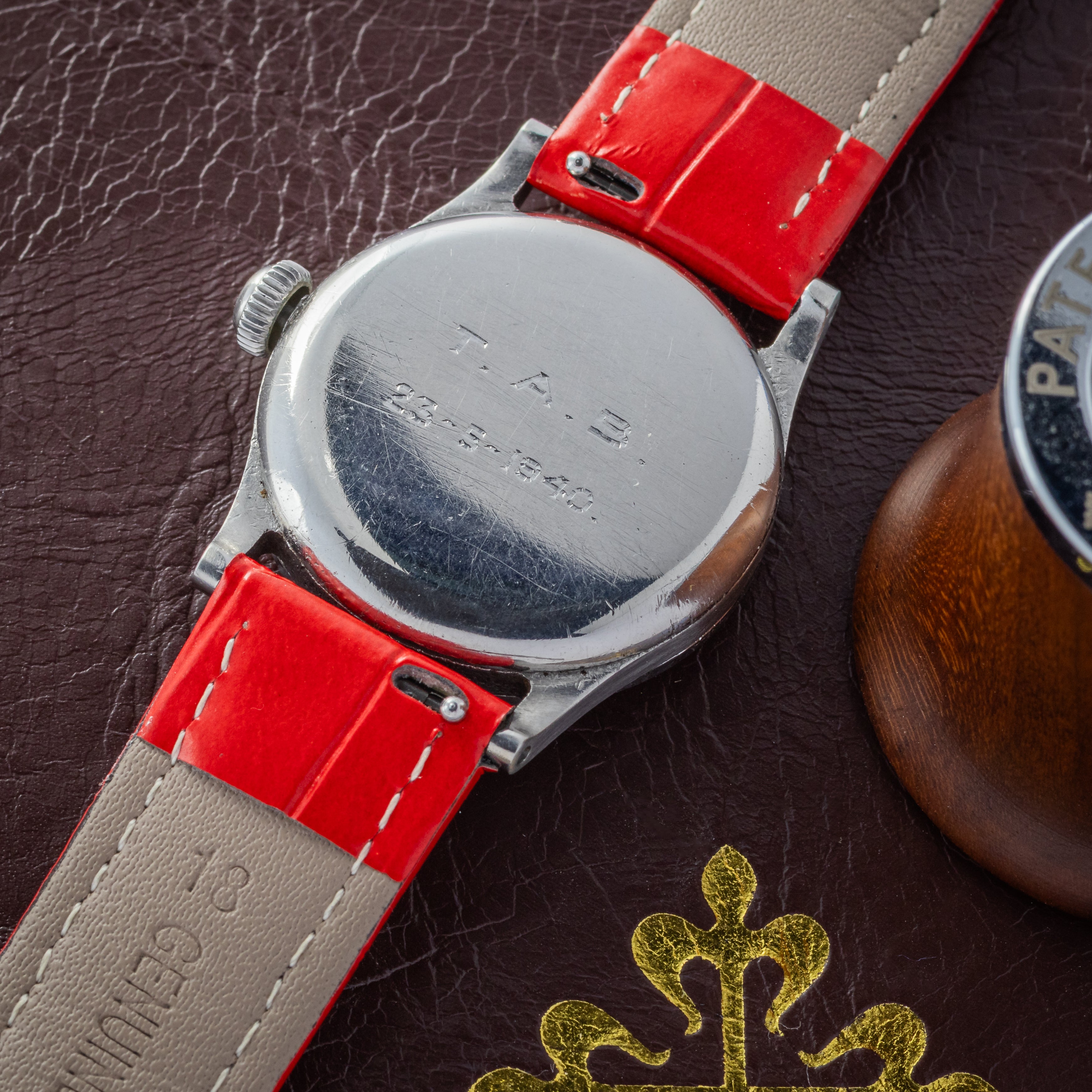
The stainless steel case is constructed with a snap-back caseback (fond encliqueté) and is engraved internally with the period presentation inscription "T.A.B. 23-5-1940." Stainless steel examples of the Ref. 96 were produced in considerably smaller numbers than their gold counterparts, reflecting the manufacture's more limited use of the material during the early decades of wristwatch production.


Condition: The watch presents in well-preserved vintage condition with honest surface wear consistent with age and use. The case retains strong overall geometry, the dial displays an attractive and even tone with clear printing and well-defined applied markers, and the overall presentation remains balanced and appealing on the wrist.

Specifications & Accompaniments
Reference
Patek Philippe Reference 96A
Year of Production
Circa 1932–1935, based on movement number
Original Date of Sale
Unknown
Case Material
Stainless Steel
Dimensions
Absolutely. Here is the refined, auction-catalogue-consistent Specifications & Accompaniments block in proper WRISTORIAN style: tightened, standardized, and elevated without overreaching. Refined Product Metafields Reference Patek Philippe Reference 96A Year of Production Circa 1932–1935, based on movement number Original Date of Sale Unknown Case Material Stainless steel Dimensions 30.5 mm diameter; 18 mm lug width; 37.5 mm lug-to-lug; 9 mm thickness
Dial
Silvered dial with warm ivory tonality, raised enamel Patek Philippe & Co long signature, GENEVE designation, applied Arabic numerals at 12, 3, 6, and 9, applied baton hour markers, chemin de fer minute track, and subsidiary seconds at 6 o’clock
Movement
Manually wound Patek Philippe Calibre 12-120 with subsidiary seconds
Caseback
Snap-back caseback (fond encliqueté) engraved “T.A.B. 23-5-1940”
Strap / Bracelet / Buckle
Aftermarket semi-gloss red leather strap fitted with an unsigned aftermarket buckle
Accompanied By
What appears to be the original Patek presentation box and WRISTORIAN presentation packaging
WRISTORIAN Perspective
The Reference 96 occupies a singular position in the history of Patek Philippe. Introduced in 1932, it inaugurated the Calatrava line and established the visual language that would come to define the manufacture’s dress watches for nearly a century. Its disciplined round case, slender bezel, and balanced lug architecture reflected a decisive shift away from the decorative traditions of pocket watch design toward a new ideal of modern restraint. In that sense, the Ref. 96 is not simply an early Calatrava—it is the watch that defined what a Calatrava would be.

The present example belongs to the earliest generation of this reference, produced during the formative years when the Calatrava concept was still new within the manufacture’s catalogue. Watches from this period represent the first sustained effort by Patek Philippe to develop a serially produced wristwatch built around clarity of proportion rather than complication or ornament. In many respects, these early pieces embody the moment when the firm fully embraced the wristwatch as the future of horology.

Several characteristics reinforce that early identity. The dial bears the raised enamel Patek Philippe & Co long signature above the GENEVE designation, a format associated with earlier production before the shorter signature became standard. The applied Arabic numerals at the quarter hours introduce a degree of visual dynamism rarely encountered on the otherwise austere Ref. 96, while the baton markers maintain the measured symmetry that defines the Calatrava aesthetic. Over time the silvered surface has developed a warm ivory tonality that complements the steel case and lends the watch a particularly pleasing period presence.

Stainless steel examples of the Ref. 96 are themselves an intriguing chapter in early Calatrava production. During the 1930s Patek Philippe produced the reference primarily in precious metals, with steel appearing only occasionally. When encountered in combination with early dial configurations such as the long signature and Arabic quarter numerals, the result is a watch that expresses the Calatrava idea in a particularly pure and utilitarian form—architecture without ornament, proportion without excess.

For collectors drawn to the origins of Patek Philippe’s most enduring design, watches from this early phase of Ref. 96 production hold a special fascination. They represent the moment when the manufacture’s philosophy of restrained elegance first took shape in wristwatch form. Preserved with honest character and strong visual presence, the present example offers a compelling opportunity to experience that formative chapter directly on the wrist—an early expression of the Calatrava that remains as thoughtful and balanced today as it was nearly a century ago.
Service & Operation
Service History
Serviced on November 26, 2025
Operational Status
Observed running and setting normally at the time of cataloguing. The movement has not been tested for accuracy over extended periods or for power reserve duration, and may require servicing at the buyer’s discretion. As is customary with vintage timepieces, future performance cannot be guaranteed.