
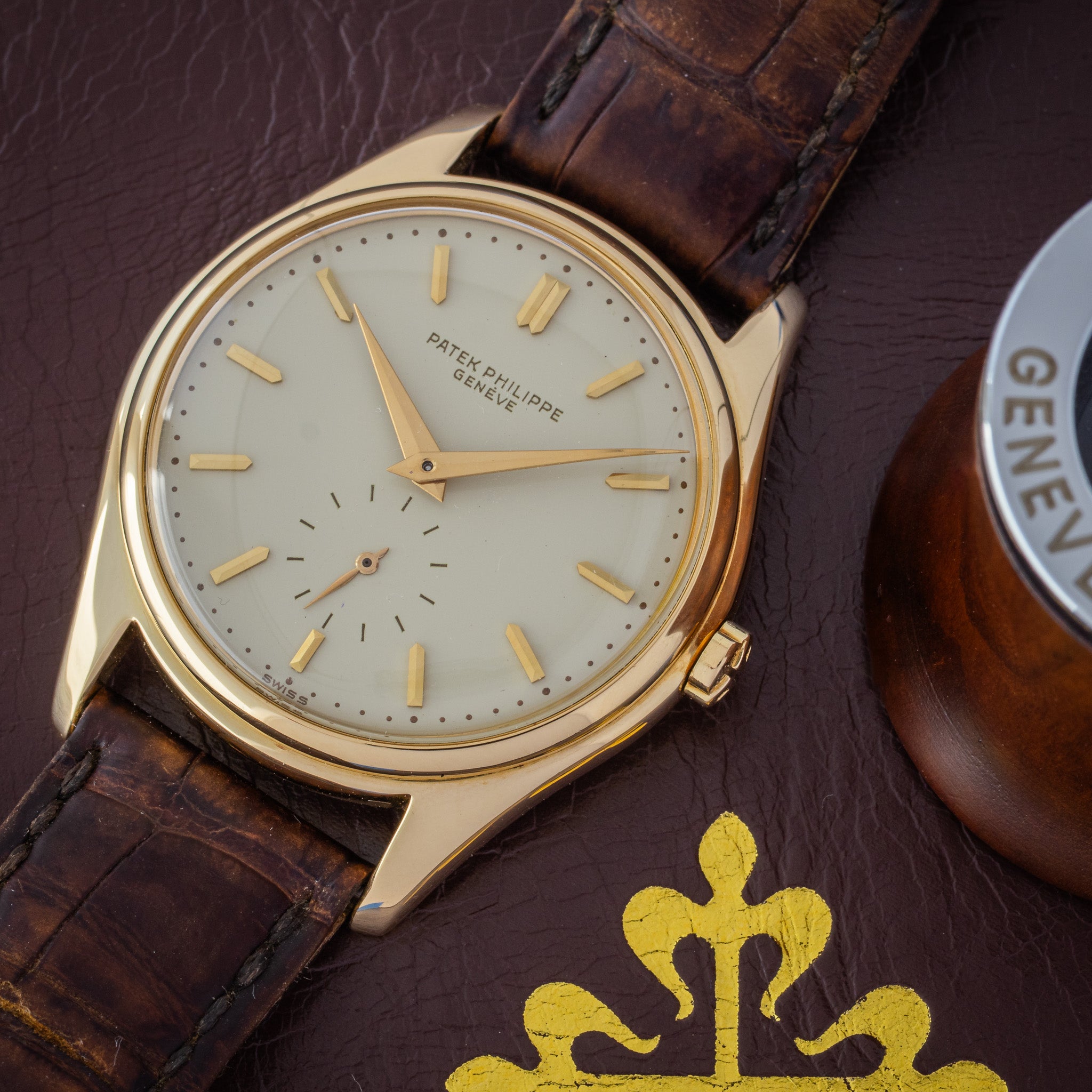


Patek Philippe Reference 2526, introduced in 1953, represents a foundational moment in the manufacture's history as its first serially produced self-winding wristwatch, powered by the celebrated Caliber 12-600 AT. This technically advanced movement, featuring bi-directional winding, a Gyromax balance, and a full 18k gold rotor, established a new benchmark for automatic wristwatch construction within the Patek Philippe catalogue.
Produced through approximately 1960, the reference is distinguished by its refined proportions and robust construction, including a decagonal screw-back case developed to improve resistance to dust and moisture while preserving the restrained elegance of mid-century Patek Philippe design.
A defining characteristic of the reference is its fired enamel dial. Unlike lacquered or plated dials typical of the period, these dials were kiln-fired, fusing the dial surface and printed elements into a glass-like layer over a metal base. The result is a dial of remarkable depth and visual stability, widely regarded as one of the most beautiful dial executions produced in serial wristwatch manufacture.
The present example represents a later execution within the early production period of the reference, featuring applied yellow gold baton hour markers affixed directly to the dial rather than secured by rivets. This construction reflects the evolution of the reference as production matured, while retaining the essential aesthetic language that defines the model.
The dial displays a subsidiary seconds register at six o'clock, a finely executed outer minute track composed of printed dot markers, and an applied gold "Patek Philippe Genève" signature with accent. The overall composition remains balanced and visually coherent, with strong legibility and well-preserved printing.
Close inspection under magnification reveals fine hairline cracks within the enamel surface. These are subtle, consistent with the aging characteristics occasionally observed in fired enamel dials of the period, and are largely imperceptible to the naked eye. Importantly, the dial retains its structural integrity, clarity, and aesthetic presence, presenting attractively on the wrist.
The 18k yellow gold case retains the characteristic architecture of the reference, including a broad polished bezel and slender tapered lugs. Hallmarks remain visible, supporting the preservation of the case geometry, while the caseback remains free of engraving.
Condition: The watch presents in attractive vintage condition with strong case proportions and a well-preserved dial displaying fine hairline enamel cracking visible only under magnification, while remaining visually cohesive and appealing in normal viewing conditions.
