
Patek Philippe Ref. 2526J First-Series Calatrava with Factory Diamond Dial, 1953
 Trusted Globally by Collectors
Lifetime Guarantee of Authenticity
Condition Clearly Documented
Complimentary Fully Insured U.S. Shipping
Fully Insured International Shipping Quoted
Trusted Globally by Collectors
Lifetime Guarantee of Authenticity
Condition Clearly Documented
Complimentary Fully Insured U.S. Shipping
Fully Insured International Shipping Quoted
Choose options
Timepiece Information
Introduced in 1953, the Patek Philippe Reference 2526 represents one of the most important technical milestones in the history of the manufacture as the first wristwatch model produced by Patek Philippe to house a self-winding movement. The reference debuted the celebrated Caliber 12-600, a highly refined automatic movement featuring bi-directional winding, a Gyromax balance, and a full-sized 18k gold rotor. At the time of its introduction the movement represented one of the most sophisticated automatic calibers produced in Switzerland and marked the beginning of Patek Philippe's modern lineage of self-winding wristwatches.
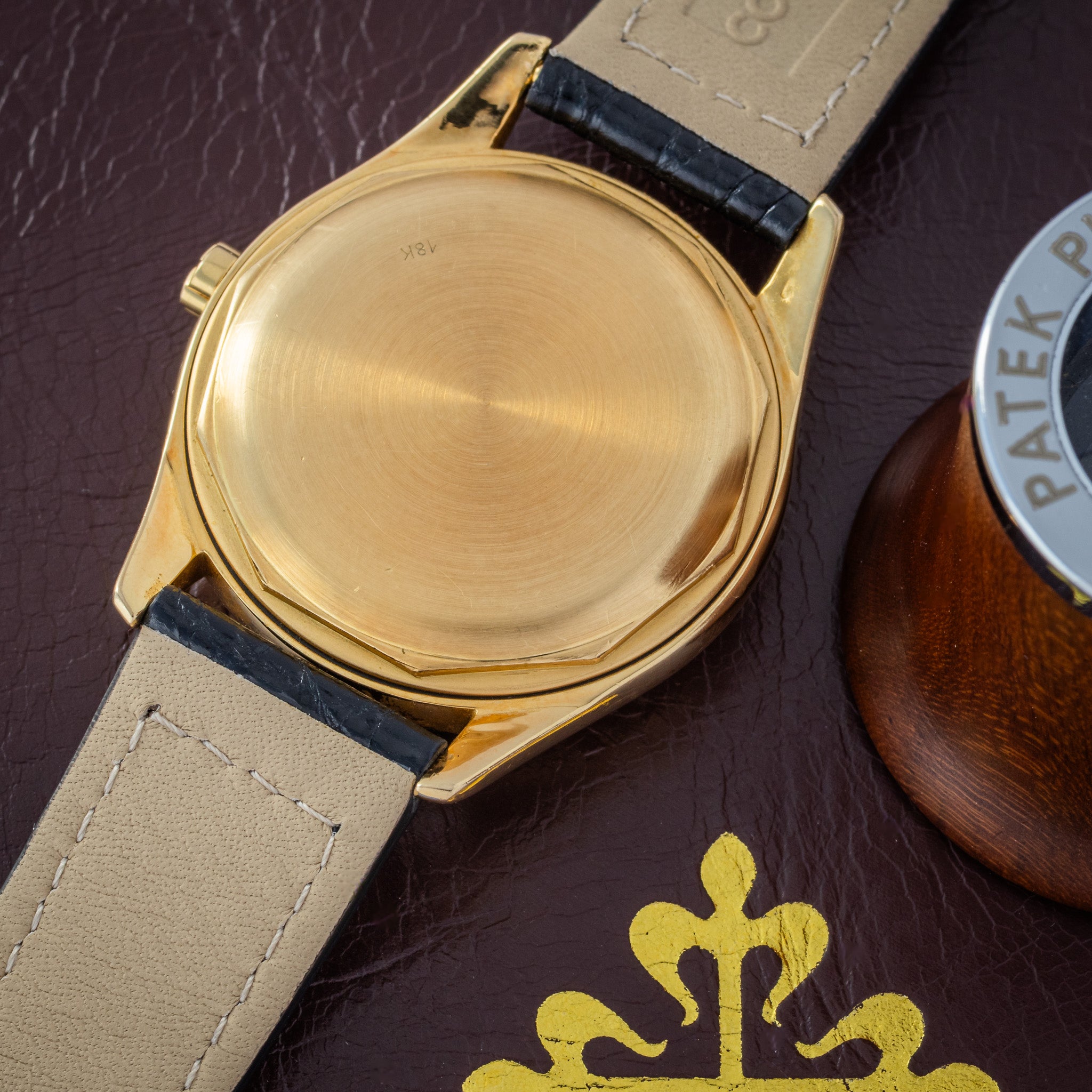
Produced between approximately 1953 and 1960, the Reference 2526 was distinguished by both its mechanical innovation and its refined construction. The case measures approximately 35.8 mm in diameter and incorporates the characteristic decagonal screw-back architecture (fond vissé) developed to improve resistance to dust and moisture. These cases were produced exclusively in precious metals and represent one of the earliest examples of Patek Philippe combining advanced automatic movement technology with robust water-resistant case construction.
The present example was manufactured in 1953 and sold on November 26 of that same year, as confirmed by the accompanying Extract from the Archives. Watches from this earliest production period represent the formative phase of the reference and correspond to the initial introduction of the Caliber 12-600 automatic movement within the Patek Philippe catalogue. Early production examples from the inaugural year of the reference remain particularly notable within the broader history of the model.
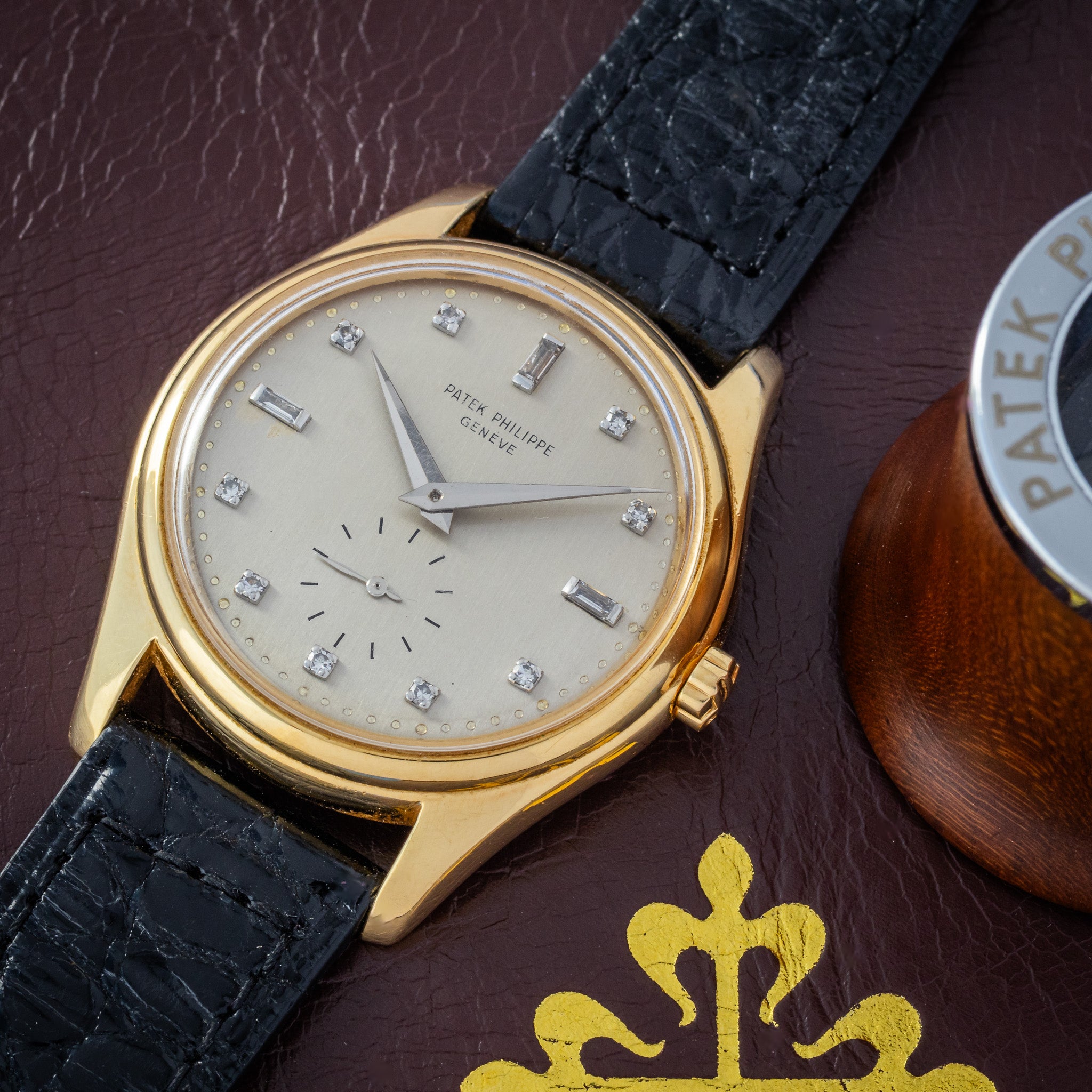
In contrast to the more widely encountered fired enamel dials associated with many early examples of the reference, the present watch features a silvered metal dial set with diamond hour markers. The accompanying Extract from the Archives confirms the diamond hour marker configuration as original to the watch at the time of delivery. The dial displays baguette-cut diamonds at the 12, 3, and 9 o'clock positions and round brilliant diamonds at the remaining hours, including the marker above the subsidiary seconds register at six o'clock. The dial further features a finely printed Patek Philippe Genève signature with accent, an outer minute track composed of recessed metallic dot markers with slightly larger dots marking the hours, and factory original white gold dauphine hands.
Diamond-set dial configurations on the Reference 2526 were produced in very small numbers and are rarely encountered within the broader production of the model. Period examples were typically executed as special-order variants and are known in both enamel and silvered dial forms. According to guidance from a noted scholar of vintage Patek Philippe, the present watch is believed to represent the earliest known documented example of a diamond-set dial configuration for the reference. Although additional examples are known, such jeweled dial executions remain exceptionally uncommon and occupy a particularly rare and historically intriguing position within Reference 2526 production.
The 18k yellow gold case retains the characteristic architecture of the reference with a broad polished bezel and slender tapered lugs. A deep Swiss gold hallmark is present beneath the lug at approximately the 11 o'clock position, supporting the preservation of the case geometry. The decagonal screw-back caseback remains free of presentation engraving. The watch is powered by the self-winding Caliber 12-600 with subsidiary seconds and was serviced on April 18, 2025.
Condition: The watch presents in attractive vintage condition with strong case geometry and well-defined lugs. The silvered dial appears bright and well preserved, and the diamond hour markers remain secure and evenly aligned. The printed signature and minute track remain clearly visible. The case retains visible Swiss hallmarks and the crown operates smoothly when winding and setting. The watch was observed setting and running normally at the time of cataloguing.
Today the 2526 occupies a special place within the vintage Patek Philippe canon. Collectors regard it not simply as an early automatic watch, but as one of the foundational references of the modern era. Its proportions remain remarkably contemporary, the case construction introduced improved water resistance through its distinctive screw-back architecture, and the movement established a technical benchmark that influenced the manufacture's automatic watches for decades to follow. For many collectors, the Reference 2526 represents the point where mechanical innovation and classical design met in perfect balance.
Within that already celebrated reference, however, certain dial configurations elevate the watch into an entirely different realm of rarity. The present example belongs to that extraordinary category. Instead of the more commonly encountered fired enamel dial associated with many early examples, this watch features a silvered dial set with diamond hour markers. The configuration introduces a subtle brilliance to the design while preserving the disciplined visual balance that defines Patek Philippe's mid-century aesthetic. The diamonds are integrated with restraint rather than excess, allowing the watch to retain the quiet elegance that collectors associate with the finest examples of the reference.
Particularly remarkable is the configuration of the dial itself. Diamond-set dials on the Reference 2526 were produced only in very small numbers and were typically reserved for special orders. According to guidance from a respected scholar of vintage Patek Philippe, the present watch is believed to represent the earliest known documented diamond-dial configuration produced for the reference. The watch surfaced through the grandson of the original owner, who purchased the piece new in 1953. In retrospect, the acquisition proved remarkably prescient: what was once simply an elegant and luxurious Patek Philippe has, over the course of seven decades, come to be recognized as an exceptionally uncommon dial configuration within the manufacture’s first automatic wristwatch reference.
The appeal of the watch extends beyond rarity alone. On the wrist, the Reference 2526 continues to demonstrate why it has become one of the most admired vintage Patek Philippe designs ever produced. The case proportions remain beautifully balanced, the dial presents with clarity and refinement, and the diamond markers add a refined visual rhythm that reveals itself subtly as the light moves across the surface. Handling the watch reinforces the sense of quality that collectors expect from this reference—the crown engages smoothly and confidently, and the watch retains the quiet mechanical assurance that made the caliber 12-600 AT such a milestone in the history of the manufacture.
For the collector who studies vintage Patek Philippe closely, the Reference 2526 is more than simply another dress watch. It represents the birth of the manufacture's automatic era and stands as one of the most influential references of the twentieth century. Within that lineage, unusual dial configurations and early production examples are the watches that collectors pursue patiently over many years. A first-year 1953 example with a confirmed factory diamond dial - believed to be among the earliest known example - occupies a particularly rarefied position within that landscape.
Any serious Patek Philippe collection will almost certainly include a Reference 2526. When the opportunity arises to acquire a first-year 1953 example with a diamond dial of such extraordinary rarity, preserved through decades of family ownership, the reference moves beyond being simply representative of the model. It becomes one of those watches that collectors proudly place at the center of a collection—an object that reflects both the technical history of the manufacture and the enduring fascination of its most exceptional creations.

