
Water Resistance and Vintage Watches
Original publication: August 2026
Revision: September 2026
8-Minute Read
Executive Summary
Water resistance is not permanently preserved by an engraving, reference number or screw-down caseback. It is the present performance of a system that can include the case, crown, crown tube, crystal, pushers, correctors, caseback, gaskets and their sealing surfaces. Age, impact, corrosion, replacement parts and every opening of the case can change that system.
This creates a decisive distinction between historical capability and present suitability. Patek Philippe References 565 and 1463 were important because their water-resistant construction represented real engineering progress. That history deserves recognition, but it does not establish that an individual example remains suitable for immersion many decades later.
A competent pressure test can show that a watch sealed under defined conditions at a particular moment. It cannot make the result permanent or decide whether the benefit of water exposure justifies the possible loss. Leakage in a modern sports watch may produce a repair bill. In an important vintage watch, it can irreversibly alter an original dial, hands, luminous material, movement and case interior. The governing question is therefore not merely whether the watch may resist water, but how much confidence this particular watch deserves and what may be lost if that confidence proves misplaced.
Introduction
Earlier catalogues often used waterproof or étanche. Modern manufacturers and standards generally prefer water-resistant, which more accurately acknowledges limits. A vintage case may have been engineered to resist water when new, yet subsequently opened, polished, corroded or fitted with replacement crowns, crystals and gaskets.
This White Paper examines the system, the ratings, the effects of age, the value and limits of pressure testing, and the consequences of failure. Its governing principle is straightforward: water resistance must be maintained and verified, and verification does not eliminate the need for judgment.
1. Water Resistance as a System and Historical Achievement
Water enters through paths, not labels. Depending on the watch, those paths may include the middle case and caseback, crown and tube, crystal and bezel, chronograph pushers, calendar correctors and other openings. Each interface must remain adequately sealed. A screw-down crown secures one opening; it cannot compensate for a damaged gasket, worn tube, poorly seated crystal or compromised caseback.
Modern Patek Philippe watches illustrate the system approach. Patek identifies the middle case, bezel, sapphire caseback, gasket and pushers among the assembled components and currently tests certified water-resistant watches at a unified overpressure of 3 bar, corresponding to 30 metres.1 That statement concerns watches assembled, sealed and tested to a defined contemporary standard.
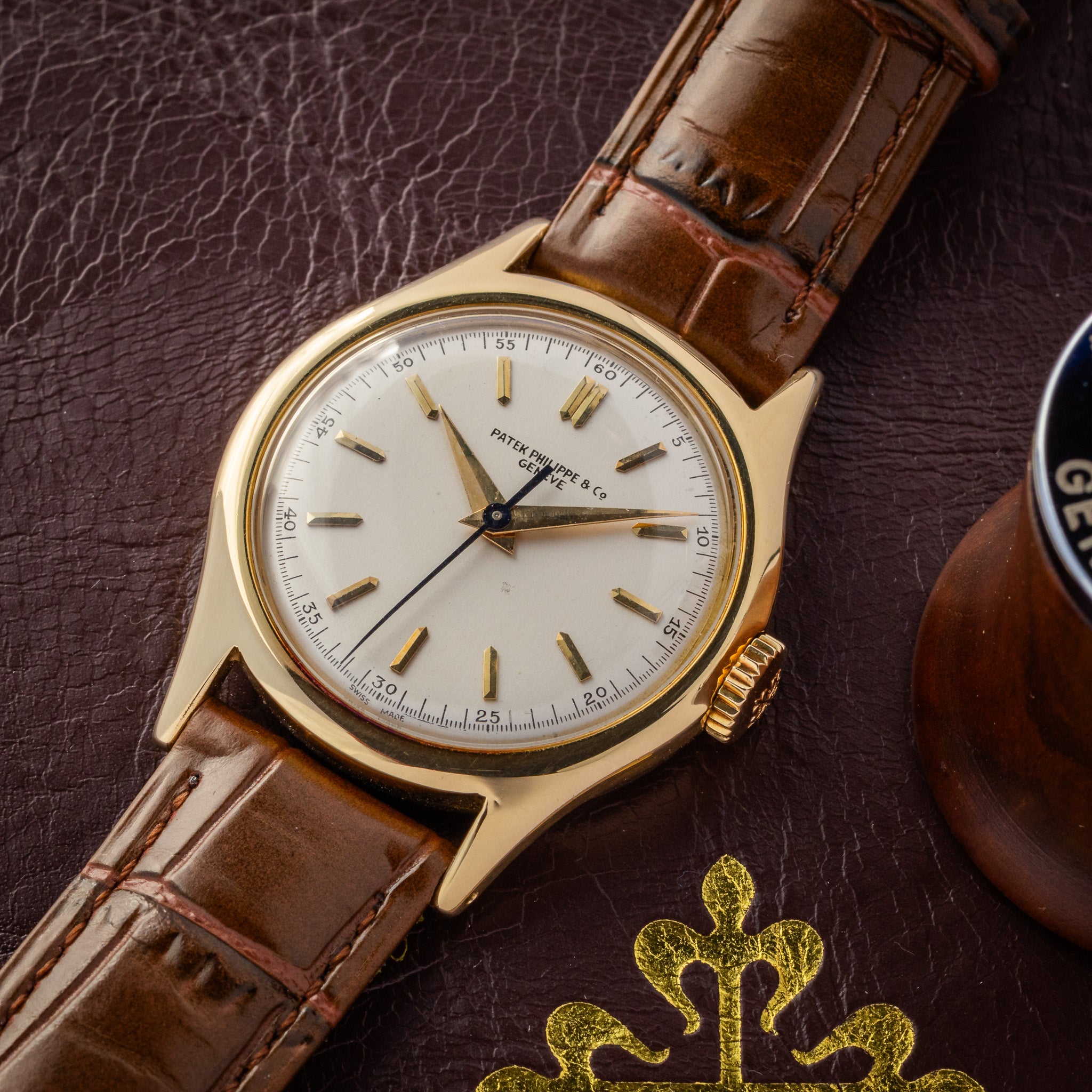
The historical achievement remains important. Introduced in 1938, Patek Philippe Reference 565 used a robust two-piece screw-back case made by Taubert, successor to François Borgel and a specialist in water-resistant cases.2 Reference 1463 extended the idea to a chronograph; Phillips describes it as Patek Philippe's first water-resistant chronograph, introduced around 1940.3
Those references matter partly because sealed construction was technically consequential when they were created. Their original specifications describe design and delivery. Present water resistance belongs to the physical watch now in hand. Historical importance is not a continuing warranty.
2. What ATM, Bar and Metres Actually Communicate
Modern watches commonly express water resistance in bar, atmospheres or metres. In ordinary industry shorthand, 1 bar approximates the pressure added by 10 metres of water depth. The markings provide a useful translation, but not universal permission for particular activities.
| Rating | Common depth marking | Broad contemporary context |
|---|---|---|
| 3 bar / 3 ATM | 30 m | Basic or manufacturer-defined everyday water resistance |
| 5 bar / 5 ATM | 50 m | Greater everyday water resistance, subject to manufacturer instructions |
| 10 bar / 10 ATM | 100 m | Swimming and recreational water exposure on many watches |
| 20 bar / 20 ATM | 200 m | Sports, swimming and more serious water use on appropriately designed watches |
| 30 bar+ / 30 ATM+ | 300 m+ | Increasingly specialized sports and diving construction |
Patek Philippe demonstrates why generic charts are insufficient. Under its current standard, Patek says certified 3-bar watches may be used for washing hands, showering, bathing, swimming, aquatic activities and diving to 30 metres.4 Other manufacturers give more restrictive instructions for similar markings. The number is inseparable from the design, test protocol and manufacturer guidance. With an older watch lacking current model-specific instructions, become more conservative, not less.
3. The Specification Stays the Same. The Watch Does Not.
Imagine two watches originally rated to 10 bar. One is new. The other has endured heat, salt water, chlorine, impacts, service and repeated case opening. Their markings remain identical; their actual resistance may not.
Gaskets harden and lose elasticity. Crowns, tubes and threads wear. A shock can disturb a crystal. Polishing can alter precisely manufactured surfaces, while corrosion can create a leakage path too small to see without disassembly. Manufacturer guidance recognizes this change. Seiko states that water resistance is not permanently guaranteed and may be affected by aging gaskets or deformation after accidental shock.5
A replacement gasket may restore one part of the system while a worn tube, distorted caseback or imperfect crystal seat remains. A component that fits may not duplicate the original geometry or material. This matters with a ten-year-old sports watch and becomes decisive with a watch seven or eight decades old.
4. What Pressure Testing Can and Cannot Establish
A qualified watchmaker can test an appropriate watch to determine whether its case seals under defined conditions. Modern dry testers measure minute case deformation under vacuum and positive air pressure without immersing the watch.6 Dry testing is attractive when actual immersion would create unacceptable risk, but the method and pressure must suit the watch's construction and condition.
A successful test is meaningful evidence. It does not establish that the watch will remain sealed indefinitely, that controls may be operated while wet, that a future impact will not disturb the system or that heat, soap, salt and chlorine are irrelevant.
If the case is opened after testing, the earlier result should be treated as obsolete until the seal is restored and verified. A collector anticipating exposure should ask for the actual result, test method and pressure rather than accept the vague statement that the watch was "checked." Testing is a snapshot, not immortality, and it cannot decide whether the owner should accept the remaining risk.
5. Real-World Exposure and the Collector's Asymmetry
Laboratory conditions are controlled. Ownership is not. Pools introduce chlorine; oceans add salt and sand; showers bring heat, soap and directed water; saunas and hot tubs add steam, chemicals and temperature. Manufacturers may reasonably differ because their guidance concerns different watches, tests and maintenance assumptions. Patek permits showering and bathing with its current certified watches, while Seiko advises against baths and saunas.7
Patek also recommends rinsing an appropriate water-resistant watch after salt water or a chlorinated pool.8 That is not a reason to put an untested vintage watch under a faucet. Claims that ordinary swimming creates the equivalent of enormous depth are commonly exaggerated; ISO 22810 expressly addresses daily use and swimming.9 Condition and manufacturer guidance remain more useful than imaginary depth calculations.
That consequence creates the collector's asymmetry. Moisture may corrode the movement and permanently alter a dial, hands, luminous material and interior surfaces. A movement can often be repaired at a price. An original dial that survived seventy years may never be returned to its prior state. A tested vintage watch and a modern sports watch with the same rating therefore present different decisions even if their probabilities of leakage appear similar.
If persistent fogging or visible moisture appears, stop wearing and operating the watch and obtain qualified attention promptly. Citizen and Casio both direct owners to service when fogging does not clear or moisture is visible.10 Waiting for the evidence to disappear can consume time while corrosion develops.
6. A Collector's Decision Framework
Before exposing a vintage watch to water, ask five questions. Design: Was it intended for the proposed exposure? Condition: Are every case component and sealing surface suitable now? Verification: Was the assembled watch tested recently by a qualified watchmaker? Change: Has it been opened, impacted or repaired since? Consequence: What would be lost if water entered despite every precaution?
The first four questions address capability. The fifth addresses judgment. A watch may pass the capability test and still fail the judgment test.
Specialized dive engineering reinforces the distinction. ISO 6425 addresses divers' watches, including saturation-diving provisions.11 Rolex's 1967 Sea-Dweller used an automatic helium escape valve to address decompression after saturation diving.12 Such capability has meaning because it serves a defined use, not because every owner needs to demonstrate it.
The conservative operating rule is simple. Treat an untested vintage watch, or one opened since its last test, as not water-resistant. Do not operate crowns, pushers or correctors while wet. Do not assume one screw-down component guarantees the rest of the case. When water exposure is expected and the vintage watch is difficult to replace, wear a suitable modern watch.
These rules do not deny historical engineering or the value of testing. They recognize that preservation and demonstration are different goals. An exceptional old watch does not need to prove the capability its case possessed when new.
WRISTORIAN Perspective
Water resistance is a present physical condition, not a historical fact permanently attached to a watch. Original design establishes intent. Inspection, maintenance and testing help establish present capability. Neither design nor testing decides what risk the owner should accept.
That distinction matters because originality changes the consequence of failure. Water damage to a modern watch may be expensive. Water damage to an exceptional vintage watch may erase material no repair can authentically reproduce. This does not mean every vintage watch will leak or that testing lacks value. It means the evidence must be interpreted through age, intervening events, intended use and potential loss.
For an important vintage watch, my default is to keep it away from water unless there is a compelling reason not to. If exposure is anticipated, have the assembled watch examined and appropriately tested by a qualified watchmaker. If the case is later opened, treat the test as obsolete until resistance is verified again. Even after a successful test, use judgment.
Water resistance shows why vintage watches must be evaluated as individual objects rather than collections of specifications. We should care what a watch was when it left Geneva and what has happened since. A pressure-tested vintage watch may be capable of resisting water. A thoughtful collector may still decide not to find out. There are excellent modern watches for swimming, boating and diving. An exceptional vintage Patek Philippe does not need to prove anything.
Notes
- Patek Philippe, “Cases,” describing the components assembled into a watch case and the current unified 3-bar testing standard for certified water-resistant watches, Patek Philippe Manufacture. ↩
- Christie's, “Patek Philippe Ref. 565 with Gay Frères Bracelet,” discussing the reference's 1938 introduction, two-piece screw-back case, Taubert manufacture and intended appeal to customers interested in outdoor and athletic activities, lot essay. ↩
- Phillips in Association with Bacs & Russo, “Patek Philippe Ref. 1463 ‘Tasti Tondi,’” describing the model as Patek Philippe's first water-resistant chronograph and its screw-back case with round pushers, catalogue essay. ↩
- Patek Philippe, “Watch Care Recommendations,” stating the activities permitted for watches certified under its current water-resistance standard, Patek Philippe Service. ↩
- Seiko Watch Corporation, “What Special Care Should I Give My Watch?” stating that water resistance is not permanently guaranteed and may be affected by aging gaskets or deformation after accidental shock, Seiko Customer Service. ↩
- Witschi Electronic AG, “ProofMaster CP,” describing dry testing through analysis of case deformation under vacuum and positive pressure, technical data sheet. ↩
- Patek Philippe, “Watch Care Recommendations”; Seiko Watch Corporation, “What Special Care Should I Give My Watch?” The guidance illustrates why activities cannot be inferred from pressure ratings alone. ↩
- Patek Philippe, “Watch Care Recommendations,” advising rinsing with clean water after contact with salt water or a chlorinated pool. ↩
- International Organization for Standardization, ISO 22810:2010, Horology: Water-resistant watches. ISO identifies the standard as current following review and confirmation in 2021. ↩
- Citizen Watch Co., “When Your Watch Has Got Wet,” advising inspection or repair when water enters or persistent fogging appears, Citizen Support; Casio Computer Co., “What Should I Do if the Inside of the Glass Becomes Fogged?” advising immediate service when fogging does not clear or moisture is visible, Casio Support. ↩
- International Organization for Standardization, ISO 6425:2018, Horology: Divers' watches. ISO identifies the fourth edition as current following review and confirmation in 2024. ↩
- Rolex, “Sea-Dweller: Rising to the Challenge of Decompression,” explaining the 1967 introduction of the Sea-Dweller and automatic helium escape valve for saturation diving, Rolex Sea-Dweller. ↩
Bibliography
Casio Computer Co. “What Should I Do if the Inside of the Glass Becomes Fogged?” Casio Watch Support. https://www.casio.com/intl/support/watches/faq/article/00/05/15/48/.
Christie's. “Patek Philippe Ref. 565 with Gay Frères Bracelet.” Lot essay. https://www.christies.com/en/lot/lot-6584543.
Citizen Watch Co. “When Your Watch Has Got Wet.” Citizen Watch Global Support. https://www.citizenwatch-global.com/support/html/en/f990/precaution_11_f990.html.
International Organization for Standardization. ISO 22810:2010, Horology: Water-resistant watches. Geneva: ISO, 2010. https://www.iso.org/standard/45334.html.
International Organization for Standardization. ISO 6425:2018, Horology: Divers' watches. Geneva: ISO, 2018. https://www.iso.org/standard/66517.html.
Patek Philippe. “Cases.” Patek Philippe Manufacture. https://www.patek.com/en/manufacture/quality-and-fine-workmanship/cases.
Patek Philippe. “Watch Care Recommendations.” Patek Philippe Service. https://www.patek.com/en/service/taking-care-of-your-watch/watch-care-recommendations.
Phillips in Association with Bacs & Russo. “Patek Philippe Ref. 1463 ‘Tasti Tondi.’” Catalogue essay. https://www.phillips.com/detail/patek-philippe/109747.
Rolex. “Sea-Dweller: Rising to the Challenge of Decompression.” https://www.rolex.com/en-us/watches/sea-dweller.
Seiko Watch Corporation. “What Special Care Should I Give My Watch?” Seiko Customer Service. https://www.seikowatches.com/se-en/customerservice/faq/care-maintenance-2.
Witschi Electronic AG. “ProofMaster CP.” Technical data sheet. https://www.witschi.com/wp-content/uploads/20241029_witschi_proofmaster-cp_data-sheet.pdf.
Research & Methodology
This White Paper was developed from three principal categories of evidence:
- Primary technical sources, including current manufacturer care instructions and technical descriptions from Patek Philippe, Seiko, Citizen, Casio and Rolex.
- Published standards, principally ISO 22810:2010 for water-resistant watches and ISO 6425:2018 for divers' watches.
- Specialist horological scholarship, including auction-catalogue research concerning Patek Philippe References 565 and 1463 and WRISTORIAN's examination of the Reference 565 illustrated in the paper.
Manufacturer instructions were treated as model- and manufacturer-specific rather than universal rules. Historical auction scholarship was used to establish the significance and construction of vintage references, not to establish the present water resistance of any individual watch.
No destructive testing, immersion testing or independent laboratory testing was performed for this paper. The discussion of pressure testing describes established professional practices but does not prescribe a test pressure or procedure for any particular vintage watch. Those decisions require physical examination by a qualified watchmaker.
Where sources differ, the paper adopts the narrower conclusion: numerical ratings must be interpreted through the applicable manufacturer instructions, and vintage watches require individual assessment. Statements of collector judgment are identified through context and are concentrated in the WRISTORIAN Perspective.
Disclosure
This White Paper is provided for educational and scholarly purposes. Information is drawn from sources WRISTORIAN believes to be reliable, including manufacturer publications, international standards, auction-catalogue scholarship and, where applicable, WRISTORIAN's examination of relevant examples. Accuracy, completeness and continuing applicability are not guaranteed.
The Patek Philippe Reference 565 illustrated in this paper is identified as part of the WRISTORIAN Collection. No conclusion is offered regarding its current water resistance, and it was not pressure-tested or exposed to water for purposes of this paper.
Vintage-watch scholarship evolves as previously undocumented watches, archival information and source material emerge. Dates, technical descriptions, known-population figures and historical claims should be understood in light of the evidence available at the time of publication.
Nothing in this White Paper constitutes investment advice, an appraisal, a guarantee of authenticity for any watch not specifically examined and offered by WRISTORIAN, or a representation concerning future value. References to manufacturers, auction houses and other organizations do not imply sponsorship or endorsement.
Publication Record
Original publication: August 2026
Revision: September 2026
Author: Tom Warburton
Publisher: WRISTORIAN Publishing
Copyright: © 2026 WRISTORIAN. All rights reserved.
Contact Information
For scholarly correspondence, publication inquiries or related research matters, please contact us:
WRISTORIAN
P.O. Box 5088
Lighthouse Point, FL 33074-5088
United States
