

Patek - 2597J
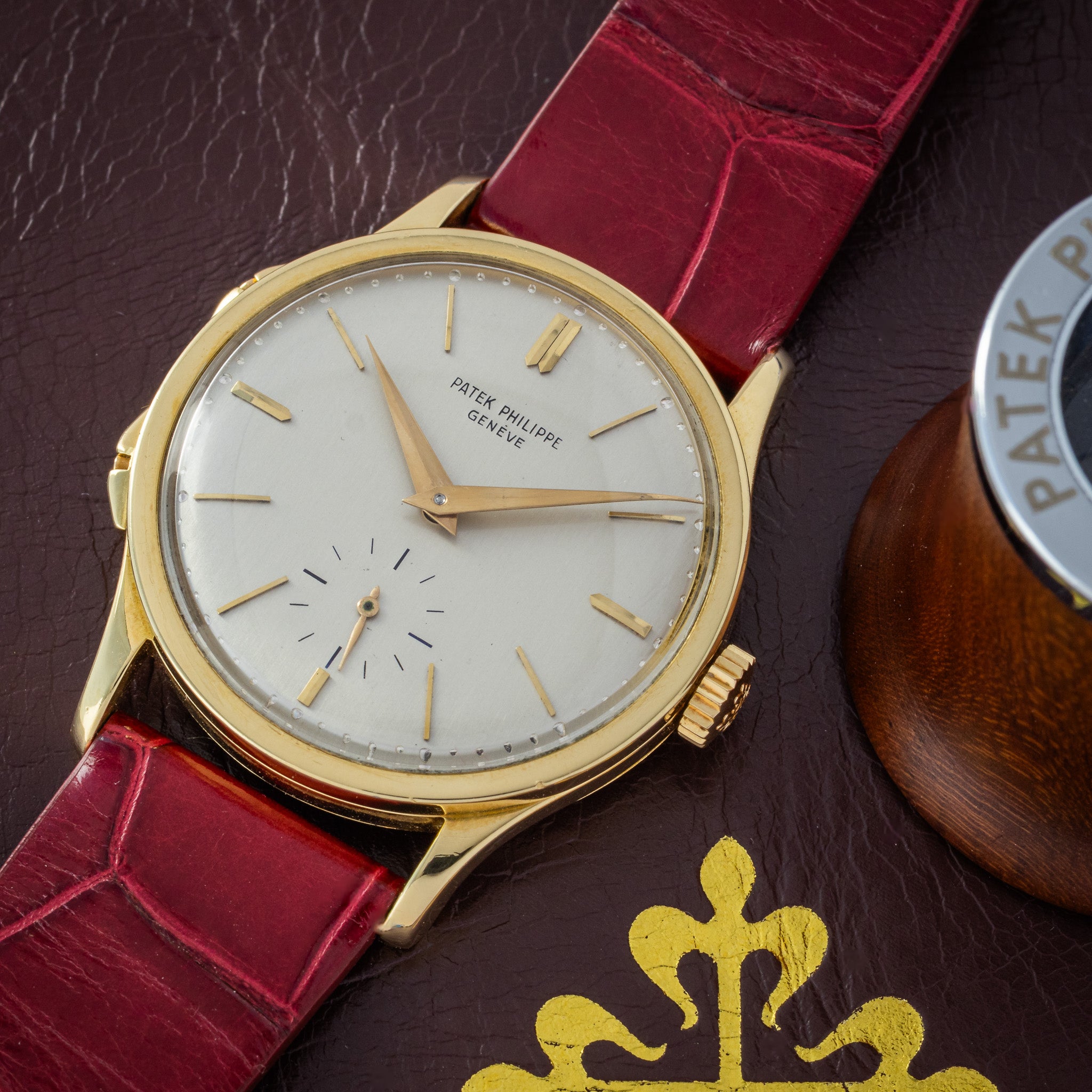
Vers 1960 · Boîtier n° 310.486 · Mouvement n° 729.414 Time Travel. Ce modèle, choisi pour son équilibre entre originalité et authenticité, témoigne de l'attrait intemporel du design Patek Philippe du milieu du XXe siècle. Ses proportions harmonieuses épousent parfaitement le poignet, tandis que la finesse de la typographie du cadran et des finitions du boîtier souligne la quête discrète d'excellence de la manufacture. Les collectionneurs apprécieront la qualité des composants et l'élégance sobre qui le place au-delà des tendances éphémères : un objet fonctionnel sublimé par la forme. Sur le marché actuel, les connaisseurs recherchent ces pièces pour leur cohérence et la clarté de leur histoire : un garde-temps fonctionnel, préservé avec respect plutôt qu'avec ostentation. Adaptée à un usage quotidien ou à une étude approfondie au sein d'une collection spécialisée, elle offre à la fois une satisfaction esthétique et un potentiel de collection à long terme. Accompagnée d'un extrait.


Patek - 2597J
 Lifetime Guarantee of Authenticity
Complimentary Insured Worldwide Shipping
Three-Day Inspection Window
Trusted Globally by Collectors
Lifetime Guarantee of Authenticity
Complimentary Insured Worldwide Shipping
Three-Day Inspection Window
Trusted Globally by Collectors
Patek - 2597J
Prix de vente$999,999.00 USD
Choisir les options
Patek - 2597J
Prix de vente$999,999.00 USD
Timepiece Information
Catalogue Notes
Specifications & Accompaniments
Reference
Patek Philippe Reference 2597J
Year of Production
1960
Original Date of Sale
February 3, 1961
Case Material
18k Yellow Gold
Dimensions
35.2 mm diameter; 9.1 mm thickness; 43.2 mm lug-to-lug; 20 mm lug width
Dial
Silvered first-series dial with very fine applied yellow gold hour markers, double index at 12, pearled minute track, and subsidiary seconds at 6 o’clock. Signed PATEK PHILIPPE / GENEVE in crisp raised enamel script, without accent over “GENEVE” and without “SWISS” designation.
Movement
Caliber 12-400 HS. Manual winding. Louis Cottier “Heure Sautante” jumping-hour mechanism allowing the hour hand to be advanced or reversed via case pushers without stopping the movement.
Caseback
Snap-back caseback (fond encliqueté), engraved
Strap / Bracelet / Buckle
Burgundy gloss alligator leather strap, aftermarket replacement. Thin cut-edge construction with attractive scale pattern. Previously worn with light signs of use, remaining supple and suitable for continued wear. Original Patek Philippe 18k yellow gold tang buckle, stamped “PPC” and “750.” Vintage 16 mm example with classic mid-century proportions and light honest wear.
Accompanied By
Extract from the Archives and WRISTORIAN Presentation packaging
WRISTORIAN Perspective
The Patek Philippe reference 2597 occupies an extraordinary position in the history of modern horology. Introduced during the late 1950s, at a moment when commercial jet travel was beginning to reshape the geography of the world, the watch addressed a problem that had suddenly become relevant to an entirely new class of global traveler. Crossing time zones had become routine for diplomats, businessmen, and early international tourists, yet the mechanical wristwatch remained stubbornly local in its conception. In response, Patek Philippe turned to one of the great innovators of the era, the Geneva watchmaker Louis Cottier, whose work on world-time watches had already established him as the foremost authority on practical travel complications. The result was the reference 2597, a quietly ingenious watch that allowed the wearer to adjust local time forward or backward in one-hour increments while the movement continued to run uninterrupted.
What makes the reference particularly fascinating today is the understated elegance with which this mechanical innovation was introduced. The watch retains the visual language of the classic Calatrava, avoiding the technical or instrument-like appearance that many later travel watches would adopt. Its balanced 35.5 mm case follows the architectural proportions associated with the reference 570 and was produced by the respected case maker Antoine Gerlach, whose workshop supplied cases for a number of Patek Philippe’s most celebrated mid-century references. The two pushers positioned along the left side of the case provide the interface for the jumping-hour system, yet they are integrated so naturally into the form of the watch that the mechanism reveals itself only to the attentive observer. It is precisely this combination of restraint and ingenuity that gives the reference its enduring charm.
Early examples such as the present watch are especially compelling because they preserve the original two-hand configuration of the model. In this earliest form, the watch expresses Cottier’s travel-time concept with remarkable clarity. The absence of a central seconds hand allows the jumping-hour function to remain the conceptual centerpiece of the design, reinforcing the disciplined simplicity that defines Patek Philippe’s finest mid-century creations. Over time, many watches were later modified with additional hands through factory kits, but collectors often regard the early two-hand execution as the most intellectually satisfying expression of the idea.
The present example illustrates these qualities beautifully. Produced in 1960 and sold in early 1961, it retains a dial of striking clarity, distinguished by a crisp raised enamel signature, finely preserved pearled minute track, and exceptionally delicate applied gold hour markers. The absence of a “SWISS” designation at the lower edge of the dial further reinforces its early character. Details such as these are the quiet signals that experienced collectors recognize immediately, subtle indicators of originality that contribute enormously to the watch’s appeal.
For the thoughtful collector, the reference 2597 represents far more than an uncommon mid-century complication. It stands at the beginning of a lineage that would eventually lead to some of Patek Philippe’s most admired modern travel watches. At the same time, it remains deeply rooted in the restrained elegance of the Calatrava tradition. Examples preserved with this degree of clarity and authenticity offer the rare opportunity to own not merely a beautiful vintage wristwatch, but a watch that marks the moment when mechanical horology first began to adapt to a truly global world.
What makes the reference particularly fascinating today is the understated elegance with which this mechanical innovation was introduced. The watch retains the visual language of the classic Calatrava, avoiding the technical or instrument-like appearance that many later travel watches would adopt. Its balanced 35.5 mm case follows the architectural proportions associated with the reference 570 and was produced by the respected case maker Antoine Gerlach, whose workshop supplied cases for a number of Patek Philippe’s most celebrated mid-century references. The two pushers positioned along the left side of the case provide the interface for the jumping-hour system, yet they are integrated so naturally into the form of the watch that the mechanism reveals itself only to the attentive observer. It is precisely this combination of restraint and ingenuity that gives the reference its enduring charm.
Early examples such as the present watch are especially compelling because they preserve the original two-hand configuration of the model. In this earliest form, the watch expresses Cottier’s travel-time concept with remarkable clarity. The absence of a central seconds hand allows the jumping-hour function to remain the conceptual centerpiece of the design, reinforcing the disciplined simplicity that defines Patek Philippe’s finest mid-century creations. Over time, many watches were later modified with additional hands through factory kits, but collectors often regard the early two-hand execution as the most intellectually satisfying expression of the idea.
The present example illustrates these qualities beautifully. Produced in 1960 and sold in early 1961, it retains a dial of striking clarity, distinguished by a crisp raised enamel signature, finely preserved pearled minute track, and exceptionally delicate applied gold hour markers. The absence of a “SWISS” designation at the lower edge of the dial further reinforces its early character. Details such as these are the quiet signals that experienced collectors recognize immediately, subtle indicators of originality that contribute enormously to the watch’s appeal.
For the thoughtful collector, the reference 2597 represents far more than an uncommon mid-century complication. It stands at the beginning of a lineage that would eventually lead to some of Patek Philippe’s most admired modern travel watches. At the same time, it remains deeply rooted in the restrained elegance of the Calatrava tradition. Examples preserved with this degree of clarity and authenticity offer the rare opportunity to own not merely a beautiful vintage wristwatch, but a watch that marks the moment when mechanical horology first began to adapt to a truly global world.
Service & Operation
Service History
Serviced March 4, 2025
Operational Status
Observed running and setting normally at the time of cataloguing. The movement has not been tested for accuracy over extended periods or for power reserve duration, and may require servicing at the buyer’s discretion. As is customary with vintage timepieces, future performance cannot be guaranteed.
