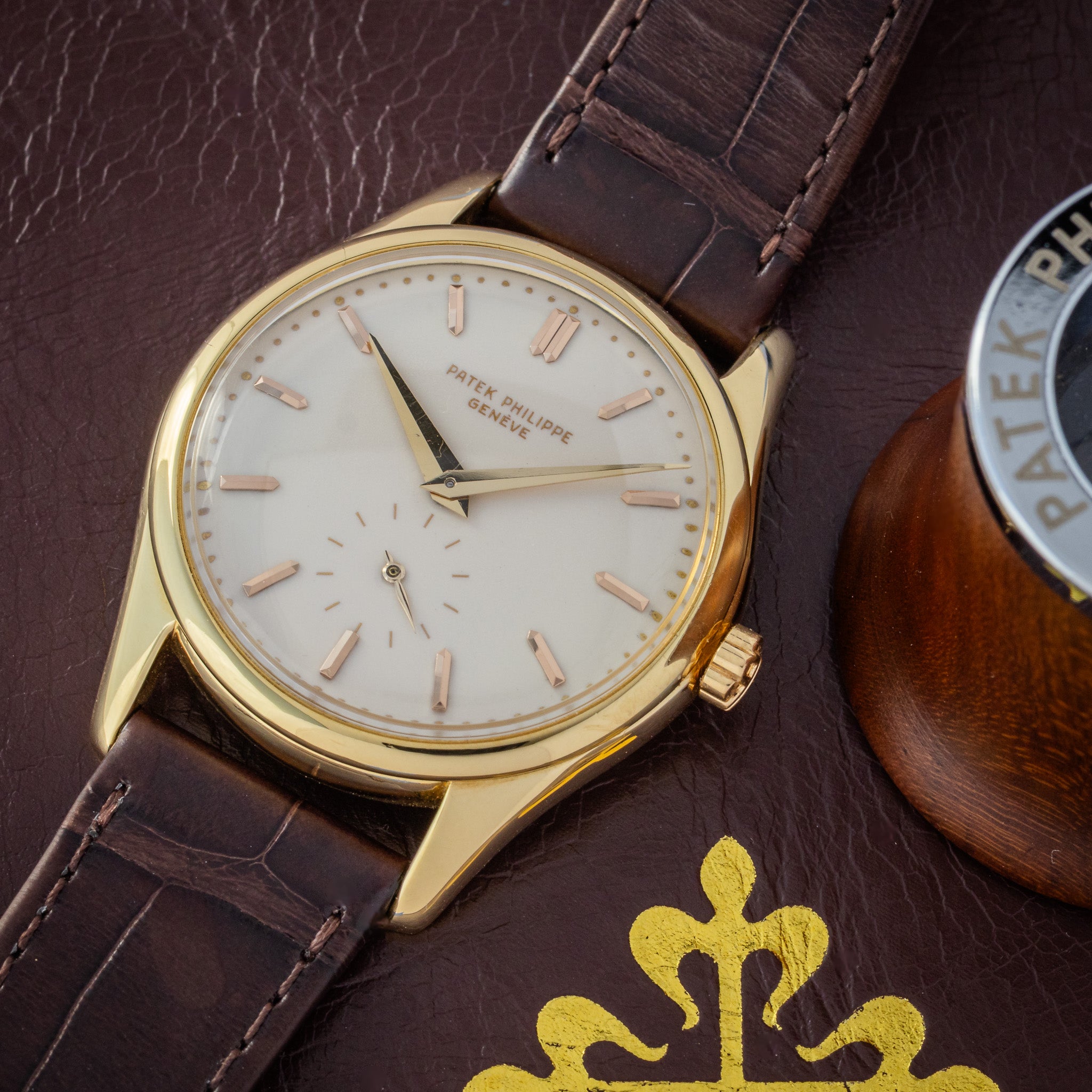
Patek - 2526J - Gravure de la 1ère série
Vers 1954 · Boîtier n° 682.076 · Mouvement n° 760.556 . Heure uniquement. Ce modèle, choisi pour son équilibre entre originalité et authenticité, témoigne de l'attrait intemporel du design Patek Philippe du milieu du XXe siècle. Ses proportions harmonieuses épousent parfaitement le poignet, tandis que la finesse de la typographie du cadran et des finitions du boîtier souligne la quête discrète d'excellence de la manufacture. Les collectionneurs apprécieront la qualité des composants et l'élégance sobre qui le place au-delà des tendances éphémères : un objet fonctionnel sublimé par la forme. Sur le marché actuel, les connaisseurs recherchent de tels exemplaires pour leur cohérence et la clarté de leur histoire : un garde-temps fonctionnel, préservé avec respect plutôt qu'avec ostentation. Adapté à un usage quotidien ou à une étude approfondie au sein d'une collection spécialisée, il offre à la fois une satisfaction esthétique et un potentiel de collection à long terme. Accompagné d'un extrait.


Patek - 2526J - Gravure de la 1ère série
Lifetime Guarantee of Authenticity
Complimentary Insured Worldwide Shipping
Three-Day Inspection Window
Trusted Globally by Collectors
Choisir les options


Patek - 2526J - Gravure de la 1ère série
Prix de vente$102,500.00 USD
Timepiece Information
Catalogue Notes
Specifications & Accompaniments
Reference
Patek Philippe Reference 2526J
Year of Production
1954, as confirmed by the Extract from the Archives
Original Date of Sale
Not stated on the Extract from the Archives
Case Material
18k Yellow Gold
Dimensions
35.5 mm diameter; approximately 10.9 mm thickness; 18 mm lug width; approximately 43.5 mm lug-to-lug span
Dial
Ivory-toned enamel dial signed “Patek Philippe Genève” in applied gold lettering, with applied yellow gold hour markers and outer minute track with dotted markers. The dial remains bright and well preserved in appearance, with no visible cracks observed under magnification.
Movement
Patek Philippe Caliber 12-600 AT, self-winding mechanical movement with sweep seconds
Caseback
Decagonal screw-back case (fond vissé) typical of the Reference 2526, engraved on the exterior
Strap / Bracelet / Buckle
Dark brown matte Patek Philippe leather strap with contrasting stitching in very good condition. Fitted with an 18k yellow gold Patek Philippe pin buckle bearing the Gay Frères maker’s mark (GM), Swiss assay hallmark, Au750 gold purity mark, and PPC oval stamp for Patek Philippe & Cie.
Accompanied By
Extract from the Archives and WRISTORIAN presentation packaging
WRISTORIAN Perspective
Few references mark a true turning point in the history of a great manufacture. The Patek Philippe Reference 2526 is one of those rare watches where a single model quietly changed the trajectory of the brand’s technical evolution. Introduced in 1953, it was the first wristwatch in the history of Patek Philippe to house a self-winding movement—an achievement that represented years of careful engineering and experimentation within the manufacture.
At the center of this advancement was the extraordinary Caliber 12-600 AT. Developed entirely in-house, the movement featured bi-directional automatic winding, a Gyromax balance, and an 18k gold rotor finished to the same high standard as the rest of the movement architecture. Even by modern standards it remains one of the most beautifully constructed automatic calibers ever produced. When the reference debuted, it signaled that Patek Philippe was fully prepared to bring the same level of refinement and mechanical discipline to automatic watches that collectors had long associated with the manufacture’s hand-wound movements.
Yet the mechanical innovation alone does not fully explain why the Reference 2526 holds such a revered position among collectors. The watch also introduced one of the most remarkable dial constructions ever used in a wristwatch. Rather than employ the standard lacquered or plated metal dials common to the period, Patek Philippe selected fired enamel. Each dial was produced using a double-baked enamel process over a metal base, creating a surface of remarkable depth and luminosity. The result is a dial that remains bright, stable, and visually alive decades after its creation—qualities that have made the 2526 one of the most admired dress watches of the twentieth century.
The present example displays the characteristics collectors most closely associate with the earliest years of the reference. The enamel dial is fitted with riveted gold hour markers, a detail found on first-series examples produced during the early life of the model. The subsidiary seconds configuration preserves the classical balance of the dial architecture, while the applied gold signature and outer minute track provide the restrained typography for which Patek Philippe became known during the mid-century period. The dial’s bright, well-preserved enamel surface remains one of the defining features of the watch.
Equally notable is the case design. Measuring approximately 35.5 millimeters in diameter, the Reference 2526 was considered large when introduced, yet its proportions feel perfectly balanced on the wrist today. The decagonal screw-back construction was engineered to provide improved protection against dust and moisture, while the smooth bezel and slender lugs maintain the quiet elegance expected of a Patek Philippe dress watch. Together these elements create a watch that is both technically modern for its era and unmistakably refined.
The exterior caseback engraving, reading “JOLLEY TO JOHN / AUGUST 17 1954,” offers a glimpse into the personal history that often accompanies watches of this period. Presentation engravings such as this frequently mark important moments—professional milestones, family celebrations, or gifts of appreciation—reminding us that many of the most important watches began their lives not as collectibles but as meaningful objects intended to accompany daily life.
Within the broader landscape of vintage Patek Philippe collecting, the Reference 2526 occupies a position that is both foundational and enduring. It represents the moment when the manufacture introduced automatic winding to its wristwatch production while simultaneously producing one of the most beautiful enamel-dial dress watches ever made. For many collectors, the reference stands as an essential chapter in the story of twentieth-century horology.
For collectors seeking the most desirable early expressions of the model, first-series examples such as the present watch hold particular appeal. The enamel dial fitted with riveted gold hour markers is a defining characteristic of the earliest production period and reflects the meticulous dial construction methods used during the reference’s introduction. Combined with the luminous enamel surface, the classical subsidiary seconds layout, and the balanced proportions of the case, these early dials represent the configuration most closely associated with the original vision of the Reference 2526. In this context, the present example offers precisely the qualities that have made the model a cornerstone of serious vintage Patek Philippe collections.
At the center of this advancement was the extraordinary Caliber 12-600 AT. Developed entirely in-house, the movement featured bi-directional automatic winding, a Gyromax balance, and an 18k gold rotor finished to the same high standard as the rest of the movement architecture. Even by modern standards it remains one of the most beautifully constructed automatic calibers ever produced. When the reference debuted, it signaled that Patek Philippe was fully prepared to bring the same level of refinement and mechanical discipline to automatic watches that collectors had long associated with the manufacture’s hand-wound movements.
Yet the mechanical innovation alone does not fully explain why the Reference 2526 holds such a revered position among collectors. The watch also introduced one of the most remarkable dial constructions ever used in a wristwatch. Rather than employ the standard lacquered or plated metal dials common to the period, Patek Philippe selected fired enamel. Each dial was produced using a double-baked enamel process over a metal base, creating a surface of remarkable depth and luminosity. The result is a dial that remains bright, stable, and visually alive decades after its creation—qualities that have made the 2526 one of the most admired dress watches of the twentieth century.
The present example displays the characteristics collectors most closely associate with the earliest years of the reference. The enamel dial is fitted with riveted gold hour markers, a detail found on first-series examples produced during the early life of the model. The subsidiary seconds configuration preserves the classical balance of the dial architecture, while the applied gold signature and outer minute track provide the restrained typography for which Patek Philippe became known during the mid-century period. The dial’s bright, well-preserved enamel surface remains one of the defining features of the watch.
Equally notable is the case design. Measuring approximately 35.5 millimeters in diameter, the Reference 2526 was considered large when introduced, yet its proportions feel perfectly balanced on the wrist today. The decagonal screw-back construction was engineered to provide improved protection against dust and moisture, while the smooth bezel and slender lugs maintain the quiet elegance expected of a Patek Philippe dress watch. Together these elements create a watch that is both technically modern for its era and unmistakably refined.
The exterior caseback engraving, reading “JOLLEY TO JOHN / AUGUST 17 1954,” offers a glimpse into the personal history that often accompanies watches of this period. Presentation engravings such as this frequently mark important moments—professional milestones, family celebrations, or gifts of appreciation—reminding us that many of the most important watches began their lives not as collectibles but as meaningful objects intended to accompany daily life.
Within the broader landscape of vintage Patek Philippe collecting, the Reference 2526 occupies a position that is both foundational and enduring. It represents the moment when the manufacture introduced automatic winding to its wristwatch production while simultaneously producing one of the most beautiful enamel-dial dress watches ever made. For many collectors, the reference stands as an essential chapter in the story of twentieth-century horology.
For collectors seeking the most desirable early expressions of the model, first-series examples such as the present watch hold particular appeal. The enamel dial fitted with riveted gold hour markers is a defining characteristic of the earliest production period and reflects the meticulous dial construction methods used during the reference’s introduction. Combined with the luminous enamel surface, the classical subsidiary seconds layout, and the balanced proportions of the case, these early dials represent the configuration most closely associated with the original vision of the Reference 2526. In this context, the present example offers precisely the qualities that have made the model a cornerstone of serious vintage Patek Philippe collections.
Service & Operation
Service History
Serviced February 19, 2025
Operational Status
Observed running and setting normally at the time of cataloguing. The movement has not been tested for accuracy over extended periods or for power reserve duration, and may require servicing at the buyer’s discretion. As is customary with vintage timepieces, future performance cannot be guaranteed.