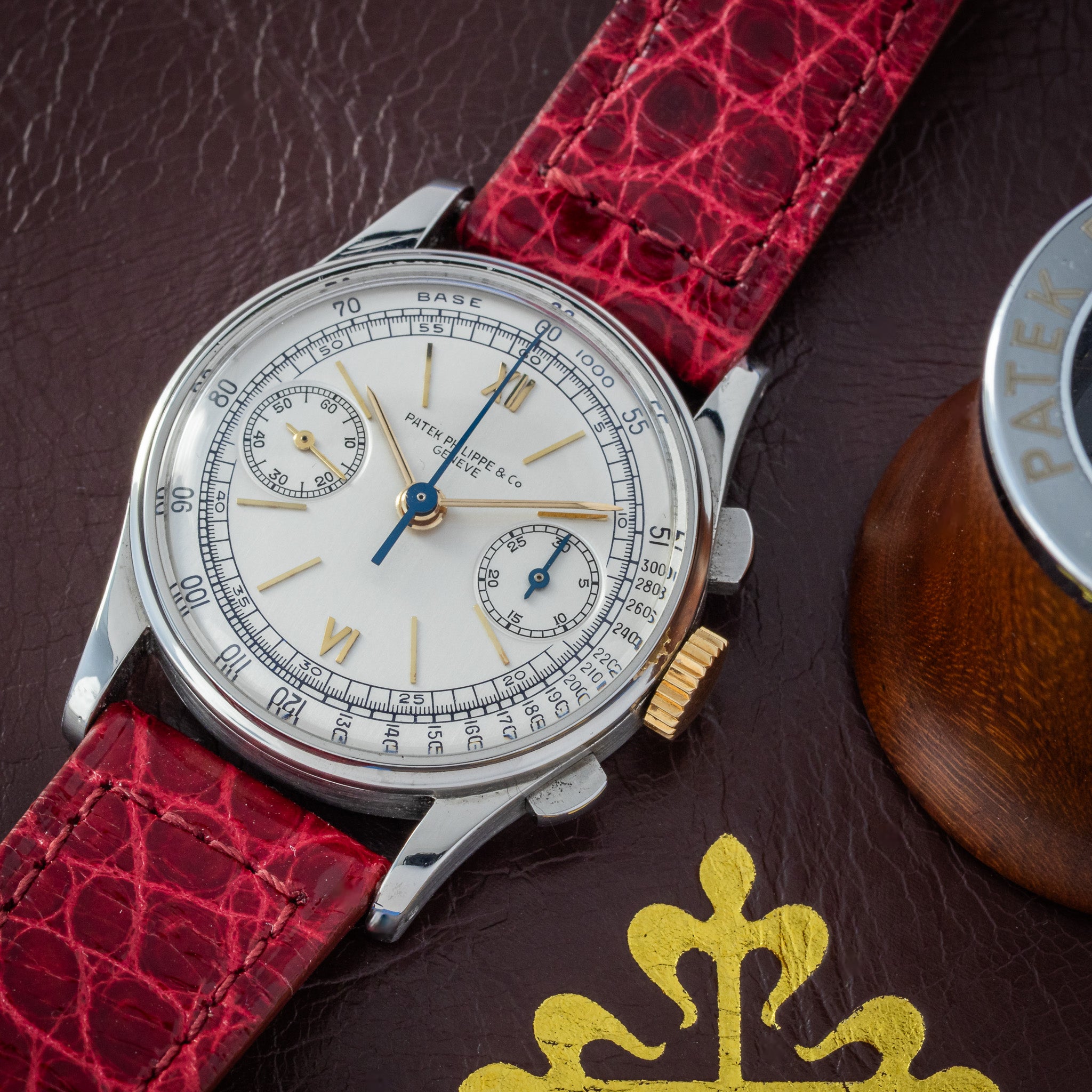
Patek - 130A - Signature longue
Vers 1941 · Boîtier n° 505.799 · Mouvement n° 862.656 Chronographe. Ce modèle, choisi pour son équilibre entre originalité et authenticité, témoigne de l'attrait intemporel du design Patek Philippe du milieu du XXe siècle. Ses proportions harmonieuses épousent parfaitement le poignet, tandis que la finesse de la typographie du cadran et des finitions du boîtier souligne la quête discrète d'excellence de la manufacture. Les collectionneurs apprécieront la qualité des composants et l'élégance sobre qui le place au-delà des tendances éphémères : un objet fonctionnel sublimé par la forme. Sur le marché actuel, les connaisseurs recherchent de tels exemplaires pour leur cohérence et la clarté de leur histoire : un garde-temps fonctionnel, préservé avec respect plutôt qu'avec ostentation. Adapté à un usage quotidien ou à une étude approfondie au sein d'une collection spécialisée, il offre à la fois une satisfaction esthétique et un potentiel de collection à long terme.


Patek - 130A - Signature longue
Lifetime Guarantee of Authenticity
Complimentary Insured Worldwide Shipping
Three-Day Inspection Window
Trusted Globally by Collectors
Choisir les options


Patek - 130A - Signature longue
Prix de vente$1,150,000.00 USD
Timepiece Information
Catalogue Notes
Specifications & Accompaniments
Reference
Patek Philippe Reference 130A
Year of Production
1941
Original Date of Sale
November 21, 1941
Case Material
Stainless steel with yellow gold crown
Dimensions
Diameter 33.0 mm; thickness approximately 11.0 mm; lug width 19 mm; lug-to-lug 41 mm
Dial
Silvered dial with applied yellow gold Roman numerals at 12 and 6, applied yellow gold baton markers, outer tachymetric scale
Movement
Patek Philippe manual-winding chronograph caliber 13''' CH, based on a Valjoux ébauche and finished by Victorin Piguet
Caseback
Snap-back case (fond encliqueté), stainless steel
Strap / Bracelet / Buckle
Later burgundy alligator leather strap with Patek Philippe 18k white gold pin buckle stamped “PPCo 750”
Accompanied By
Patek Philippe Extract from the Archives dated June 28, 2024 and WRISTORIAN presentation packaging
WRISTORIAN Perspective
Among vintage Patek Philippe chronographs, the reference 130 occupies a singular position. Introduced in 1934, it represents the manufacture’s first serially produced chronograph wristwatch and established the design language that would shape Patek Philippe chronographs for decades to come. The restrained case proportions, rectangular pushers, and beautifully balanced dial architecture that collectors now associate with classic Patek chronographs first came together in this reference.
What makes this particular example so compelling is the dial. That observation should not be taken to diminish the appeal of the stainless steel case or the rare and attractive combination of steel with yellow gold markers, hands, and crown, all of which contribute meaningfully to the watch’s character. Yet when encountering the watch for the first time, it is the dial that quietly commands attention. Vintage collectors often speak about watches that seem to have escaped the decades with unusual grace. Occasionally a dial appears whose preservation immediately arrests the eye. The present example falls squarely into that category. The raised enamel long signature remains strikingly crisp, the tachymeter printing retains excellent clarity, and the recessed chronograph registers display remarkable depth and definition. The overall impression is one of uncommon sharpness, suggesting a life spent carefully preserved rather than gradually softened by decades of daily wear.
The configuration itself adds further intrigue. Steel reference 130 chronographs are already scarce, with scholarship suggesting that approximately 280 examples were produced. Within that already limited population, examples combining a steel case with applied yellow gold Roman numerals, baton markers, and matching hands appear only infrequently. The Roman numerals at twelve and six introduce a disciplined symmetry that collectors often associate with the elegant quasi sector layouts of the period, lending the dial a sense of architectural balance that is both refined and visually distinctive.
Equally appealing is the proportion the watch maintains on the wrist. Measuring just over thirty three millimeters in diameter, the reference reflects a period in which elegance was achieved through balance rather than scale. The slender case, rectangular pushers, and carefully structured dial create a timepiece that feels purposeful, refined, and unmistakably of its era.
For experienced collectors, watches such as this often produce a moment of immediate recognition. Within the population of surviving reference 130 chronographs, examples displaying this dial configuration and level of preservation appear only occasionally. When they do surface, they reveal the reference with unusual clarity, allowing collectors to appreciate the design, craftsmanship, and proportions exactly as they were originally conceived.
Now more than eight decades removed from its manufacture in 1941, surviving examples of reference 130 have gradually found their way into long term collections, where they are often preserved for generations. As a result, opportunities to encounter particularly well preserved examples have become increasingly uncommon.
A timepiece like this does more than measure elapsed seconds. It reflects a moment when chronographs were still instruments of precision, built to record speed, distance, and performance, yet already evolving into objects of quiet elegance. The reference 130 sits precisely at that intersection. For the thoughtful collector, an example preserved with this level of clarity offers something rare: the opportunity to experience the watch very nearly as it must have appeared when it first left the workshops of Patek Philippe in the early 1940s.
For collectors who value originality, proportion, and historical importance in equal measure, the appeal becomes self evident. A stainless steel reference 130 is already a rare chronograph. One displaying this uncommon Roman numeral configuration and preserved with such remarkable clarity stands apart even within that small population. It is not simply a fine example of the reference. It is the kind of example that reminds collectors why the earliest Patek Philippe chronographs continue to command such admiration today.
What makes this particular example so compelling is the dial. That observation should not be taken to diminish the appeal of the stainless steel case or the rare and attractive combination of steel with yellow gold markers, hands, and crown, all of which contribute meaningfully to the watch’s character. Yet when encountering the watch for the first time, it is the dial that quietly commands attention. Vintage collectors often speak about watches that seem to have escaped the decades with unusual grace. Occasionally a dial appears whose preservation immediately arrests the eye. The present example falls squarely into that category. The raised enamel long signature remains strikingly crisp, the tachymeter printing retains excellent clarity, and the recessed chronograph registers display remarkable depth and definition. The overall impression is one of uncommon sharpness, suggesting a life spent carefully preserved rather than gradually softened by decades of daily wear.
The configuration itself adds further intrigue. Steel reference 130 chronographs are already scarce, with scholarship suggesting that approximately 280 examples were produced. Within that already limited population, examples combining a steel case with applied yellow gold Roman numerals, baton markers, and matching hands appear only infrequently. The Roman numerals at twelve and six introduce a disciplined symmetry that collectors often associate with the elegant quasi sector layouts of the period, lending the dial a sense of architectural balance that is both refined and visually distinctive.
Equally appealing is the proportion the watch maintains on the wrist. Measuring just over thirty three millimeters in diameter, the reference reflects a period in which elegance was achieved through balance rather than scale. The slender case, rectangular pushers, and carefully structured dial create a timepiece that feels purposeful, refined, and unmistakably of its era.
For experienced collectors, watches such as this often produce a moment of immediate recognition. Within the population of surviving reference 130 chronographs, examples displaying this dial configuration and level of preservation appear only occasionally. When they do surface, they reveal the reference with unusual clarity, allowing collectors to appreciate the design, craftsmanship, and proportions exactly as they were originally conceived.
Now more than eight decades removed from its manufacture in 1941, surviving examples of reference 130 have gradually found their way into long term collections, where they are often preserved for generations. As a result, opportunities to encounter particularly well preserved examples have become increasingly uncommon.
A timepiece like this does more than measure elapsed seconds. It reflects a moment when chronographs were still instruments of precision, built to record speed, distance, and performance, yet already evolving into objects of quiet elegance. The reference 130 sits precisely at that intersection. For the thoughtful collector, an example preserved with this level of clarity offers something rare: the opportunity to experience the watch very nearly as it must have appeared when it first left the workshops of Patek Philippe in the early 1940s.
For collectors who value originality, proportion, and historical importance in equal measure, the appeal becomes self evident. A stainless steel reference 130 is already a rare chronograph. One displaying this uncommon Roman numeral configuration and preserved with such remarkable clarity stands apart even within that small population. It is not simply a fine example of the reference. It is the kind of example that reminds collectors why the earliest Patek Philippe chronographs continue to command such admiration today.
Service & Operation
Service History
Serviced March 1, 2025
Operational Status
Observed running and setting normally at the time of cataloguing. The movement has not been tested for accuracy over extended periods or for power reserve duration, and may require servicing at the buyer’s discretion. As is customary with vintage timepieces, future performance cannot be guaranteed.