

Patek - 96J-SCI
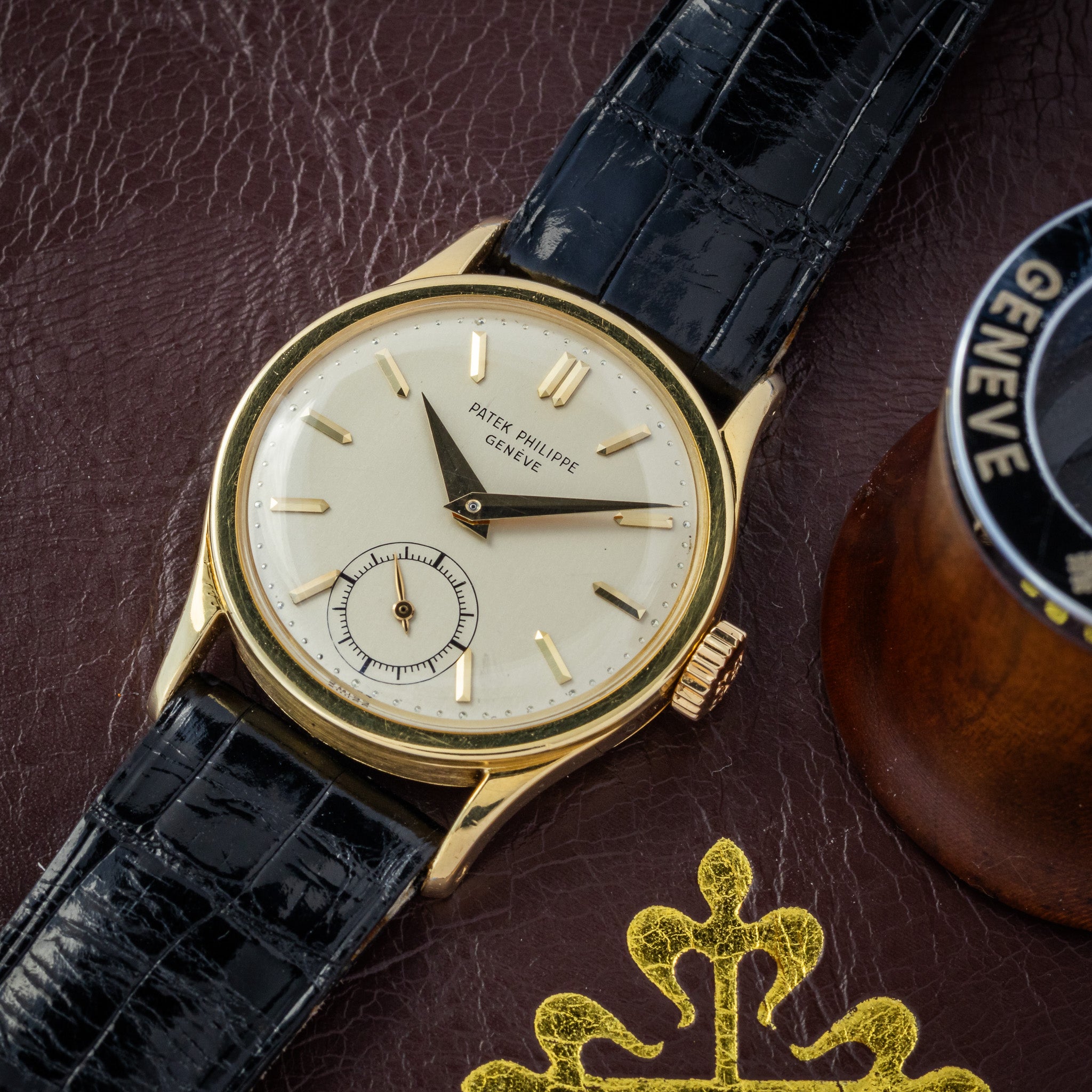
Vers 1950-55 ? · N° de boîtier : 305.381 · N° de mouvement : 720.405 . Heure uniquement. Ce modèle, choisi avec soin pour son équilibre entre originalité et authenticité, témoigne de l’attrait intemporel du design Patek Philippe du milieu du XXe siècle. Ses proportions harmonieuses épousent parfaitement le poignet, tandis que la finesse de la typographie du cadran et des finitions du boîtier souligne la quête discrète d’excellence de la manufacture. Les collectionneurs apprécieront la qualité des composants et l’élégance sobre qui le place au-delà des tendances : un objet fonctionnel sublimé par la forme. Sur le marché actuel, les connaisseurs recherchent de tels exemplaires pour leur cohérence et la clarté de leur histoire : un garde-temps fonctionnel, préservé avec respect plutôt qu’avec ostentation. Adapté à un usage quotidien ou à une étude approfondie au sein d’une collection spécialisée, il offre à la fois une satisfaction esthétique et un potentiel de collection à long terme. Accompagné d’un certificat d’authenticité.


Patek - 96J-SCI
 Lifetime Guarantee of Authenticity
Complimentary Insured Worldwide Shipping
Three-Day Inspection Window
Trusted Globally by Collectors
Lifetime Guarantee of Authenticity
Complimentary Insured Worldwide Shipping
Three-Day Inspection Window
Trusted Globally by Collectors
Patek - 96J-SCI
Prix de vente$16,474.00 USD
Choisir les options
Patek - 96J-SCI
Prix de vente$16,474.00 USD
Timepiece Information
Catalogue Notes
Specifications & Accompaniments
Reference
Reference 96J
Year of Production
Movement number consistent with production circa 1950–1955.
Original Date of Sale
Original date of sale unknown
Case Material
18K yellow gold
Dimensions
Case diameter 30.5 mm; thickness approximately 9 mm; lug width 18 mm; lug-to-lug 38.5 mm
Dial
Silvered opaline dial with applied gold baton hour markers and subsidiary seconds
Movement
Manually wound calibre 12-120 with subsidiary seconds and Geneva Seal finishing
Caseback
Fond clipsé (snap-on caseback).
Strap / Bracelet / Buckle
Patek Philippe thin stitched glossy black alligator strap fitted with a Swiss gold-plated buckle of period-correct style, not original to the watch
Accompanied By
Contemporary Patek Philippe service travel pouch (service wallet), service documentation card, service hang tag, and intact caseback service seal
WRISTORIAN Perspective
The Reference 96 is not merely an early Calatrava — it is the Calatrava.
When Patek Philippe introduced the reference in 1932, the manufacture itself was entering a decisive new chapter. That same year the Stern family assumed control of the company and began redefining its direction after the turbulence of the early twentieth century. The Ref. 96 emerged as the architectural expression of that transition. Drawing upon the restrained principles of early modernist design—often associated with Bauhaus-era thinking—the watch rejected ornament in favor of proportion, clarity, and balance. In doing so, it established the design vocabulary that would define Patek Philippe’s dress watches for nearly a century.
By the early 1950s that vocabulary had reached its clearest and most mature expression. The measured diameter, slender bezel, balanced lugs, and disciplined dial architecture create a watch whose visual logic feels inevitable rather than styled. The Ref. 96 did not become influential through novelty; it became influential because its proportions proved enduringly correct.
The 30.5 mm case remains one of the most studied proportions in horology. On paper it appears modest; on the wrist it is exact. The 18 mm lug span extends the watch visually across the wrist, giving it presence beyond its diameter and producing a stance that feels architectural rather than diminutive. Designers and collectors alike have returned to these proportions repeatedly, treating the Ref. 96 as a benchmark for classical dress watch design.
Inside, the Calibre 12-120 represents the spiritual core of mid-century Patek Philippe. Thin, manually wound, and finished to Geneva Seal standard, it embodies the manufacture’s philosophy that precision and restraint are not opposites but companions. The subsidiary seconds at six o’clock preserve classical symmetry while allowing the dial to remain free of unnecessary complication.
The silvered opaline dial reinforces that discipline. Light does not flash across it—it settles. Applied gold markers provide structure without ornament, while the raised enamel Patek Philippe signature introduces a subtle dimensionality characteristic of mid-century dial craftsmanship. Details such as this, often overlooked by casual observers, are precisely the elements that experienced collectors study most carefully when evaluating the originality and preservation of a vintage Calatrava.
Factory service by Patek Philippe in 2025 ensures that the mechanical integrity of the watch aligns with its visual preservation. Proper stewardship of a mid-century Calatrava does not modernize it; it sustains it, allowing the watch to continue functioning exactly as its designers intended more than seventy years ago.
Over time the Ref. 96 has become something rarer than a successful model—it has become a reference point. The Calatrava language established here would guide Patek Philippe’s formal watches for generations, influencing countless later references while remaining fundamentally unchanged in its architectural logic. Few wristwatches can claim such continuity of influence.
Serious collectors have long recognized that certain watches define a manufacture’s identity rather than merely participating in it, and the Ref. 96 stands firmly in that category. With its crisp hallmark, striking raised signature, and beautifully preserved dial, the present example allows the architecture of the original Calatrava to remain fully legible more than seventy years after its creation. Elegant, disciplined, and historically essential, it offers something rarer than spectacle: the quiet assurance that enduring design—when properly preserved—never loses its authority.
When Patek Philippe introduced the reference in 1932, the manufacture itself was entering a decisive new chapter. That same year the Stern family assumed control of the company and began redefining its direction after the turbulence of the early twentieth century. The Ref. 96 emerged as the architectural expression of that transition. Drawing upon the restrained principles of early modernist design—often associated with Bauhaus-era thinking—the watch rejected ornament in favor of proportion, clarity, and balance. In doing so, it established the design vocabulary that would define Patek Philippe’s dress watches for nearly a century.
By the early 1950s that vocabulary had reached its clearest and most mature expression. The measured diameter, slender bezel, balanced lugs, and disciplined dial architecture create a watch whose visual logic feels inevitable rather than styled. The Ref. 96 did not become influential through novelty; it became influential because its proportions proved enduringly correct.
The 30.5 mm case remains one of the most studied proportions in horology. On paper it appears modest; on the wrist it is exact. The 18 mm lug span extends the watch visually across the wrist, giving it presence beyond its diameter and producing a stance that feels architectural rather than diminutive. Designers and collectors alike have returned to these proportions repeatedly, treating the Ref. 96 as a benchmark for classical dress watch design.
Inside, the Calibre 12-120 represents the spiritual core of mid-century Patek Philippe. Thin, manually wound, and finished to Geneva Seal standard, it embodies the manufacture’s philosophy that precision and restraint are not opposites but companions. The subsidiary seconds at six o’clock preserve classical symmetry while allowing the dial to remain free of unnecessary complication.
The silvered opaline dial reinforces that discipline. Light does not flash across it—it settles. Applied gold markers provide structure without ornament, while the raised enamel Patek Philippe signature introduces a subtle dimensionality characteristic of mid-century dial craftsmanship. Details such as this, often overlooked by casual observers, are precisely the elements that experienced collectors study most carefully when evaluating the originality and preservation of a vintage Calatrava.
Factory service by Patek Philippe in 2025 ensures that the mechanical integrity of the watch aligns with its visual preservation. Proper stewardship of a mid-century Calatrava does not modernize it; it sustains it, allowing the watch to continue functioning exactly as its designers intended more than seventy years ago.
Over time the Ref. 96 has become something rarer than a successful model—it has become a reference point. The Calatrava language established here would guide Patek Philippe’s formal watches for generations, influencing countless later references while remaining fundamentally unchanged in its architectural logic. Few wristwatches can claim such continuity of influence.
Serious collectors have long recognized that certain watches define a manufacture’s identity rather than merely participating in it, and the Ref. 96 stands firmly in that category. With its crisp hallmark, striking raised signature, and beautifully preserved dial, the present example allows the architecture of the original Calatrava to remain fully legible more than seventy years after its creation. Elegant, disciplined, and historically essential, it offers something rarer than spectacle: the quiet assurance that enduring design—when properly preserved—never loses its authority.
Service & Operation
Service History
Factory serviced by Patek Philippe on May 1, 2025
Operational Status
Observed running and setting correctly at the time of cataloguing
