
Water Resistance in Vintage Watches
Water resistance is one of the most misunderstood subjects in vintage watches. A watch may have been genuinely water-resistant when new. It may even pass a pressure test today. Neither fact necessarily means that exposing an important vintage watch to water is sensible. A collector sees a screw-down caseback, a substantial crown, perhaps the word étanche in period literature, and assumes the watch was designed to resist water. That may be historically correct. It tells us much less about whether the same watch should be exposed to water today.
The useful question is therefore not simply, “Is this watch water-resistant?” It is: How much confidence should I place in the water resistance of this particular watch, in its present condition, and what am I risking if that confidence proves misplaced? That is a very different question.
1. Water Resistance Is a System, Not a Feature
Water resistance is created by the interaction of several components. Depending upon the watch, those may include the case construction, caseback, crown and crown tube, crystal and its seating, gaskets, pushers, correctors, and the surfaces against which those components seal.
A screw-down crown is particularly useful because it mechanically secures one of the principal openings into the case. But a screw-down crown is not magic. A watch with a screw-down crown can leak through a damaged gasket, worn crown tube, poorly seated crystal, compromised pusher, or improperly fitted caseback. Conversely, sophisticated modern case construction can achieve substantial water resistance without relying upon a screw-down crown alone.
The point is simple: water resistance belongs to the complete case-and-seal system, not to one component. Modern watchmaking has made these systems extraordinarily effective. Patek Philippe currently tests its certified water-resistant watches in air and underwater by immersion at an overpressure of 3 bar, corresponding to 30 metres.1 That is useful information for a modern watch manufactured, assembled, sealed, and tested to a known standard.
Vintage watches present a completely different problem. A watch manufactured in 1940 may have been opened dozens of times. Its crown may have been replaced. The crown tube may be worn. A caseback may have been repeatedly tightened and removed. Gaskets may have hardened, compressed, shrunk, or been replaced with substitutes. A crystal may no longer seat exactly as it once did. Corrosion or previous repair work may have affected a sealing surface. None of those conditions can be determined simply by looking at the reference number. Water resistance belongs to the present physical watch, not merely to the specifications it possessed when it left the manufacturer.
2. “Waterproof” Was Once an Important Technical Achievement
It is easy to forget how consequential water-resistant case construction was during the early decades of the wristwatch. Moisture was an obvious enemy of a mechanical movement. Creating a case that allowed a watch to be wound and set while protecting it from dust and water required considerably more engineering than simply fitting a tight caseback.
For Patek Philippe collectors, Reference 565 provides an especially useful example. Introduced in 1938, Reference 565 is generally described in major auction-house scholarship as Patek Philippe’s first large water-resistant wristwatch. Its approximately 35 mm two-piece case employed a screw-down back and protective inner cover. The cases were manufactured by Taubert, successor to the Borgel case-making enterprise and an important specialist in water-resistant watch cases.2
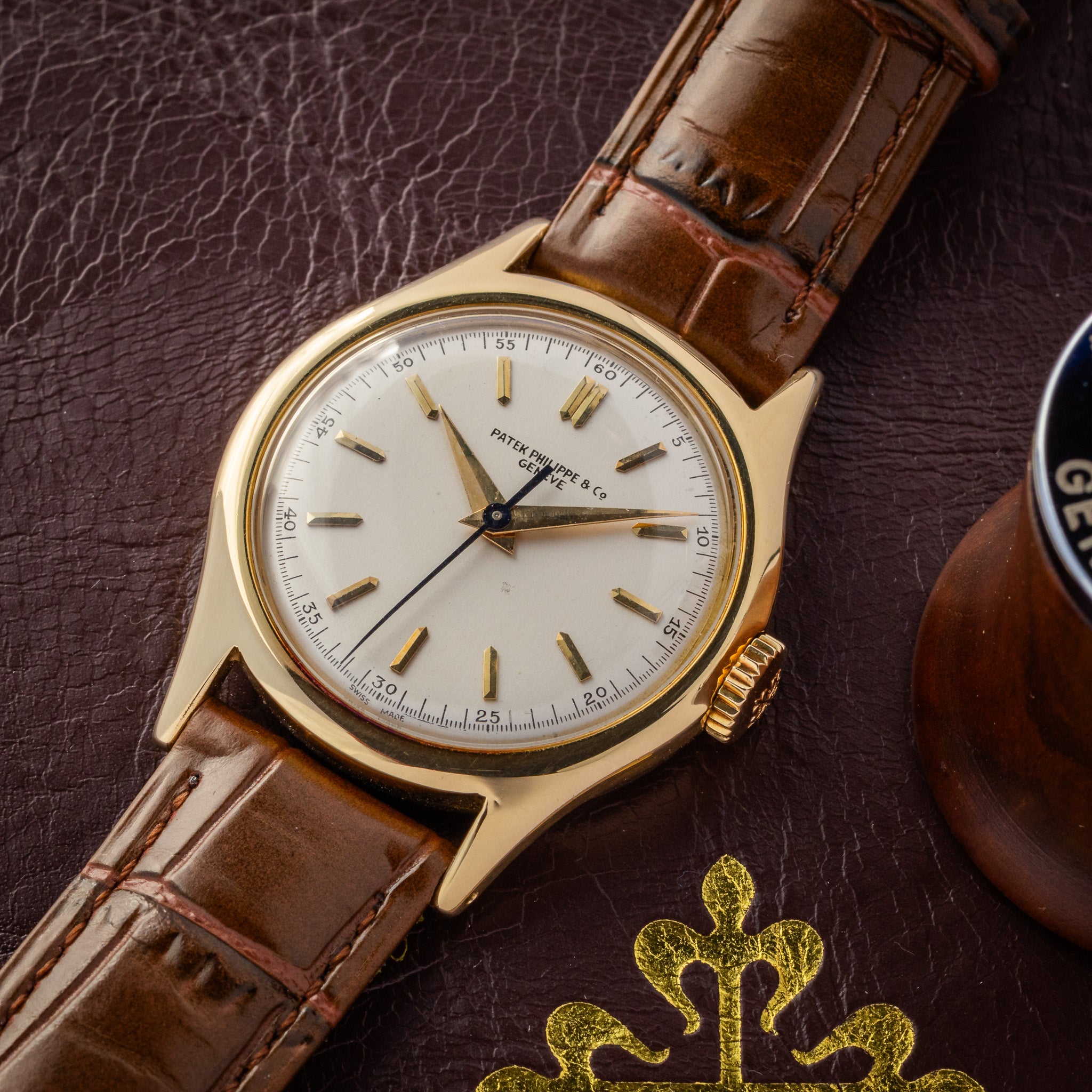
The concept subsequently extended into complicated watches. Patek Philippe Reference 1463, introduced around 1940, combined a chronograph with a water-resistant case, screw-down back, and distinctive round pushers. Phillips describes it as Patek Philippe’s first water-resistant chronograph.3
These watches matter partly because water resistance was technically significant when they were created. But here is the collector’s trap: Historical water resistance and present-day water resistance are not the same thing. A Reference 565 being étanche in 1940 does not establish that an individual Reference 565 remains suitable for immersion more than eighty years later.
3. What 3 ATM, 5 ATM, 10 ATM and 20 ATM Actually Mean
Modern watches frequently express water resistance in bar, ATM, metres, or some combination of the three. In common watch-industry shorthand, the progression looks roughly like this:
| Rating | Common Depth Marking | General Context |
|---|---|---|
| 3 ATM / 3 bar | 30 m | Basic water resistance |
| 5 ATM / 5 bar | 50 m | Greater everyday water resistance |
| 10 ATM / 10 bar | 100 m | Swimming and substantial recreational water exposure on many watches |
| 20 ATM / 20 bar | 200 m | Sports and more serious water use |
| 30 ATM+ | 300 m+ | Increasingly specialized sports and dive-watch construction |
| Extreme ratings | 1,000 m+ | Purpose-built professional or extreme-depth engineering |
The table is deliberately a guide, not a universal permission slip. Manufacturer instructions matter. Tissot, for example, describes its 3 bar watches as suitable for hand washing, 5 bar for hand washing and bathing, 10 bar for showering and swimming, and 20 or 30 bar for snorkeling and scuba diving. Seiko publishes somewhat different guidance for its watches.4
Patek Philippe provides an especially useful warning against blindly following generic internet charts. Since 2024, Patek has applied a unified 30-metre standard to its certified water-resistant watches. The manufacture specifically states that those watches may be worn for washing hands, showering, bathing, swimming, other aquatic activities, and even diving to a depth of 30 metres.5 In other words, two watches carrying apparently similar numerical ratings may come with materially different manufacturer guidance.
That is why statements such as “3 ATM always means splashes only” or “10 ATM always means you can dive with it” are too crude. A depth marking is not simply a literal instruction to descend to that depth, nor is it a complete description of everything the watch can safely endure. Read the number. Then read what the manufacturer says the number means.
4. The Specification Stays the Same. The Watch Does Not.
Imagine two watches originally rated to 10 ATM. One is factory fresh. The other is ten years old. It has spent summers in extreme heat, been exposed repeatedly to salt water or swimming-pool chemicals, received several knocks, undergone service, and had its caseback removed more than once. The engraving on the cases may still be identical. Their actual ability to resist water may not be.
Gaskets age. Sealing materials can harden, compress, deform, or lose elasticity. Crowns and crown tubes wear. A shock can deform a component. Casebacks are removed during servicing and must subsequently be closed and sealed correctly. Crystals and their gaskets can be disturbed. Environmental exposure adds another variable. Seiko expressly cautions that water resistance is not permanently guaranteed and can be affected by aging gaskets or deformation caused by accidental shock. Patek Philippe recommends regular testing and, in instructions for certain watches, advises having water resistance tested annually.6
This matters even with a relatively young watch. A five- or ten-year-old sports watch that has lived a hard life should not be treated as though its original factory test occurred yesterday. With a seventy- or eighty-year-old vintage watch, the argument becomes considerably stronger. The specification does not age. The watch does.
5. Pressure Testing, the Real World and the Collector’s Asymmetry
Fortunately, a collector does not have to guess. A competent watchmaker can pressure-test an appropriate watch to determine whether the case is sealing at the time of the test. Dry testing can evaluate case deformation under controlled air pressure without immersing the watch. Other procedures use pressure and water to identify leakage.
A successful test is meaningful. It is evidence that the case maintained its seal under the conditions of that test. But pressure testing is evidence, not immortality. Seals age. Crowns are operated. Cases are opened. Watches receive shocks. Components move. Environmental conditions change. Testing also occurs under controlled conditions. Ownership does not.
A swimming pool introduces chlorine. The ocean introduces salt, sand, and other contamination. A shower introduces heat, soaps, shampoos, and water directed at the watch. A hot tub or Jacuzzi adds considerably higher temperatures and chemicals. Some manufacturers specifically caution against baths, saunas, hot springs, or very hot water because heat, steam, soap, or other substances may accelerate deterioration or otherwise affect the watch.7 Ocean exposure presents another practical issue. Patek Philippe and other manufacturers advise rinsing appropriate water-resistant watches with clean fresh water after contact with salt water or chlorinated pool water.8
There is also a persistent claim that ordinary swimming creates such enormous “dynamic pressure” that modest movement through the water somehow turns a shallow pool into the pressure equivalent of a deep dive. That should not be overstated. Movement through water can increase pressure acting on a watch, and manufacturer instructions should be followed. But ISO 22810 specifically addresses water-resistant watches intended for daily use and swimming. A laboratory rating is better understood as performance under defined testing conditions than as a mathematical conversion between arm speed and imaginary depth.9
For a collector, there is an even more important consideration: the consequence of failure is asymmetric. If water enters an ordinary modern sports watch, the result may be an expensive repair. If water enters a highly original vintage Patek Philippe with an exceptional dial, moisture may affect the movement, dial, hands, luminous material, and interior case surfaces. Corrosion can begin where it is initially invisible. An original dial whose condition has survived for seventy or eighty years can be permanently altered. The economic cost may be substantial. The historical cost can be worse.
What exactly does the collector gain by swimming with that watch? Very little. What could be lost? Potentially something irreplaceable.
6. At the Other Extreme: Divers’ Watches and Helium Valves
Purpose-built divers’ watches belong to a different world. ISO 6425 governs divers’ watches intended for depths of at least 100 metres and includes separate provisions for watches intended for saturation diving.10 Modern professional dive watches may offer ratings of hundreds or even thousands of metres, along with heavily engineered cases, screw-down crowns, rotating timing bezels, specialized gaskets, and other systems designed for extreme environments. Some also incorporate helium escape valves. The purpose of the valve is frequently misunderstood.
Professional saturation divers can spend extended periods inside pressurized environments breathing gas mixtures containing helium. Helium atoms can gradually enter a watch case. During decompression, external pressure falls. If the helium trapped inside the watch cannot escape quickly enough, the resulting pressure differential can damage the watch and, in extreme circumstances, force the crystal from the case. The helium escape valve allows that internal pressure to escape in a controlled manner. Rolex patented its helium escape valve in 1967, the year it launched the Sea-Dweller. The company developed the system specifically for saturation diving, and the valve automatically releases excess internal pressure during decompression.11
It is serious engineering solving a very specific professional problem. It is not something an owner needs to swim laps, stand waist-deep in the ocean, or sit beside a hotel pool. And that distinction may be the broader lesson of water resistance itself: capability should be understood in the context of intended use.
WRISTORIAN Perspective
Water resistance is an excellent example of why vintage watches should be evaluated as individual objects rather than collections of specifications. We care about what a watch was when it left Geneva. We should care just as much about what has happened to it since.
A screw-down caseback is historically interesting. An original water-resistant case design may materially contribute to the importance of a reference. Patek Philippe References 565 and 1463 deserve recognition precisely because their case architecture represented meaningful technical progress. But I would not confuse that history with permission to jump into a swimming pool.
For an important vintage watch, my default assumption is simple: keep it away from water unless there is a compelling reason not to. If water exposure is anticipated, have the watch examined and appropriately pressure-tested by a qualified watchmaker first. If the case is subsequently opened, consider the previous test obsolete until water resistance is verified again. And even after a successful test, use judgment.
A pressure-tested vintage watch may be capable of resisting water. A thoughtful collector may still decide not to find out.
There are plenty of excellent modern watches engineered for swimming, boating, diving, and standing waist-deep in the ocean. An exceptional vintage Patek Philippe does not need to prove anything. Its survival may be considerably more important than demonstrating a capability its case possessed when Harry Truman was president.
Notes
- Patek Philippe, “Watch Cases,” Patek Philippe Manufacture, describing the manufacture’s current unified water-resistance standard and testing of certified water-resistant watches in air and underwater at an overpressure of 3 bar. ↩
- Christie’s, catalogue entry for Patek Philippe Reference 565, describing the reference as the first large water-resistant Patek Philippe wristwatch, launched in 1938, with a two-piece 35 mm case, screw back, dust cover, and cases manufactured by Taubert; Sotheby’s likewise discusses the Borgel and Taubert history associated with the reference. ↩
- Phillips in Association with Bacs & Russo, catalogue essay for Patek Philippe Reference 1463, describing the model as first released in 1940 and as Patek Philippe’s first water-resistant chronograph, fitted with a screw-down caseback and round chronograph pushers. ↩
- Tissot, “FAQ: What Do the Water Resistance Ratings of a Tissot Watch Mean?”; Seiko Watch Corporation, “Water Resistance.” The manufacturers publish different activity guidance for similar pressure ratings, illustrating why generalized rating charts should not supersede model-specific instructions. ↩
- Patek Philippe, “Unified Criteria for Water-Resistance,” Watches and Wonders 2024. Patek states that its certified water-resistant watches are tested at an overpressure of 3 bar and may be used for washing hands, showering, bathing, swimming, other aquatic activities, and diving to 30 metres. ↩
- Seiko Watch Corporation, “Water Resistance,” stating that water resistance is not permanently guaranteed and may be affected by aging gaskets or deformation following accidental shock; Patek Philippe, “Water Resistance,” recommending annual water-resistance testing in applicable owner instructions. ↩
- Seiko Watch Corporation, “Handling Cautions,” advising against wearing applicable watches while bathing or in a sauna because steam, soap, and some hot-spring components may accelerate deterioration of water-resistant performance; Citizen Watch Co., water-resistance guidance similarly cautions against hot water, spas, and saunas. ↩
- Patek Philippe, “Watch Care Recommendations,” advising owners to rinse the watch with clean water after contact with salt water or chlorinated pool water and not to operate controls underwater or while the watch remains wet. ↩
- International Organization for Standardization, ISO 22810:2010, Horology: Water-resistant watches (Geneva: ISO, 2010); Seiko owner instructions note that swimming movement can increase pressure at a given depth. ISO explains that ISO 22810 covers watches intended for daily use and swimming, while ISO 6425 applies to scuba-diving watches. ↩
- International Organization for Standardization, ISO 6425:2018, Horology: Divers’ watches (Geneva: ISO, 2018). The standard applies to divers’ watches designed for depths of at least 100 metres and separately addresses saturation divers’ watches. ↩
- Rolex, “Sea-Dweller: Superlative Waterproofness” and “Helium Escape Valve,” describing the helium escape valve patented in 1967 and its function in releasing excess internal pressure during decompression in saturation diving. ↩
Selected Sources
- Patek Philippe. “Watch Cases.” Patek Philippe Manufacture.
- Patek Philippe. “Watch Care Recommendations.” Patek Philippe Manufacture.
- Patek Philippe. Watches and Wonders 2024. “Unified Criteria for Water-Resistance.”
- International Organization for Standardization. ISO 22810:2010, Horology: Water-resistant watches.
- International Organization for Standardization. ISO 6425:2018, Horology: Divers’ watches.
- Christie’s and Sotheby’s. Catalogue scholarship concerning Patek Philippe Reference 565.
- Phillips in Association with Bacs & Russo. Catalogue scholarship concerning Patek Philippe Reference 1463.
- Seiko Watch Corporation. Water-resistance and handling guidance.
- Tissot. Water-resistance guidance.
- Rolex. Sea-Dweller and helium escape valve technical materials.
Disclosure
This White Paper Brief is provided for educational and scholarly purposes. Information is drawn from sources WRISTORIAN believes to be reliable, including published scholarship, archival material, auction records, specialist commentary, and WRISTORIAN’s own examination of relevant examples where applicable. Accuracy, completeness, and continuing applicability are not guaranteed.
Vintage-watch scholarship evolves as previously undocumented watches, archival information, and source material emerge. Production estimates, known-population figures, rarity claims, dates, and market references should therefore be understood in light of the evidence available at the time of publication.
Nothing in this White Paper Brief constitutes investment advice, an appraisal, a guarantee of authenticity for any watch not specifically examined and offered by WRISTORIAN, or a representation concerning future value.