
Patek Philippe Reference 130
Original publication: November 2026
10-Minute Read
Executive Summary
Few references explain the emergence of the modern Patek Philippe chronograph as convincingly as Reference 130. Introduced in 1934, it translated the manufacture’s established expertise in timing mechanisms into a recognizable, regularly produced wristwatch. Its restrained case, twin-register display, and remarkable variety of metals and dials allowed it to occupy both the world of elegant dress watches and that of practical precision instruments.
This paper considers the history of the reference, its early exceptions, movement architecture, dial vocabulary, uneven survival record, and present-day collecting questions. A documented steel Reference 130A from 1941 provides a focused case study. Its distinctive gold dial appointments demonstrate the fascination of an unusual configuration, while the published record of cosmetic intervention provides an equally valuable lesson in the difference between historical identity and present condition.
Introduction
In the early twentieth century, wristwatches were still developing their identity as serious precision instruments. Chronographs had already demonstrated their usefulness in pocket-watch form, yet miniaturization required more than reducing dimensions. A successful wrist chronograph needed a legible display, reliable actuation, a case that could be worn comfortably, and manufacturing methods capable of consistent execution. Patek Philippe’s Reference 130 became an influential answer.
The chronology demands care. Patek Philippe’s own historical account dates the two-pusher Reference 130 to 1934. Specialist auction scholarship separately describes earlier single-button pieces and the transition to the Valjoux-based movement in the mid-to-late 1930s. Those accounts are not identical in detail. Rather than force an artificial precision, it is more illuminating to understand Reference 130 as a developing family whose commercial form gradually stabilized.
1. An Origin at the Turning Point
The Stern brothers acquired Patek Philippe in 1932, during a difficult period for the luxury trade. The same decade brought the elegant Reference 96 Calatrava and an intensified commitment to wrist-borne complications. Patek Philippe’s 2010 retrospective presents the 1934 Reference 130 with rectangular pushers at two and four o’clock as a model that would provide the archetype for the manufacture’s wrist chronographs for decades.1
The familiar horizontal two-register layout did not appear in a historical vacuum. Before the series was standardized, Patek Philippe produced single-button chronographs with controls integrated into the crown. Phillips has also described an unusual time-only watch assigned Reference 130, with an earlier movement and sector dial, as a possible prototype. Such exceptions reward investigation but should not be mistaken for the characteristic two-pusher production watch.2
Its visual discipline made the technical accomplishment approachable. A broad dial, slim bezel, and carefully proportioned lugs made the chronograph register readable without allowing the timing mechanism to dominate the wristwatch. This restraint is part of the reason the design has remained persuasive to collectors across changing tastes.
2. Case Metals and the Architecture of the Wristwatch
Yellow gold was the principal production material. Pink gold appeared in smaller numbers, while stainless steel and mixed steel-and-gold executions occupied more specialized positions. The distinction is more than a hierarchy of preciousness. Steel changes the personality of a Reference 130, replacing the warmth of a dress chronograph with a cooler, more purposeful visual language. Some steel cases also have shorter, more muscular lugs than comparable gold examples.3
Case makers and successive production batches matter because their details can help establish an individual watch’s period and authenticity. Phillips’ research separates stainless-steel cases into series associated with Georges Croisier, Dubois, and Wenger. The reported breakdown is an informed specialist reconstruction, not a complete factory ledger, and should be evaluated beside the actual case numbers and photographs of any watch under consideration.
A mixed-metal watch should not automatically be described as a factory two-tone case merely because it includes a crown or dial markers of another metal. One must distinguish a truly bi-metallic case construction from a steel case fitted with gold accents. Similarly, a gold buckle added decades later is an accessory, not evidence about the watch’s original delivery.
3. Dials as Historical Documents
The dial is the field on which Reference 130 displays its greatest diversity. Published examples include classical applied batons or numerals; two-tone, sector, and so-called aviator compositions; tachymeter, pulsation, and telemeter scales; and especially rare dark-dial executions. A sector dial organizes information through concentric zones. A pulsation scale helps estimate a patient’s pulse from a prescribed number of beats; a tachymeter relates elapsed time to speed or rate over a known interval.
There is no single preferred dial independent of originality and context. A restrained silvered dial may be more coherent than a visually dramatic dial that is undocumented or materially altered. Conversely, a genuinely original unusual configuration, supported by period documents, may explain a premium because it broadens the known vocabulary of the reference. Christie’s has documented a 1937 pink-gold Reference 130 with a two-tone sector dial, while Phillips has described scarce black-sector examples.45
An Extract from the Archives may confirm factory-recorded characteristics, including dial description, production year, and initial sale, where those particulars were recorded. It does not, by itself, certify that every visible surface remains untouched. An examination must separately consider printing, furniture, surface finish, signatures, scales, hand styles, and any evidence of restoration. This distinction has particular force for watches whose market value is unusually sensitive to details.
Collectors can study documented examples in the Sotheby’s steel sector-dial catalogue and Sotheby’s unusual pink-gold dial catalogue. These illustrated source records offer comparative evidence; their photographs are linked rather than reproduced here because republication rights have not been established.
4. The Mechanism Beneath the Dial
The classic two-pusher Reference 130 uses a hand-wound, column-wheel chronograph built around a 13-ligne movement architecture. Patek Philippe’s manufacturer history identifies the Reymond Frères/Valjoux 23VZ blank as the basis of the later calibre and describes substantial changes, regulation work, decoration, and finishing performed by Patek Philippe. Early Victorin Piguet-based pieces belong to a separate developmental chapter. The exact designation and manufacturing chronology can vary across museum, archive, and auction descriptions, so movement claims should always be tied to a particular watch.1
In a column-wheel chronograph, a rotating control wheel coordinates the levers responsible for starting, stopping, and resetting the timing mechanism. A horizontal clutch couples the chronograph train to the timekeeping movement. These details matter mechanically, but the appeal is also architectural: the arrangement permits delicate finishing of steel components, polished bevels, and exceptionally fine adjustment.
Patek Philippe traces the modified Valjoux family through the split-seconds Reference 1436 and perpetual-calendar chronographs including References 1518 and 2499. This is a lineage of movement architecture, not a claim that every component was interchangeable. It gives Reference 130 importance extending beyond its own production history.1
5. Rarity, Numbers, and the Problem of Comparison
A frequently cited estimate places total Reference 130 production around 1,500 examples over approximately three decades. That figure appears in specialist auction literature and should be described as an estimate, not a verified, complete factory total. The same caution applies to steel production: published specialists have offered differing totals and known-survivor counts. Phillips has reported an estimate of roughly 270 steel cases, while other catalogue essays use different bases and populations.36
A watch can be rare by metal, dial, case series, provenance, or the conjunction of several attributes. These categories should not be collapsed into a single unsupported claim that an individual execution is unique. Furthermore, production, surviving population, public auction appearances, and examples known to one researcher are distinct quantities. Treating them as synonyms obscures the evidence.
| Variant | Position in the family | Primary collecting question |
|---|---|---|
| Yellow gold | Principal production material | Broadest published range of conventional examples; evaluate dial and case quality |
| Pink gold | Less frequently encountered | Tone and original matching dial details can distinguish individual watches |
| Stainless steel | Smaller specialist population | Case series, lug shape, polish, and documentation carry heightened weight |
| Steel and gold | Exceptional configurations | Confirm whether the case itself is mixed-metal, not merely crown or dial furniture |
| Unusual dials | Across several case metals | Rarity claims must be supported by archive, period photographs, and specialist comparison |
Auction results can illuminate demand, but individual results depend on condition, originality, completeness, provenance, timing, and the buyer pool at that sale. The best comparative method begins by matching the material and dial family, then adjusting for surviving case definition and evidence. An attractive but restored dial belongs in a different comparison group from an untouched, archival example, even where their factory configurations were similar.
6. Case Study: A 1941 Stainless-Steel Reference 130A
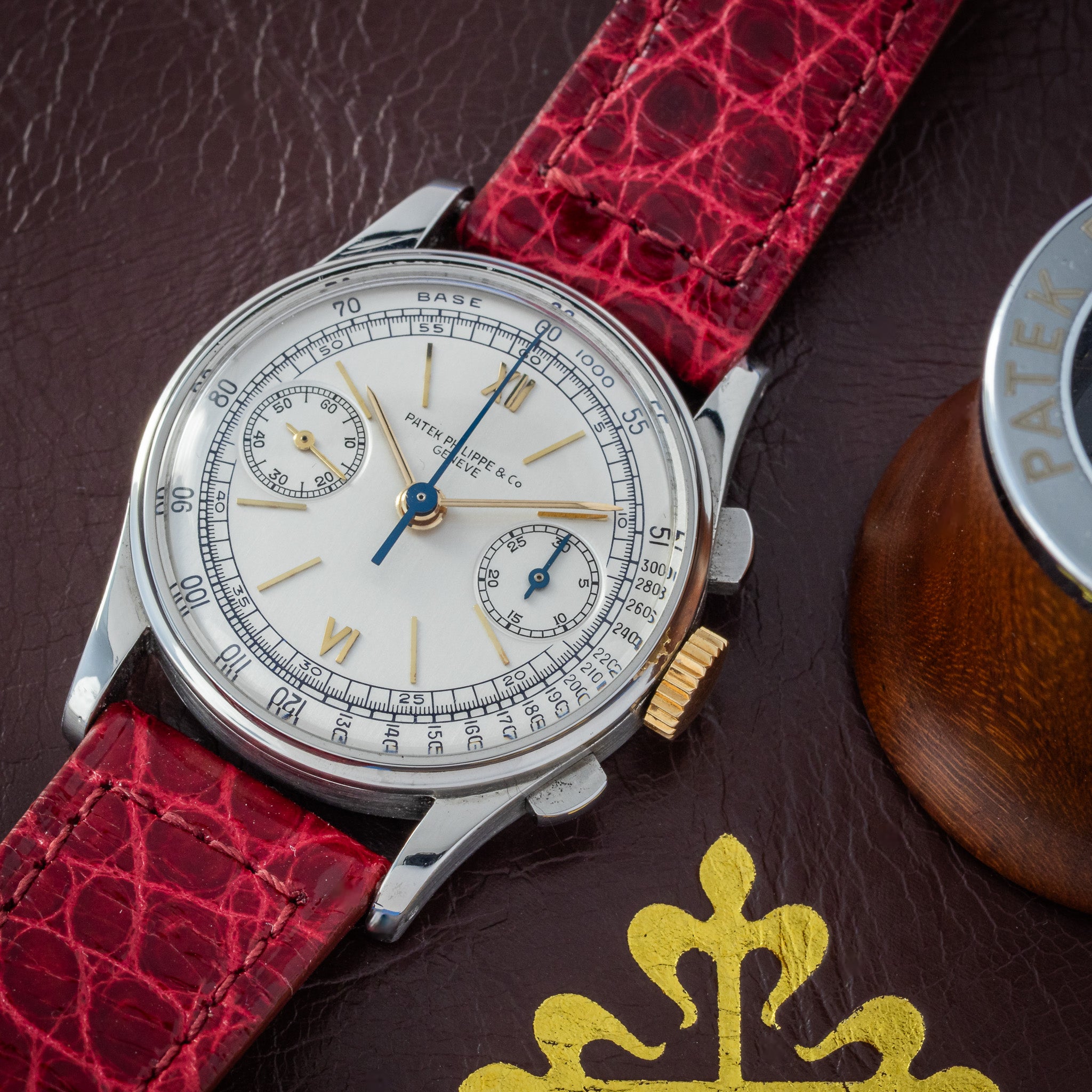
The WRISTORIAN Reference 130A examined here was manufactured in 1941 and sold on November 21 of that year, according to its Patek Philippe Extract from the Archives dated June 28, 2024. The present catalogue describes a 33-millimeter steel case, yellow-gold winding crown, applied yellow-gold Roman numerals at twelve and six, elongated gold batons, and a silvered dial with tachymeter scale. The characteristic long “Patek Philippe & Co., Genève” signature completes an unusually nuanced composition.7
The watch should not be confused with a steel-and-gold case. Its documented case is steel, while the striking precious-metal contrast appears in the crown and dial furnishings. In the photograph, the warm markers seem to float against the silvered ground; blued chronograph hands cut across the display with useful clarity. The archival description records the silvered dial with gold hour markers and tachymeter, supporting the historical configuration, though not establishing the present condition of its surface.

The qualification is significant. WRISTORIAN’s published catalogue records that an Antiquorum sale catalogue from July 2019 characterized the dial as “refreshed,” the case as “slightly repolished,” and the hands as original. The extent of that earlier work has not been independently established. The distinction between factory-recorded design and later surface history is presented here openly because thoughtful collecting requires both appreciation and candor.7
The accompanying burgundy strap and stamped white-gold Patek Philippe buckle form part of the watch’s present presentation, not evidence of its original 1941 sale. The illustrative object is unusually instructive precisely because it combines strong archival character with identifiable questions of conservation history.
7. Preservation, Evidence, and Responsible Stewardship
An important vintage chronograph is a historical object as well as an operating mechanism. Regular servicing by an experienced specialist may be essential to safeguard its movement; polishing a case or reworking a dial is a different decision. Mechanical intervention should be documented carefully, and removed original parts should be preserved whenever feasible. The convenience of making a watch appear new must be weighed against the irreplaceable evidence held in its surfaces.
Provenance claims should be explicit about their source: manufacturer archive, dated invoice, period photograph, auction documentation, personal recollection, or contemporary seller description. These do not carry equal evidentiary weight. A continuous chain of invoices may help establish custody; a manufacturer extract may establish recorded specifications; neither automatically proves an unbroken ownership history. The collector who separates those questions is better equipped to protect both scholarly understanding and future value.
Owners can keep a compact dossier containing high-resolution photographs of all sides, movement and internal hallmarks when safely available, measurements, service documentation, archival extracts, historic catalogue references, and a dated account of any known cosmetic work. Original accessories should be identified separately from later replacements. Those practices matter regardless of whether an example is destined for daily wear, a private collection, or eventual museum study.
WRISTORIAN Perspective
Reference 130 occupies a place in the Patek Philippe story that cannot be reduced to auction prices or production estimates. It helped establish an enduring visual and mechanical grammar: purposeful chronograph controls, measured proportions, and a dial sophisticated enough to convey several kinds of information without sacrificing elegance. Its variants show how the same architecture can support classical gold dress watches, more utilitarian steel chronographs, and striking specialist dial configurations.
In my view, its greatest attraction is the unusually direct relationship between design and documentation. Two watches with the same reference number can present very different collecting propositions. The material of the case, geometry of the lugs, balance of the dial, record of manufacture, and degree of intervention each influence the historical character of the surviving object. Rarity can heighten interest, but it cannot replace the work of understanding what is genuinely present.
The 1941 steel Reference 130A discussed here makes that point especially well. Its gold accents and classical numeral-and-baton arrangement are distinctive and the archived dial description offers consequential historical support. At the same time, the earlier catalogue’s condition language must travel with the object. Respecting both sides of the evidence neither diminishes the watch nor overstates what can be known. It is precisely the approach that serious collectors, dealers, and custodians owe to important vintage timepieces.
The enduring achievement of Reference 130 lies in this combination of functional precision, aesthetic range, and historical depth. To collect it purposefully is to admire the design, investigate the particular watch, and preserve the clarity of the record for the next generation.
Notes
- Patek Philippe, “The Grand Tradition of Patek Philippe Chronographs,” historical review, March 2010. https://static.patek.com/pdf/pressreleases/en/2010_PatekPhilippe_Historic_Chrono.pdf. ↩
- Logan Baker, “When the Modern Chronograph Was Born: The Patek Philippe Ref. 130,” Phillips, November 12, 2025. https://www.phillips.com/article/163751352/patek-philippe-ref-130-chronograph-time-only-sector-single-button-vertical. ↩
- Phillips, “Patek Philippe, Reference 130,” New York Watch Auction: Six, lot 107. https://www.phillips.com/detail/patek-philippe/NY080222/107. ↩
- Christie’s, “Patek Philippe Reference 130 Pink Gold Chronograph with Sector Dial,” lot essay. https://www.christies.com/en/lot/lot-5309261. ↩
- Phillips, “Patek Philippe Reference 130 Black Sector Dial,” Geneva Watch Auction: XXI, lot essay. https://www.phillips.com/detail/patek-philippe/214893. ↩
- Phillips, “Patek Philippe, Reference 130,” Geneva Watch Auction: Seven, lot 223. https://www.phillips.com/detail/patek-philippe/CH080118/223. ↩
- WRISTORIAN, “Patek Philippe Ref. 130A, Stainless-Steel Chronograph, 1941,” catalogue description and specifications. https://www.wristorian.com/products/patek-philippe-130a-steel-chronograph-1941. ↩
Bibliography
Christie’s, “Patek Philippe Reference 130 Pink Gold Chronograph with Sector Dial,” lot essay. https://www.christies.com/en/lot/lot-5309261.
Logan Baker, “When the Modern Chronograph Was Born: The Patek Philippe Ref. 130,” Phillips, November 12, 2025. https://www.phillips.com/article/163751352/patek-philippe-ref-130-chronograph-time-only-sector-single-button-vertical.
Patek Philippe, “The Grand Tradition of Patek Philippe Chronographs,” historical review, March 2010. https://static.patek.com/pdf/pressreleases/en/2010_PatekPhilippe_Historic_Chrono.pdf.
Phillips, “Patek Philippe Reference 130 Black Sector Dial,” Geneva Watch Auction: XXI, lot essay. https://www.phillips.com/detail/patek-philippe/214893.
Phillips, “Patek Philippe, Reference 130,” Geneva Watch Auction: Seven, lot 223. https://www.phillips.com/detail/patek-philippe/CH080118/223.
Phillips, “Patek Philippe, Reference 130,” New York Watch Auction: Six, lot 107. https://www.phillips.com/detail/patek-philippe/NY080222/107.
Sotheby’s, “Patek Philippe Reference 130, Stainless Steel Sector Dial, Made in 1947,” Important Watches, June 2025. https://www.sothebys.com/en/buy/auction/2025/important-watches/reference-130-a-stainless-steel-chronograph.
Sotheby’s, “Patek Philippe Reference 130, Unique Pink Gold Chronograph,” Important Watches, 2026. https://www.sothebys.com/en/buy/auction/2026/important-watches/reference-130-a-unique-pink-gold-chronograph.
WRISTORIAN, “Patek Philippe Ref. 130A, Stainless-Steel Chronograph, 1941,” catalogue description and specifications. https://www.wristorian.com/products/patek-philippe-130a-steel-chronograph-1941.
Research & Methodology
This paper synthesizes Patek Philippe’s published chronograph history, specialist auction catalogues, and the public WRISTORIAN catalogue record of the illustrated 1941 Reference 130A. Published figures described as estimates remain estimates. Contradictions in dating or counts are reported rather than silently harmonized. The referenced archive extract and Antiquorum catalogue description have been evaluated through WRISTORIAN’s published account; their original documents were not independently inspected for this publication. Illustrations are limited to WRISTORIAN-supplied photography. Additional variants are linked through documented illustrated catalogues, rather than reproducing third-party images without permission.
Disclosure
This White Paper is provided for educational and scholarly purposes. Information is drawn from sources WRISTORIAN believes to be reliable, including manufacturer publications, international standards, auction-catalogue scholarship and, where applicable, WRISTORIAN's examination of relevant examples. Accuracy, completeness and continuing applicability are not guaranteed.
WRISTORIAN presently offers the illustrated 1941 Reference 130A for sale. This commercial interest is disclosed so that the scholarly discussion and the related catalogue listing may be evaluated separately. References to the watch’s historical characteristics and condition reflect the published listing and cited secondary evidence; no fresh physical examination, movement inspection, or independent authentication was performed in preparing this paper.
Vintage-watch scholarship evolves as previously undocumented watches, archival information and source material emerge. Dates, technical descriptions, known-population figures and historical claims should be understood in light of the evidence available at the time of publication.
Nothing in this White Paper constitutes investment advice, an appraisal, a guarantee of authenticity for any watch not specifically examined and offered by WRISTORIAN, or a representation concerning future value. References to manufacturers, auction houses and other organizations do not imply sponsorship or endorsement.
Publication Record
Original publication: November 2026
Author: Tom Warburton
Publisher: WRISTORIAN Publishing
Copyright: © 2026 WRISTORIAN. All rights reserved.
Contact Information
For scholarly correspondence, publication inquiries or related research matters, please contact us:
WRISTORIAN
P.O. Box 5088
Lighthouse Point, FL 33074-5088
United States
