
Patek Philippe Ref. 5970G Perpetual Calendar Chronograph, 2007
 Trusted Globally by Collectors
Lifetime Guarantee of Authenticity
Complimentary Fully Insured Shipping
Elige opciones
Timepiece Information
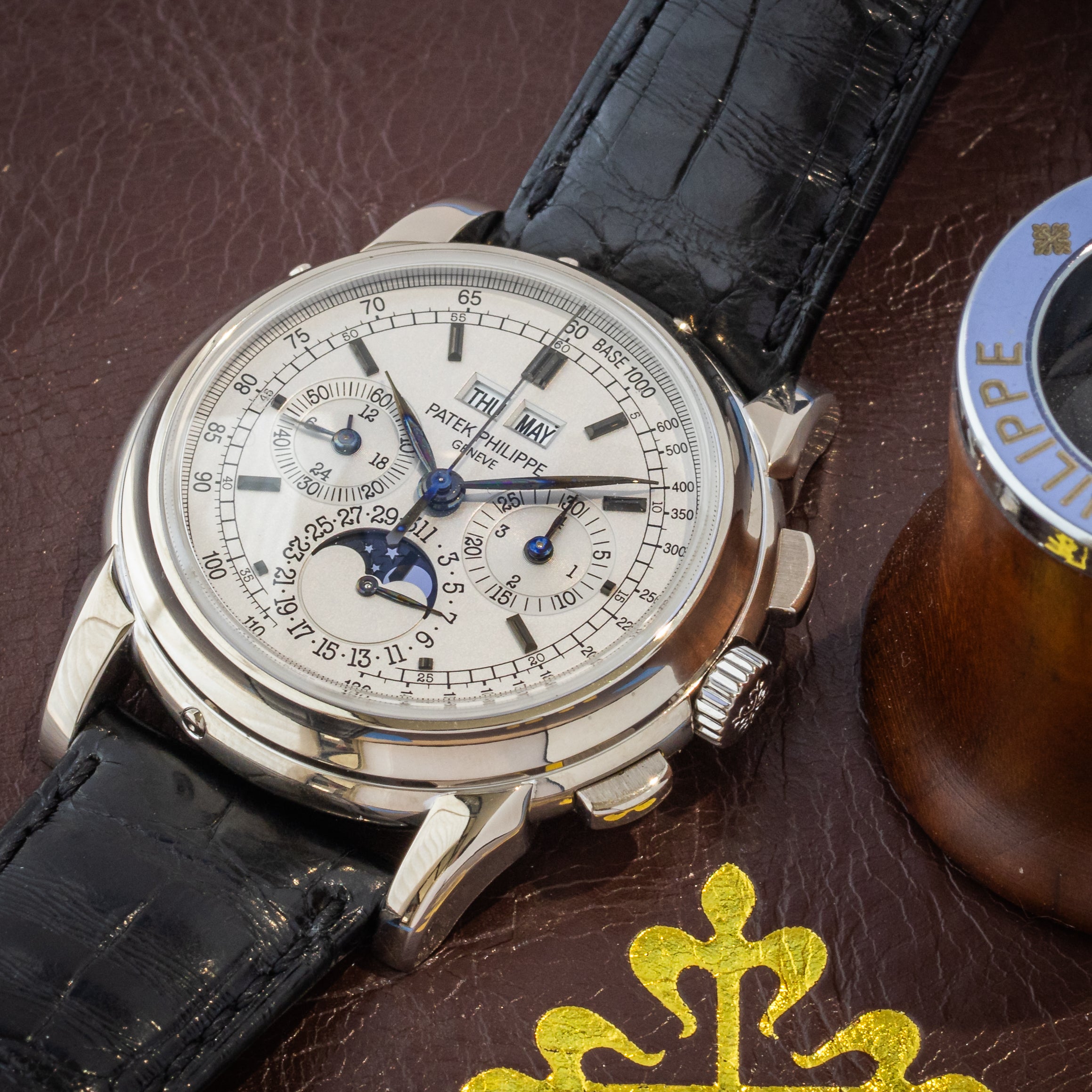
Introduced in the mid-2000s as the successor to Reference 3970, Reference 5970 continued Patek Philippe's lineage of serially produced perpetual-calendar chronographs established by References 1518, 2499 and 3970. Its 40 mm case represented a substantial increase over the 36 mm proportions of its immediate predecessor, improving legibility while retaining the traditional round case, rectangular chronograph pushers and strongly faceted lugs associated with the manufacture's historic complicated wristwatches. The white-gold 5970G was among the first versions offered and was paired with a silvered dial and contrasting blackened white-gold indications.
The dial is organized around day and month apertures at 12 o'clock, constant seconds combined with a 24-hour indication at 9 o'clock, a 30-minute chronograph register combined with the leap-year cycle at 3 o'clock, and a date display with moon phases at 6 o'clock. An outer tachymeter scale expands the composition to the edge of the dial, recalling selected earlier versions of Reference 2499 while giving the larger case a balanced and visually complete architecture.
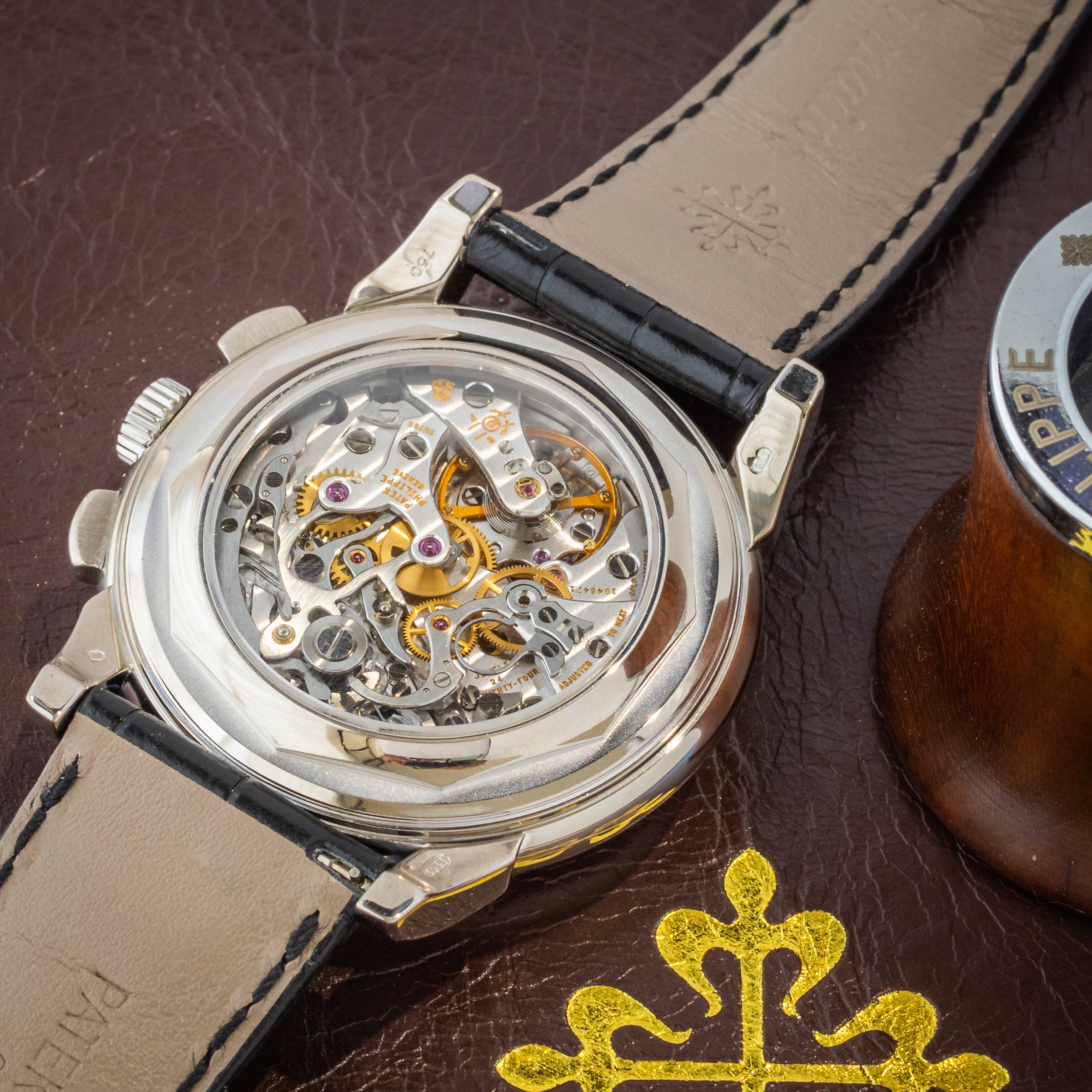
Reference 5970 is powered by the manually wound caliber CH 27-70 Q, a 24-jewel perpetual-calendar chronograph movement derived from the Nouvelle Lemania 2310 and extensively reworked and finished by Patek Philippe. Visible through the sapphire-crystal exhibition back, the Geneva Seal movement represents the final generation of Patek Philippe perpetual-calendar chronographs built around the Lemania architecture before the introduction of Reference 5270 and the manufacture's in-house caliber CH 29-535 PS Q.
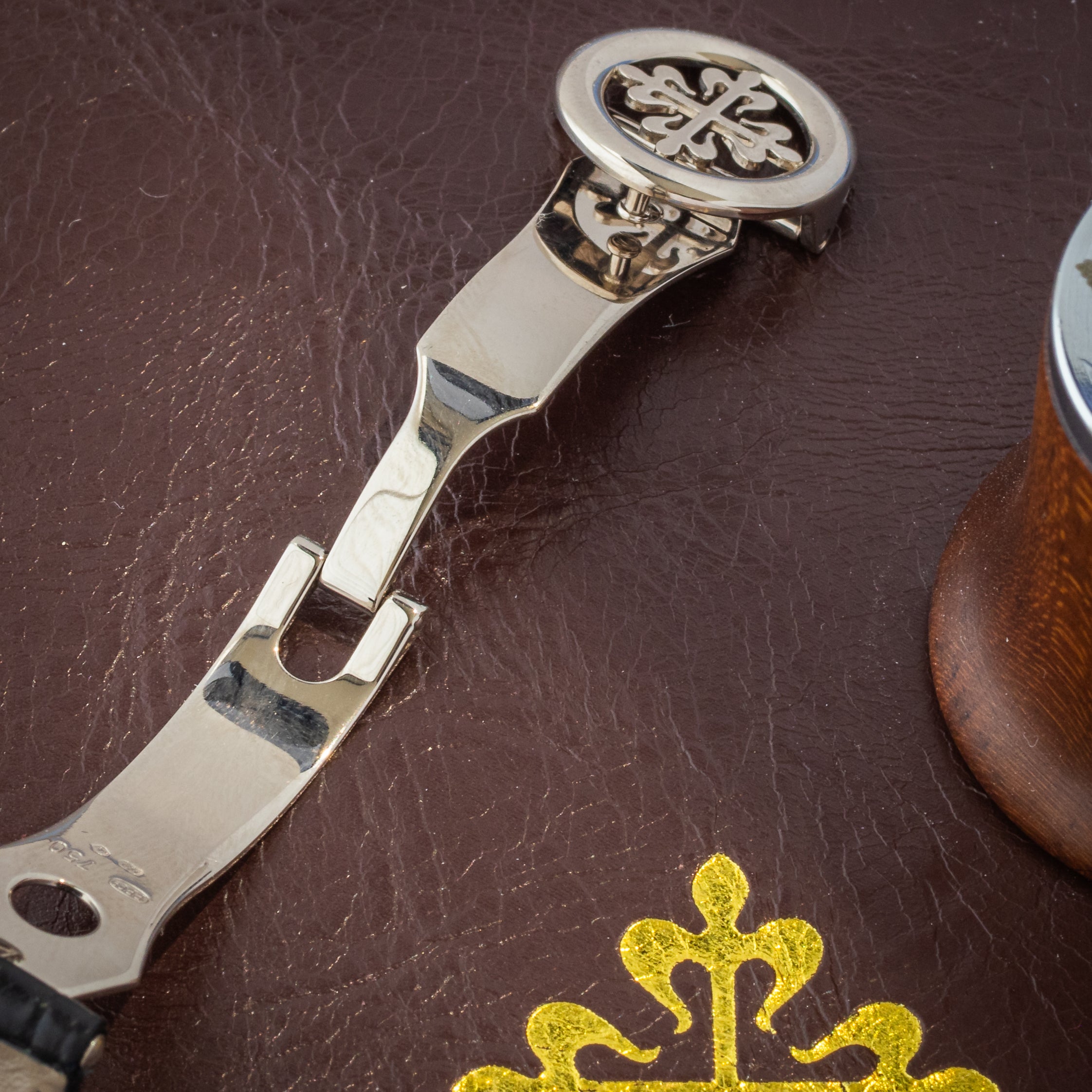
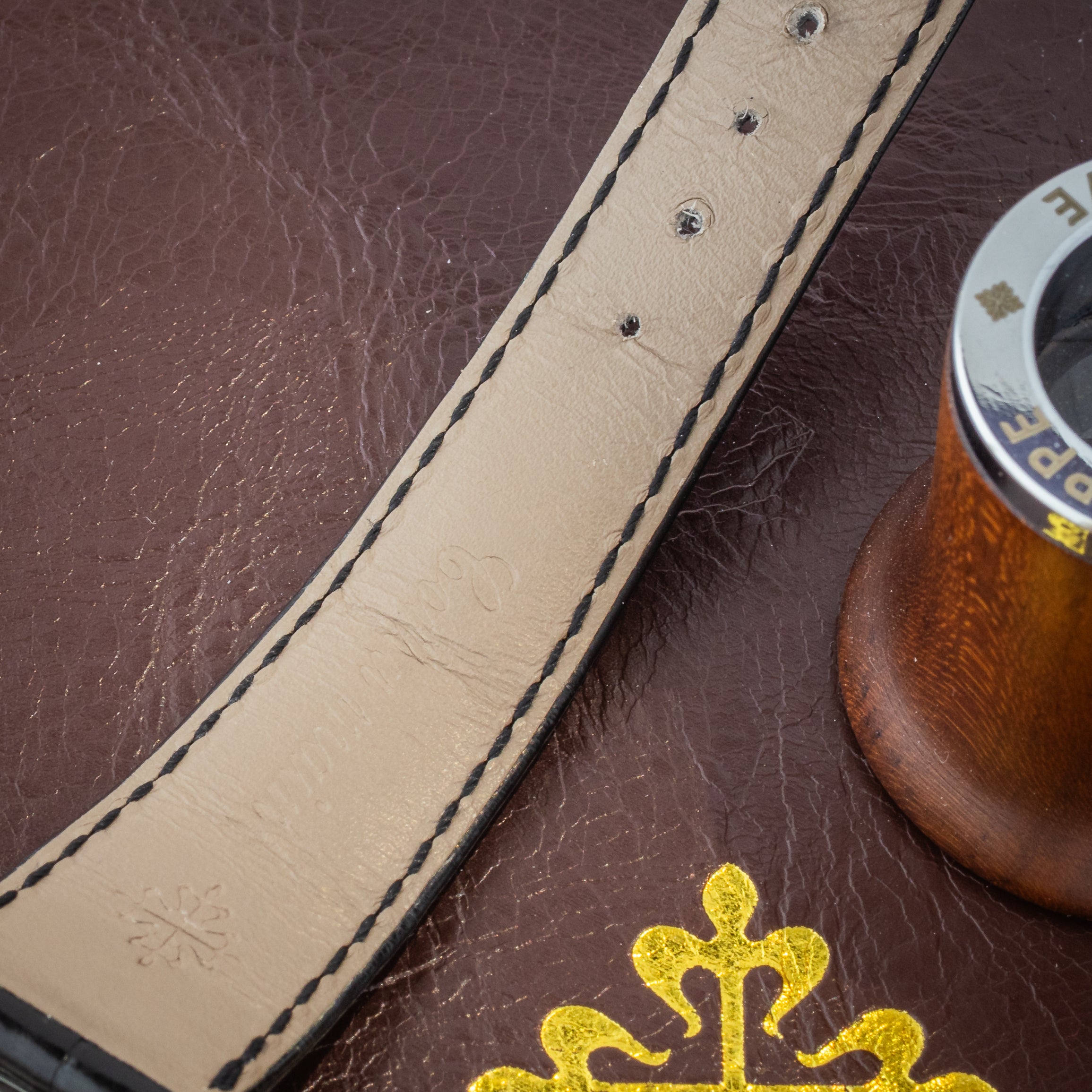
Condition: The silvered dial presents cleanly, with well-defined printing, applied blackened white-gold baton indexes and clearly rendered subsidiary indications. The white-gold case displays light surface wear and evidence of prior polishing while retaining its characteristic faceted lugs and visible hallmarks. The movement presents attractively beneath the sapphire-crystal exhibition back. The fitted Patek Philippe alligator strap shows creasing and wear consistent with use, while the signed white-gold deployant clasp displays light surface marks.
Its place in the Stern family story gives the reference unusual historical weight. The 5970 is widely identified as the first model developed and designed under Thierry Stern’s direction, following a responsibility entrusted to him by his father, Philippe Stern. It can therefore be understood as a genuine generational handoff: the culmination of the traditional complicated-watch culture strengthened under Philippe Stern and an early declaration of Thierry Stern’s ability to carry that legacy forward without merely repeating it.
That achievement is visible in the case and dial. At 40 mm, the 5970 has the authority expected of a modern grand complication, yet it avoids the excess that compromised many complicated watches of its period. The faceted lugs, stepped case, rectangular chronograph pushers and expansive tachymeter scale draw unmistakably upon References 1518 and 2499, but the result is not nostalgic. It feels settled, complete and entirely its own.
The white-gold 5970G may be the purest expression of the design. Its cool-toned case, silvered dial, blackened white-gold indications and tempered use of blue create a watch that is technical without appearing clinical and important without becoming ostentatious. The density of information is considerable, yet the dial never feels confused. Every aperture, register and scale occupies precisely the space it requires.
The caliber CH 27-70 Q deepens the reference’s importance. Built upon the celebrated Lemania architecture and extensively reworked and finished by Patek Philippe, it represents the final generation of the manufacture’s perpetual-calendar chronographs using that distinguished foundation and the closing chapter of a mechanical tradition shared with References 3970 and 5020. Its construction, tactile operation and Geneva Seal finishing have helped make the movement as central to the appeal of the 5970 as the watch’s exterior design.
Its remarkably brief production life only sharpened that identity. Produced for approximately six to seven years, Reference 5970 had the shortest run of Patek Philippe’s serially produced perpetual-calendar chronographs. Exact production totals have never been publicly confirmed by the manufacture, but there was little time for the reference to become commonplace, and the white-gold version belonged principally to the opening years of production.
Collector admiration has consequently moved well beyond ordinary enthusiasm. Reference 5970 is frequently described as one of the finest watches Patek Philippe has produced, and John Mayer’s assessment remains difficult to improve upon: “as good as it gets and... as good as it may ever get.” The remark captures what specifications alone cannot: the sense that the 5970 arrived at a nearly perfect intersection of heritage, scale, mechanical character and wearable proportions.
The 5970 has already crossed from desirable neo-vintage complication into established modern grail. Strong, complete examples are increasingly treated as long-term collection watches rather than temporary acquisitions, making condition, documentation and completeness progressively more consequential. This 2007 example, sold through the Patek Philippe Salons de Genève and accompanied by its Certificate of Origin, original presentation materials, interchangeable solid caseback and extensive accessories, offers the kind of completeness serious collectors increasingly seek.
For the collector who wants one complicated Patek Philippe to embody the manufacture’s past, its modern evolution and the transition between two generations of family leadership, Reference 5970G makes an exceptionally persuasive case. It is historically important, mechanically significant, visually resolved and genuinely wearable: a watch that is already recognized as a grail, yet may still be only beginning to receive its full measure of appreciation.

