


Patek - 2597J
 Trusted Globally by Collectors
Lifetime Guarantee of Authenticity
Condition Clearly Documented
Complimentary Fully Insured U.S. Shipping
Fully Insured International Shipping Quoted
Trusted Globally by Collectors
Lifetime Guarantee of Authenticity
Condition Clearly Documented
Complimentary Fully Insured U.S. Shipping
Fully Insured International Shipping Quoted
Elige opciones
Timepiece Information
Patek - 2597J
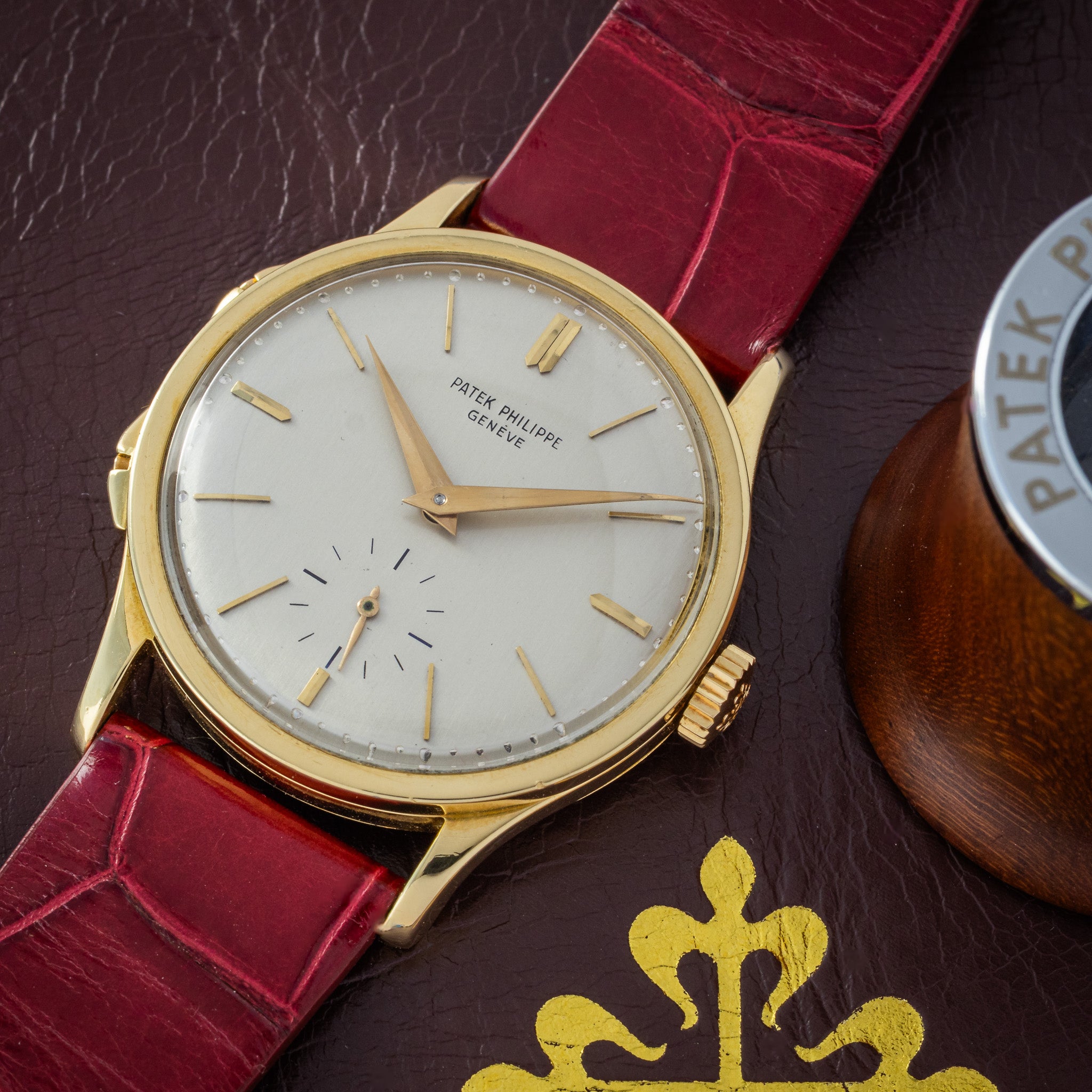
Hacia 1960 · Caja n.° 310.486 · Movimiento n.° 729.414 Time Travel. Un ejemplar cuidadosamente seleccionado por su equilibrio entre originalidad y honestidad, esta pieza refleja el atractivo perdurable del lenguaje de diseño de mediados de siglo de Patek Philippe. Sus proporciones se adaptan con elegancia a la muñeca, mientras que la fina tipografía de la esfera y el acabado de la caja subrayan la discreta búsqueda de la excelencia de la manufactura. Los coleccionistas apreciarán la integridad de sus componentes y la sobria elegancia que lo eleva por encima de las modas: un objeto funcional refinado en forma. En el mercado actual, los conocedores valoran estos ejemplares por su coherencia y la claridad de su historia: un reloj con propósito, conservado con respeto en lugar de con excesos. Adecuado para el uso diario o para un estudio minucioso en una colección selecta, ofrece tanto satisfacción estética como un gran valor como pieza de colección a largo plazo. Incluye extracto.
What makes the reference particularly fascinating today is the understated elegance with which this mechanical innovation was introduced. The watch retains the visual language of the classic Calatrava, avoiding the technical or instrument-like appearance that many later travel watches would adopt. Its balanced 35.5 mm case follows the architectural proportions associated with the reference 570 and was produced by the respected case maker Antoine Gerlach, whose workshop supplied cases for a number of Patek Philippe’s most celebrated mid-century references. The two pushers positioned along the left side of the case provide the interface for the jumping-hour system, yet they are integrated so naturally into the form of the watch that the mechanism reveals itself only to the attentive observer. It is precisely this combination of restraint and ingenuity that gives the reference its enduring charm.
Early examples such as the present watch are especially compelling because they preserve the original two-hand configuration of the model. In this earliest form, the watch expresses Cottier’s travel-time concept with remarkable clarity. The absence of a central seconds hand allows the jumping-hour function to remain the conceptual centerpiece of the design, reinforcing the disciplined simplicity that defines Patek Philippe’s finest mid-century creations. Over time, many watches were later modified with additional hands through factory kits, but collectors often regard the early two-hand execution as the most intellectually satisfying expression of the idea.
The present example illustrates these qualities beautifully. Produced in 1960 and sold in early 1961, it retains a dial of striking clarity, distinguished by a crisp raised enamel signature, finely preserved pearled minute track, and exceptionally delicate applied gold hour markers. The absence of a “SWISS” designation at the lower edge of the dial further reinforces its early character. Details such as these are the quiet signals that experienced collectors recognize immediately, subtle indicators of originality that contribute enormously to the watch’s appeal.
For the thoughtful collector, the reference 2597 represents far more than an uncommon mid-century complication. It stands at the beginning of a lineage that would eventually lead to some of Patek Philippe’s most admired modern travel watches. At the same time, it remains deeply rooted in the restrained elegance of the Calatrava tradition. Examples preserved with this degree of clarity and authenticity offer the rare opportunity to own not merely a beautiful vintage wristwatch, but a watch that marks the moment when mechanical horology first began to adapt to a truly global world.

